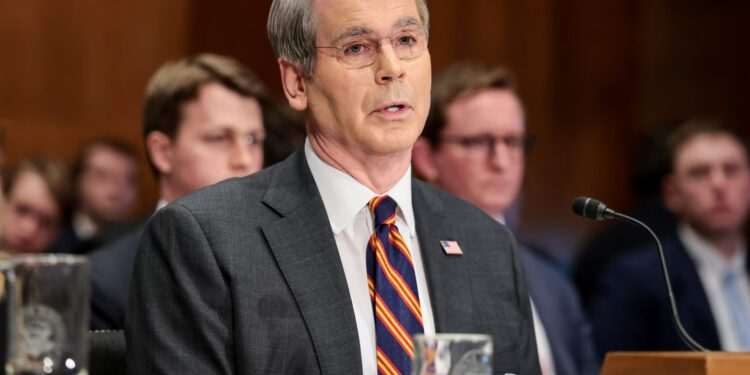
Treasury Secretary Scott Bessent Demands Immediate Senate Vote on CLARITY Act, Warning of US Crypto Leadership Loss
On July 30th, U.S. Treasury Secretary Scott Bessent issued a forceful public appeal for the Senate to immediately vote on the CLARITY Act, directly accusing Democratic lawmakers of politically motivated delays in advancing critical digital asset legislation. Bessent’s call, made public via social media, underscores the urgent need for regulatory certainty in the burgeoning crypto sector.
Bessent highlighted that the House of Representatives passed a version of the bill over a year ago, and bipartisan staff from the Senate Banking and Agriculture Committees have dedicated thousands of hours to refining the legislation. A Republican-backed draft is now prepared for a full Senate vote.
The Secretary warned that continued regulatory ambiguity for digital assets risks driving the industry abroad, thereby eroding America’s crucial leadership in the global crypto landscape. He sharply criticized Senate Democrats for engaging in “political maneuvering” at a pivotal moment for legislative progress. Bessent emphasized that American exceptionalism, once a shared bipartisan objective, is now at stake, questioning whether Washington is truly committed to retaining innovative industries through intelligent regulatory frameworks if the CLARITY Act falters.
Addressing Criticisms: Enhanced Consumer Protection and AML Measures
Countering concerns regarding consumer protection and illicit finance, Bessent asserted that Titles II and III of the CLARITY Act draft significantly expand compliance obligations for digital asset intermediaries. This expansion aims to align them more closely with the stringent standards applied to traditional financial institutions. He clarified that the White House and Treasury Department view this legislation not as deregulation, but as a critical step to integrate previously unregulated transactions, custody services, and market activities into a robust federal framework.
At its core, the CLARITY Act seeks to establish clear market structure rules for U.S. digital assets, delineating the jurisdictional boundaries between the Securities and Exchange Commission (SEC) and the Commodity Futures Trading Commission (CFTC). Should the bill pass, the CFTC would primarily oversee most spot markets for digital commodities, while assets with investment contract or securities characteristics would remain under the SEC’s purview. Proponents argue that this clear division will mitigate regulatory uncertainty and foster a more predictable environment for compliant businesses to innovate and grow domestically.
The Blockchain Regulatory Certainty Act (BRCA): Protecting Innovation Amidst Scrutiny
Bessent also vigorously defended the inclusion of the Blockchain Regulatory Certainty Act (BRCA) provisions within the CLARITY Act. This crucial section aims to shield decentralized software developers, non-custodial wallet developers, and infrastructure tool providers. Its intent is to prevent them from being classified as Money Services Businesses (MSBs) under the Bank Secrecy Act (BSA) solely for the act of writing or publishing code, ensuring innovation isn’t stifled by misapplied regulations.
Bessent clarified that this provision merely codifies the Treasury Department’s long-held policy, emphasizing that it creates no “backdoors” for criminal enterprises. Notably, he revealed that the National Fraternal Order of Police (FOP), an organization that initially opposed these elements, has now expressed support after the latest bill iteration incorporated strengthened law enforcement and anti-money laundering safeguards. This shift underscores how BRCA has evolved from a technical protection clause for the developer community into a complex political negotiation, balancing law enforcement prerogatives, open-source innovation, and robust financial crime prevention.
A Satoshi Nakamoto Ultimatum and the Lingering Ethics Hurdle
Bessent concluded his compelling statement with a pointed quote from Bitcoin’s enigmatic creator, Satoshi Nakamoto: “If you don’t believe me or don’t get it, I don’t have time to try to convince you, sorry.”
He augmented this with his own stark warning: “America will either lead or lose its lead; it’s not more complicated than that.” This direct challenge is clearly aimed at undecided senators, framing the CLARITY Act as a crucial battle for America’s future technological and financial leadership on the global stage.
Despite Bessent’s fervent push, the bill’s path forward remains fraught with uncertainty. Senate Majority Leader John Thune had previously indicated that the CLARITY Act was unlikely to pass before the upcoming August recess, citing unresolved negotiations surrounding critical crypto ethics provisions.
While the latest draft incorporates restrictions on the issuance or sponsorship of digital assets by the President, Vice President, members of Congress, and certain federal officials, Democrats remain critical. Their concerns include the expiration of these restrictions in 2029, the primary enforcement authority resting with the Department of Justice, and the exclusion of officials’ children from the scope of the provisions. With midterm election pressures mounting, Bessent’s urgent call for a vote appears to be a strategic, final push by the White House to compel the Senate to declare its position on this pivotal legislation.