BIP-110’s Swift Demise: The Controversial Bitcoin Soft Fork That Failed to Launch
A contentious Bitcoin soft fork, proposed under the banner of “anti-spam,” met an abrupt end, producing only two blocks before its swift “curtain call.” On August 9th, Bitcoin Improvement Proposal (BIP-110), once championed with significant fanfare, collapsed due to a severe lack of miner support. The fork, from activation to stagnation, lasted less than a day, relegating it to an unviable minority chain. Adding fuel to the fire, its primary proponent, developer Luke Dashjr, faced widespread criticism and backlash from the Bitcoin community, accused of abusing his BIP editing privileges.
The Eight-Hour Standoff: BIP-110’s Rapid Collapse
The Bitcoin network recently witnessed another contentious fork attempt. On August 9th, as Bitcoin reached block height 961,632, nodes supporting BIP-110 entered a mandatory signaling phase. Under its rules, BIP-110 nodes would reject blocks not containing a support signal, thereby splitting off a minority chain from the main Bitcoin blockchain.
BIP-110 was conceived as a temporary soft fork proposal to regulate Bitcoin block space usage, specifically aiming to restrict non-financial data—such as Ordinals inscriptions, images, and text—from Bitcoin transactions. Proponents argued that a deluge of such data consumed limited block space, inflated transaction fees, and diverted Bitcoin from its foundational purpose as a monetary system.
However, protocol upgrades on Bitcoin typically require miner consensus, achieved through block signaling and a high threshold (usually 95%) before activation. BIP-110 controversially set its activation threshold at a mere 55%—requiring 1,109 out of 2,016 blocks within a two-week difficulty period to signal support. Yet, in the final difficulty period before the mandatory phase, only 51 blocks (approximately 2.53%) signaled support, falling drastically short of the proposed standard.
The reluctance of miners was a critical factor. While inscription-based transactions sparked debate, they also generated substantial transaction fee revenue. Limiting non-financial data inherently meant a potential reduction in miner profits. Despite the minimal cost of signaling support, miners overwhelmingly opted against participation.
Lacking adequate miner and hash rate backing, BIP-110 nodes could only maintain an isolated, minority chain. This chain inherited Bitcoin’s current mining difficulty of approximately 127.48 trillion but attracted only a minuscule fraction of SHA-256 hash power, rendering it incapable of sustaining Bitcoin’s normal block production rate.
Following the fork, the BIP-110 chain stalled after only two blocks were mined by the Roughnecks pool over roughly eight hours. In stark contrast, the main Bitcoin blockchain continued its stable operation, steadily widening its lead. Monitoring data for BIP-110 shows the branch stuck at block height 961,633, while the main chain progressed to 961,833, a difference of approximately 200 blocks. Crucially, no new BIP-110 support signals appeared on the main chain’s blocks post-fork.
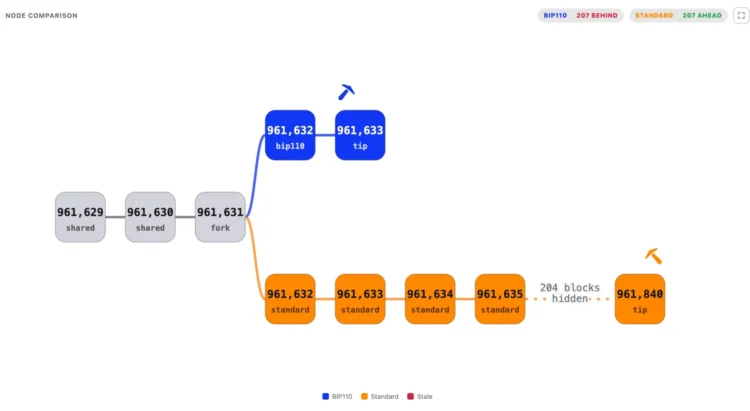
The core technical challenge stemmed from Bitcoin’s difficulty adjustment mechanism, which recalibrates only every 2,016 blocks, not in real-time with hash rate fluctuations. Inheriting the main chain’s high difficulty with minimal hash power caused a drastic slowdown in block production for the BIP-110 chain. At its current hash rate, this minority chain could take approximately 350 days to reach its next difficulty adjustment, compared to the main Bitcoin chain’s roughly two weeks.
Technically, this fork attempt has unequivocally failed, unable to alter Bitcoin’s consensus rules or establish a competitive alternative chain.
With persistent insufficient hash rate support, the economic viability and operational capacity of the BIP-110 fork chain rapidly diminished. Continuing to dedicate mining resources to it became impractical. Consequently, Roughnecks, one of the initial pools supporting the fork, announced a halt to its related mining operations. The pool stated its decision to cease mining under the Roughnecks name after a team meeting and advised other miners on the BIP-110 chain to pause operations until further notice. PyBLOCK, another pool, followed suit, temporarily suspending BIP-110 signal support.
Furthermore, the BIP-110 fork presented significant asset security risks. As a soft fork, it lacked built-in replay protection. Bitcoin developer Kevin Loaec warned users to proactively isolate their assets in the early stages of the fork; otherwise, without replay protection, transacting on the fork chain could inadvertently transfer real BTC.
The Battle for Bitcoin’s Soul: PoW Algorithms and Reputational Damage
Despite the BIP-110 fork chain’s stagnation, its proponents refused to concede failure. They argued that the lack of sustained hash rate support wasn’t due to insufficient community consensus but rather the deliberate resistance of large mining pools.
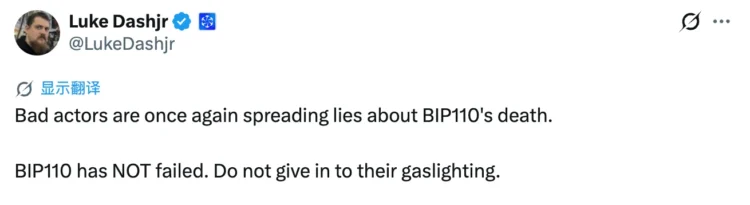
Luke Dashjr, a Bitcoin Knots maintainer and co-founder of the OCEAN mining pool, dismissed claims of the proposal’s demise as “malicious actors spreading lies” and “PUA.” He asserted that the chain split wasn’t caused by BIP-110 itself but by “certain malicious mining pools and miners resisting changes to network rules.” Dashjr emphasized that “BIP-110 had and still has sufficient support; it was simply attacked by a minority force.”
Dathon Ohm, author of the BIP-110 proposal, echoed these sentiments, accusing large mining pools of conspiring to transform Bitcoin from a currency into a “toxic data dumping ground.” He revealed that the community was now formulating a proposal to change Bitcoin’s Proof-of-Work (PoW) algorithm.
Indeed, recent discussions among BIP-110 supporters have openly explored changing the PoW algorithm to “fire” existing Bitcoin miners, thereby eliminating reliance on them. Candidate algorithms mentioned include RandomX, BLAKE3, Scrypt, and Autolykos v2. Dashjr even suggested a random algorithm selection mechanism to prevent miners from preparing in advance. However, no PoW change proposal has been formally initiated or confirmed.
From its inception, BIP-110 has been mired in controversy. Opponents maintained that the Bitcoin network should not judge the purpose of transactions as long as sufficient fees are paid. They argued that restricting specific data types would undermine Bitcoin’s long-standing neutrality and censorship-resistance properties.
Michael Saylor, CEO of MicroStrategy, famously published 110 reasons against BIP-110, citing risks of precedent, activation mechanism flaws, and qualitative disputes. Saylor emphasized that while anyone can fork Bitcoin, such forks are meaningless without security, utility, capital, and users. He stressed that consensus must be earned, not merely declared.
Renowned analyst PlanB also publicly opposed BIP-110, believing that its supporters did not truly grasp Bitcoin’s decentralized nature.
Blockstream co-founder Adam Back raised technical concerns. He viewed BIP-110, despite its temporary “junk data” restriction premise, as potentially impairing Bitcoin’s future upgrade capabilities. Specifically, the proposal would disable OP_SUCCESS opcodes in Tapscript, which are considered crucial foundational mechanisms for future soft fork upgrades. Furthermore, BIP-110’s imposed size limits on Taproot control blocks could impede the development of potential Layer 2 technologies like BitVM.
As the controversy escalated, Luke Dashjr himself became the subject of public condemnation within the Bitcoin community.
Wang Chun, co-founder of F2Pool, after blocking numerous BIP-110 supporting X accounts, declared Luke Dashjr to be not only financially bankrupt but also reputationally bankrupt. He sarcastically suggested Dashjr’s next step should be to attempt changing the PoW algorithm, predicting a similar unfavorable outcome.
Mark Erhardt, a Bitcoin Core contributor, formally proposed removing Luke Dashjr from his BIP editor position. Erhardt cited Dashjr’s involvement in BIP-110 and his alleged abuse of editing privileges, including prematurely assigning a BIP number to the proposal and rapidly merging updates despite minimal contributions to BIP editing in recent years. Erhardt concluded that trust, communication, and coordination between Luke Dashjr and other BIP editors had completely eroded.
Conclusion: The Imperative of Consensus
Ultimately, while the ability to fork Bitcoin remains open to anyone, without the fundamental pillars of hash rate support, economic incentives, and broad community consensus, a fork merely duplicates code; it does not create a viable new network.