By HIBIKI, CryptoCity
Vitalik Buterin Unveils Evolving Ethereum Roadmap: Quantum Security & Privacy Take Center Stage
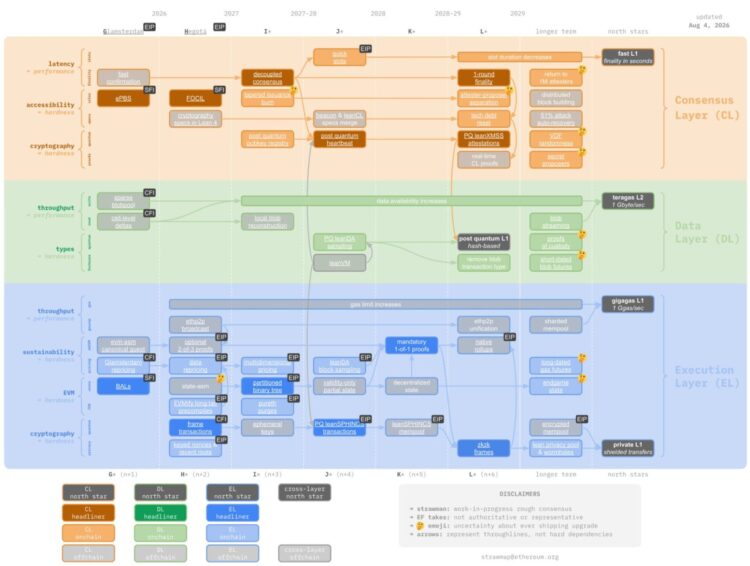
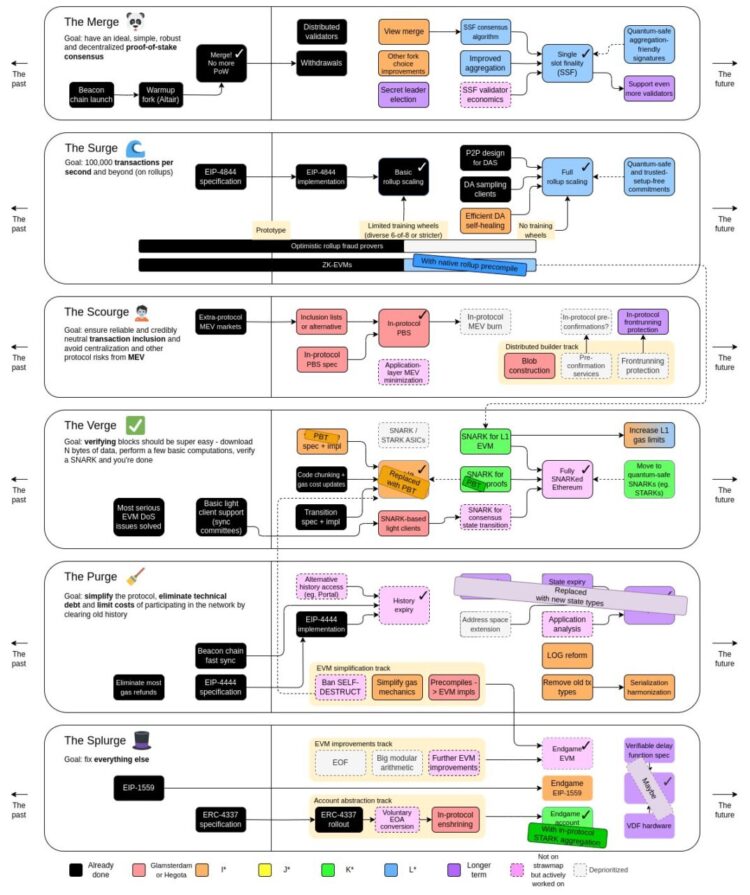
Ethereum co-founder Vitalik Buterin recently took to social media platform X to share a fascinating comparison: his personal 2023 Ethereum roadmap side-by-side with the Ethereum Foundation’s latest Strawmap. This insightful analysis reveals a dynamic evolution in Ethereum’s strategic priorities.
Buterin highlighted that while the two roadmaps share considerable overlap, several key shifts have emerged. Notably, quantum resistance has seen a significant boost in priority, while other areas, such as Verifiable Delay Functions (VDFs) and various EVM-related enhancements, have been de-emphasized. Furthermore, some technical approaches have been superseded by more advanced solutions; for instance, the Verkle Tree’s progression from a unified binary tree to a partitioned binary tree, and the replacement of the state expiry mechanism with a novel state type.
Privacy and Quantum Resistance: The New Pillars of Ethereum
A striking revelation from Buterin’s comparison is the emergence of entirely new initiatives in the Strawmap that were absent from his 2023 vision. This reflects a profound shift towards fortifying Ethereum’s future, with strong privacy protection and proactive scaling for the post-quantum era now at the forefront.
On the privacy front, Buterin pointed to innovations like key randomness and latest root, partial FOCIL mechanisms (see Technical Terms below), streamlined privacy pools, and a novel design dubbed “wormholes.” Crucially, FOCIL-related mechanisms are slated to be a cornerstone upgrade in Ethereum’s upcoming Hegota hard fork.
In the realm of quantum resistance, the Strawmap integrates cutting-edge technologies such as leanSPHINCS (see Technical Terms below) for signatures and aggregation, alongside a groundbreaking framework called zkzk frames (see Technical Terms below). This framework is designed to seamlessly support post-quantum signatures and STARK integration, ensuring Ethereum’s resilience against future computational threats.
STARK and AI-Assisted Formal Verification: Reinforcing the Protocol’s Core
Buterin underscored the critical role of STARK recursive verification (see Technical Terms below) and AI-assisted formal verification, now considered indispensable components for Ethereum’s long-term technical integrity.
He elaborated on a protocol mechanism known as “Aggregate Union Verification Dependencies,” envisioned for deployment across the execution, consensus, and data layers. The robust security of this ambitious approach, Buterin emphasized, is attainable only through rigorous formal verification, a process increasingly reliant on advanced AI tools.
Vitalik’s Persistent Quantum Push and the Rise of Native Rollups
Vitalik Buterin’s advocacy for quantum readiness has been unwavering throughout the year. From urging developers in January to embrace quantum-resistant cryptography, to proposing a phased plan in February for replacing four potentially quantum-vulnerable cryptographic elements, and making quantum security and privacy central to the streamlined Ethereum redesign in July – his commitment is clear.
The Strawmap further introduces forward-looking concepts absent in 2023, including block space and gas futures, and the groundbreaking inclusion of native rollups. Buterin clarified that native rollups were not on the radar previously because SNARK technology (see Technical Terms below) had not yet matured sufficiently to support such sophisticated scaling designs.
As zkzk frames progress, the protocol may eventually offer developers a more streamlined instruction set architecture, such as leanISA or RISC-V. In this future, the Ethereum Virtual Machine (EVM) could transition from an inherent base protocol function to an intermediary layer built upon these new instruction sets, signifying a profound architectural evolution.
Ethereum’s Future: High Performance, Scalability, and Streamlined Efficiency
Concluding his post, Vitalik Buterin articulated a compelling vision for Ethereum: a quantum-resistant blockchain that champions user privacy, upholds security and censorship resistance, and simultaneously achieves high performance and scalability, all while striving for greater streamlining and efficiency.
The Strawmap itself is a testament to this adaptive philosophy. Serving as a living reference document for the Ethereum Foundation’s protocol upgrade directions, it is a continuously revised draft rather than a rigid timetable. Extending its outlook to 2029, its most recent update was on August 4th.
The Ethereum Foundation has previously faced scrutiny regarding upgrade delays and resource allocation. In June of this year, the foundation underwent a significant restructuring, laying off 20% of its staff and reorganizing into five core groups aligned with CROPs objectives. Concurrently, new entities like EthLabs and EthSystems were established to bolster research & development and institutional-grade privacy technologies, signaling a proactive approach to its evolving mission.
- Related Coverage:Ethereum Foundation Lays Off 20% of Staff, Cuts Budget by 40%! “Five Jungle Architecture” Officially Unveiled
Key Technical Concepts Explained
FOCIL Mechanism (Fork-Choice Enforced Inclusion Lists)
FOCIL is a mechanism designed to enhance transaction inclusion reliability and censorship resistance within Ethereum, operating at the consensus layer. According to the Strawmap, FOCIL is slated to be a primary upgrade in Ethereum’s Hegota hard fork. Its purpose is to prevent validators from arbitrarily excluding specific transactions, thereby mitigating the risk of censorship or monopolization during the crucial block building process.
leanSPHINCS Signatures
leanSPHINCS represents a streamlined, hash-based post-quantum signature scheme, part of the broader SPHINCS signature family. These signatures are independent of elliptic curve cryptography, ensuring their security even if future quantum computers develop the capability to compromise traditional cryptographic methods. On the Ethereum Magicians forum, Vitalik Buterin clarified that a hash-based approach was chosen over lattice-based cryptography to maintain the protocol’s foundational simplicity and reduce overall operational complexity.
zkzk frame
The zkzk frame is a transaction framework concept proposed by Vitalik Buterin on the Ethereum Magicians forum, corresponding to the preliminary proposal EIP-8288. Its innovative design aims to integrate post-quantum signatures with STARK aggregation technology. This framework allows transactions to declare their cryptographic verification dependencies, enabling block builders to aggregate the verification requirements of multiple transactions into a single recursive STARK proof. This approach is crucial for efficiently incorporating larger quantum-resistant signatures while maintaining optimal on-chain data volume and Gas costs. The proposal is currently under discussion and has not yet received a formal EIP number.
STARK (Scalable Transparent Argument of Knowledge)
STARK is a powerful zero-knowledge proof technology that empowers a verifier to confirm the accuracy of a computation’s result without needing to re-execute the entire computation itself. Unlike some other zero-knowledge proof systems, STARK does not require a trusted setup and inherently offers quantum-resistant security properties. Consequently, it is envisioned as a core verification tool across Ethereum’s execution, consensus, and data layers in numerous upgrade plans.
SNARK (Succinct Non-Interactive Argument of Knowledge)
SNARK is another prominent zero-knowledge proof technology, distinguished by its compact proof size and rapid verification speed. These characteristics have led to its widespread adoption in current scaling solutions, most notably in zk-rollups, where efficiency is paramount.
(The above content is excerpted and reproduced with permission from our partner “CryptoCity”, original link)
Disclaimer: This article is intended solely for providing market information. All content and opinions are for reference only and do not constitute investment advice. They do not represent the views and positions of BlockBeats. Investors should make their own decisions and trades. The author and BlockBeats will not bear any responsibility for direct or indirect losses resulting from investor transactions.