VanEck: Bitcoin Correction Nearing End, Market Enters Accumulation Phase
After nearly 11 months of a challenging downturn, the Bitcoin market appears to be on the cusp of a significant transition. According to a recent report from leading asset management firm VanEck, the prolonged correction phase for the world’s largest cryptocurrency is nearing its conclusion, with multiple “capitulation signals” now active, indicating a shift towards an accumulation phase driven by major players.
However, VanEck cautions against viewing this as an immediate signal for short-term speculative buying. The firm emphasizes that while the market is indeed entering a period of strategic accumulation, the process of truly bottoming out for Bitcoin will require sustained patience and time.
Key Capitulation Signals Emerge
Matthew Sigel, Head of Digital Asset Research, and Patrick Bush, Senior Investment Analyst at VanEck, highlighted critical findings from their “Bitcoin Capitulation Check” indicators. Out of 12 metrics tracked by their team, a remarkable 8 are currently flashing signals consistent with market capitulation.
The experts further elaborated that over the past three months, all 12 indicators had, at various points, entered the “capitulation zone”—a period characterized by widespread despair and forced selling by retail investors. This comprehensive data strongly suggests that the market has already endured a significant capitulation sell-off and is now either approaching or firmly entrenched in the accumulation phase, where sophisticated investors are strategically buying up assets.
Current Market Snapshot and Institutional Resilience
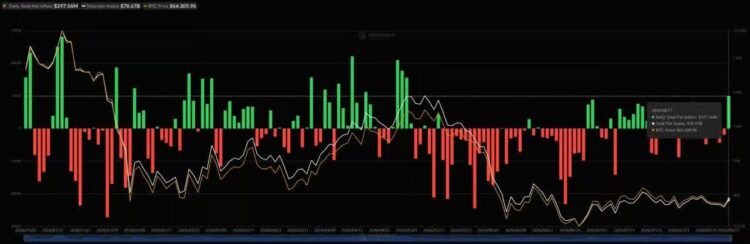
As of today, Bitcoin is trading around the $64,200 mark, having been confined to a tight range between $58,000 and $66,000 since early June. Despite this sideways movement, BTC remains significantly below its all-time high.
Crucially, this period of price stagnation has not deterred institutional capital. US Bitcoin spot Exchange-Traded Funds (ETFs) have recently experienced a resurgence of robust buying interest. Notably, Monday alone saw these funds attract nearly $300 million in inflows, marking their strongest single-day net inflow since May 5th.
Historical Cycles Point to Imminent Transition
Drawing parallels with historical market cycles, VanEck notes that Bitcoin’s three previous bear markets averaged 12.7 months from peak to trough. The current downturn, which commenced last October, has now entered its 11th month. Should historical patterns hold true, the market could gradually transition from its correction phase to a more sustained accumulation phase between September and November of this year.
Yet, VanEck reiterates a vital warning for investors: these capitulation indicators should not be misinterpreted as short-term, guaranteed-profit buy signals. Historical analysis reveals that when 8 to 12 indicators have simultaneously activated, the average returns over the subsequent 90 and 180 days have often fallen below the historical baseline. This underscores that the bottoming process is typically characterized by continued volatility, demanding patience from investors.
A Potentially Shallower Bottom
Despite the need for patience, VanEck suggests that the ultimate bottom of this current Bitcoin correction might be shallower than those observed in previous bear markets. Several factors contribute to this more optimistic outlook:
- The successful launch of Bitcoin spot ETFs, which has broadened access for institutional investors.
- A noticeable increase in the proportion of Bitcoin held by institutional entities.
- The absence of major “black swan” events—such as the dramatic collapses of FTX, Celsius, or Terra Luna—that significantly amplified panic in prior cycles. These mitigating factors have substantially reduced the potential for widespread fear and contagion.
On-Chain Data Reveals Strategic Redistribution
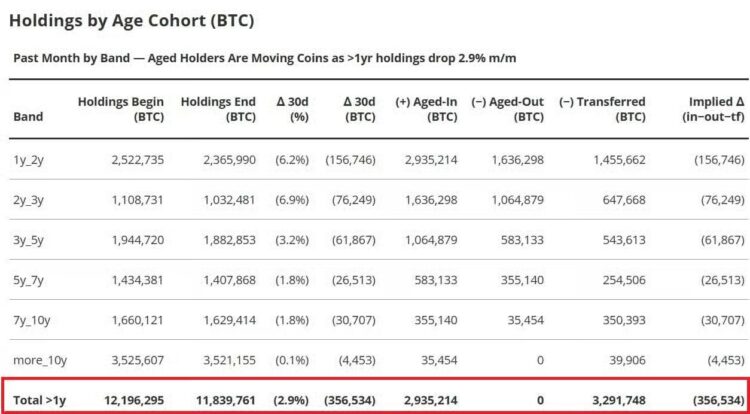
Further supporting the narrative of a market shift, on-chain data indicates subtle yet significant changes in supply dynamics. Over the past 30 days, the volume of Bitcoin held for over one year has decreased by approximately 356,000 BTC, settling at 11.84 million BTC. This shift has caused the proportion of long-term holders to dip below the 60% threshold for the first time in several months, signaling that some long-term holdings are undergoing redistribution and changing hands at current lower price levels.
Disclaimer: This article provides market information for reference only. All content and views expressed are for informational purposes and do not constitute investment advice. They do not represent the views or positions of the author or BlockBeats. Investors are solely responsible for their own decisions and trades, and neither the author nor BlockBeats will be liable for any direct or indirect losses incurred as a result of investor transactions.