

Bitcoin recently captivated the crypto world with a breathtaking surge, vaulting from $62,000 to decisively breach the $80,000 mark. This remarkable ascent represents the second-largest weekly gain in nearly five years. Typically, such explosive rallies ignite a ‘Fear of Missing Out’ (FOMO) frenzy, drawing traders into leveraged products like futures to amplify potential profits. Yet, the narrative behind this particular surge appears strikingly different.
Intriguing data suggests that this impressive rally was primarily propelled by a massive ‘short covering’ event, rather than a significant influx of new long positions. This implies that Bitcoin’s upward trajectory wasn’t fueled by aggressive bullish speculation, but rather by the forced capitulation of traders who had bet against its rise.
Short Squeeze: The Unexpected Catalyst
The most compelling evidence for this phenomenon can be found in Bitcoin’s Futures Open Interest (OI) – the total number of outstanding futures contracts. According to Glassnode data, the current Bitcoin futures OI stands at approximately 587,584 BTC, marking a five-month low. This represents a substantial contraction from the 645,760 BTC recorded on August 14.
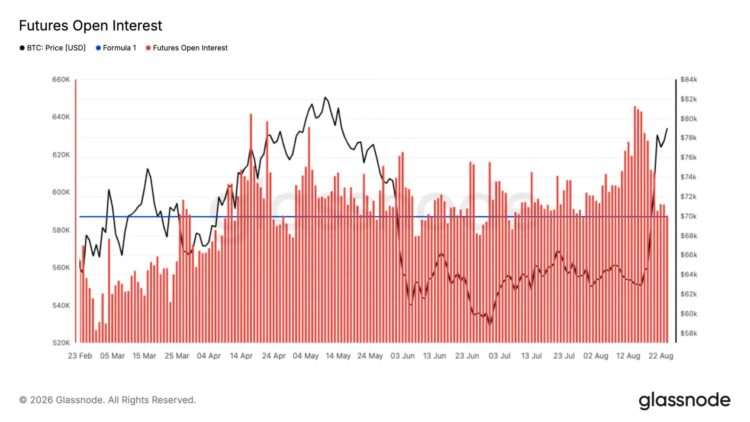
This presents a noteworthy divergence: while Bitcoin’s spot price soared, futures Open Interest concurrently declined. This indicates that short positions – those betting on a price decrease – were either voluntarily closed by traders cutting their losses, or forcibly liquidated by exchanges due to insufficient margin. This dynamic is the hallmark of a powerful short squeeze.
Indeed, market data corroborates this pattern, revealing billions of dollars in short positions liquidated as Bitcoin ascended. This classic short squeeze mechanism provided potent upward momentum, propelling Bitcoin past the $80,000 threshold.
Funding Rates Remain Moderate: A Sign of Measured Optimism
Another crucial metric offering insights into market sentiment is the annualized funding rate for perpetual futures contracts.
Funding rates serve as a barometer for market positioning and sentiment. With current annualized rates consistently below 10%, it suggests a prevailing bullish bias, but notably, without a significant escalation in long leverage.
Typically, a strong and widespread demand for long positions would trigger a substantial increase in funding rates. The absence of such a surge further reinforces the conclusion that this rally is primarily attributable to the retreat of short sellers, rather than an aggressive, leverage-fueled chase by bullish investors.
Paradoxically, a reduction in futures Open Interest is not necessarily a negative signal. In fact, it often contributes to a more stable and sustainable rally, particularly when this ‘cooling’ primarily impacts futures positions collateralized by Bitcoin or other crypto assets.
A Healthier Rally Emerges from Cooling Futures
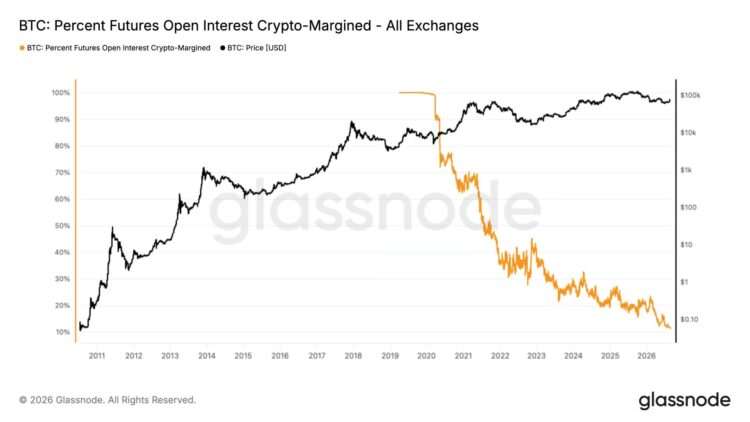
According to Glassnode, the Open Interest in crypto-margined futures has plummeted to a historic low of approximately 52,000 BTC, representing a mere 11% of the total market trading volume.
This shift signals a significantly more robust market structure. When futures contracts are collateralized by cash, a decline in Bitcoin’s price does not simultaneously diminish the value of the collateral itself. This crucial distinction significantly reduces the risk of cascading liquidations, which can exacerbate market downturns.
Conversely, using Bitcoin or other crypto assets as collateral creates a vulnerability: a price drop simultaneously devalues the collateral, triggering margin calls and forced liquidations. These liquidations, in turn, exert further downward pressure on prices, creating a self-reinforcing negative feedback loop: ‘price drop → collateral devaluation → liquidation → further price drop’.
The current trend towards cash-margined futures is instrumental in mitigating this self-reinforcing liquidation risk. This structural evolution is likely a key factor behind the observed decrease in Bitcoin’s overall market volatility in recent years, paving the way for more resilient price action.
Disclaimer: This article is provided for informational purposes only. All content and opinions expressed herein are for reference and do not constitute investment advice. They do not necessarily reflect the views or positions of the author or publisher. Investors are solely responsible for their own investment decisions and transactions. The author and publisher shall not be held liable for any direct or indirect losses incurred by investors as a result of their trading activities.




