
Author: Nancy, PANews
Solana’s Resurgence: Unpacking the Factors Driving SOL’s Strong Rebound and Future Potential
After a protracted period of subdued performance, Solana (SOL) has finally entered a phase of powerful resurgence. Since August, SOL has demonstrated consistent upward momentum, not only reversing a trend of consecutive monthly negative returns dating back to October of a previous year but also achieving its strongest single-month performance since March of a previous year.
This impressive rally is far from being a mere reflection of fleeting market sentiment. Instead, it is underpinned by a confluence of significant factors: sustained capital inflows, substantial improvements in on-chain fundamentals, critical technical upgrades, and, perhaps most importantly, a pivotal reform of its tokenomics model, which is set to profoundly influence SOL’s long-term value.
A Decade-Long High: Institutional Inflows Fuel SOL’s Momentum
This month has witnessed a robust surge in SOL’s price, with the token briefly surpassing the $110 mark and establishing a new high since late January of this year.
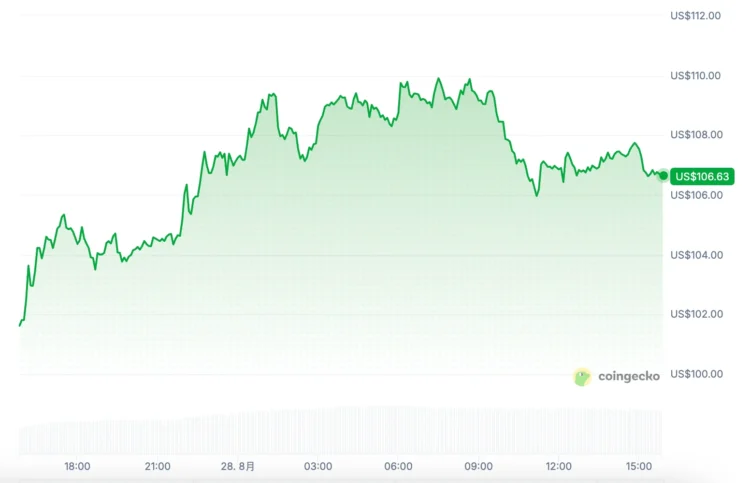
Analyzing its monthly performance, SOL recorded a cumulative gain of 46.9% in August, effectively ending a ten-month streak of monthly declines. This makes August its most robust month in the past year. Driven by this forceful price rebound, SOL’s year-to-date decline has dramatically narrowed to approximately 13%, a stark contrast to its full-year decline of 34.1% in a prior year.
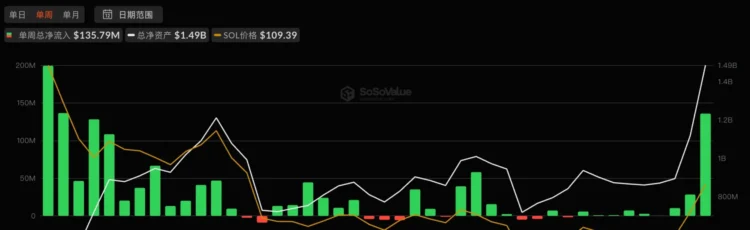
A primary catalyst behind this current rally is the continuous influx of institutional capital and ETF investments. Solana spot ETFs have recently experienced sustained inflows over multiple days. Data from SoSoValue indicates that, in the past week alone, these ETFs garnered cumulative net inflows of approximately $1.36 billion, marking the highest single-week inflow since November of a previous year. Monthly figures further underscore this trend, with August’s capital inflow into Solana spot ETFs reaching its second-highest level since their inception.
Concurrently, Solana treasury entities, such as DeFi Development Corp (DAT), have actively increased their SOL holdings. DeFi Development Corp, for instance, recently announced the resumption of SOL purchases, adding approximately 19,000 SOL with an investment of about $1.86 million. This boosts their total SOL holdings to roughly 2.33 million tokens, valued at an estimated $180 million. Similarly, Solmate Infrastructure disclosed an additional acquisition of 1,000 SOL, pushing the total value of their holdings beyond $100 million.
Access channels for traditional institutions have also broadened significantly. Schwab’s crypto platform, which oversees assets totaling $12.6 trillion, recently unveiled plans to enable direct SOL trading. This development is poised to substantially lower the entry barrier for conventional financial institutions seeking to invest in SOL.
Strengthening Foundations: On-Chain Growth and Technical Milestones
Beyond financial improvements, Solana’s on-chain fundamentals have demonstrated sustained strength, with several key indicators reaching unprecedented historical highs.
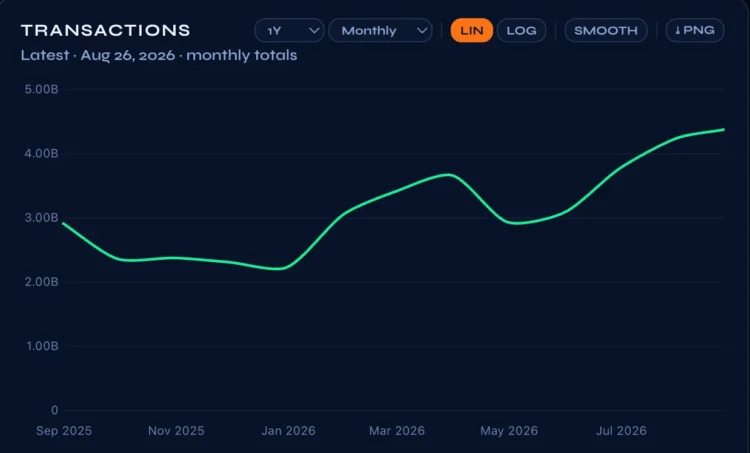
According to State of Solana data, the network processed a record-breaking 4.48 billion transactions in August. Since late December of a previous year, monthly transaction volume has surged by approximately 2.25 billion transactions, representing an impressive 100.9% increase. Furthermore, RWA.xyz data reveals that the total value of Real World Assets (RWA) on the Solana chain has surpassed $4.04 billion, and the number of RWA holders has grown to over 355,000 – both new historical peaks for the network.
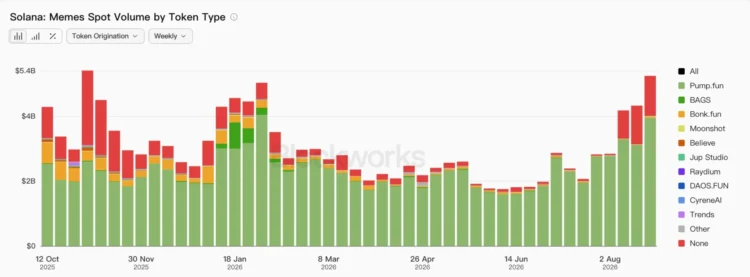
Meme coin trading activity has also experienced a notable resurgence. Blockworks data indicates that the weekly spot trading volume for meme coins on the Solana chain recently exceeded $5.24 billion, marking a new high since late November of a prior year.
The stablecoin market on Solana continues its expansionary trajectory. Artemis data shows that the stablecoin supply on the Solana chain has swelled to $16.5 billion, an increase of approximately $4.1 billion (or 33%) compared to $12.4 billion recorded during the same period last year.
Moreover, a series of beneficial technical advancements have provided crucial support for enhancing network performance. For example, SIMD-0286 was recently activated on the mainnet, elevating the block compute unit limit from 60 million to 100 million, a substantial 66% increase in capacity. The Agave 4.2 client, progressively rolled out on the mainnet in August, introduced several upgrades, including a 90% reduction in rent fees, a 3.3x increase in maximum transaction size, and a phased reduction of block time from 400 milliseconds to 200 milliseconds.
A more transformative consensus layer modification, the Alpenglow project, is slated for mainnet deployment around October this year with Agave 4.3. This initiative aims to drastically reduce transaction finality from approximately 12.8 seconds to an impressive 150 milliseconds. It will also shift a significant volume of votes that traditionally occupied block space to off-chain aggregation, thereby liberating more block capacity for genuine user transactions. Should these upgrades proceed as planned, Solana’s confirmation speed, block space utilization, and overall network efficiency are poised for further substantial improvements.
Tokenomics Transformation: Reshaping SOL’s Supply and Demand
A more direct and potentially long-lasting positive influence on SOL’s valuation stems from the ongoing improvements to its tokenomics model.
As the broader crypto market increasingly shies away from tokenomics models characterized by “high emissions, substantial unlocks, and weak value capture,” a growing number of projects are proactively re-evaluating their token’s supply and demand dynamics. In recent months, numerous projects, including Ethena, Polygon, Aptos, Sushiswap, Venice, and Near, have either initiated or are planning tokenomics reforms. These initiatives primarily focus on reducing unlock pressure, utilizing protocol revenue for token buybacks or burns, adjusting inflation and emission mechanisms, and optimizing staking incentives.
Solana is now actively participating in this industry-wide wave of tokenomics reform.
Currently, SOL’s economic model faces several points of contention. These include a perceived excessively fast SOL issuance rate, significant continuous selling pressure from staking rewards, transaction fees that do not adequately reflect actual compute resource utilization, users habitually over-declaring compute units leading to scheduling inefficiencies, and a SOL burn rate that remains relatively low compared to its issuance.
To address these critical issues, the Solana community has put forward two pivotal proposals: SIMD-550 and SIMD-553. These initiatives aim to adjust SOL’s supply mechanism from two complementary angles: “less issuance” and “more burning,” thereby striving to align the tokenomics model more closely with the network’s actual usage patterns.
SIMD-550: Curtailing New Supply
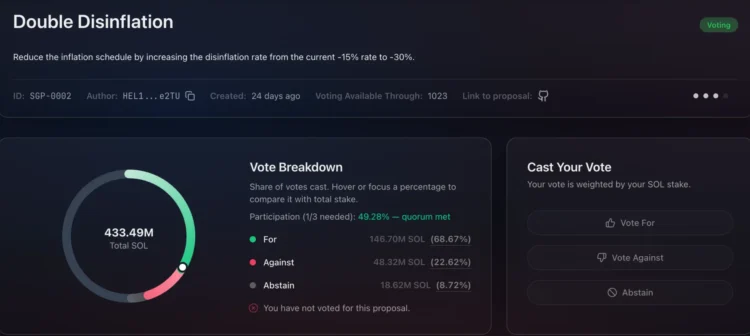
SIMD-550 primarily tackles the issue of SOL’s rapid new supply. This proposal seeks to accelerate the annual inflation rate reduction speed from 15% to 30% and bring forward the timeline for SOL to reach a baseline inflation rate of 1.5% from approximately 2032 to 2029. Based on the proposal’s projections, the nominal staking yield is anticipated to gradually decrease from about 5% to approximately 2.25% over the next three years.
Proposed by Helius engineers, SIMD-550 is a streamlined version of the earlier SIMD-0411 plan. Compared to the even older SIMD-228, which was more complex in its mechanics and ultimately failed to achieve quorum due to controversy, SIMD-550 significantly simplifies the community’s understanding, voting process, and implementation.
Voting on this proposal is currently nearing completion, with a participation rate of approximately 49.15%, comfortably exceeding the 1/3 quorum requirement. A substantial 68.58% of the votes cast are in favor.
SIMD-553: Enhancing Token Burning
SIMD-553 addresses the challenge of insufficient token burning. This proposal mandates that resource fees be charged based on the declared compute units for transactions, with all such fees being subsequently burned. Approved in July, this initiative aims to dramatically increase SOL’s daily burn rate from the current range of approximately 600-800 tokens to between 7,500 and 9,000 tokens.
The core rationale behind SIMD-553 is to better synchronize resource fees with declared transactions and the corresponding reserved network capacity. Currently, users often “over-declare compute units,” requesting a resource limit significantly higher than their actual usage. The scheduler, in turn, reserves block space according to this over-declared amount, which not only diminishes packing efficiency but also means existing fixed fees do not accurately reflect true resource consumption. By charging fees based on declared compute units and burning them entirely, this proposal increases the cost of falsely declaring high limits, thereby mitigating this incentive distortion. Crucially, as network activity intensifies, SOL’s burn rate will proportionally increase.
From a comprehensive tokenomics perspective, SIMD-550 is designed to curtail new supply, while SIMD-553 is engineered to bolster token burning from the supply side. A report by 21Shares projects that, combined, these two proposals are expected to reduce net SOL issuance by approximately $1.4-1.5 billion in value over a six-year period. This could potentially compress staking yields, simultaneously enhancing SOL’s scarcity and redirecting capital from staking towards the vibrant on-chain DeFi and application ecosystems.
The Road Ahead: Demand, Utility, and Long-Term Value
It is crucial to acknowledge that tokenomics reform, while vital, does not inherently guarantee value capture, nor does it automatically translate into an inevitable rise in SOL’s price. The true determinant of a token’s long-term value lies in its sustained ability to attract genuine users and capital, ensuring that actual network demand consistently outpaces new supply over extended periods.
(The above content is an excerpt and reproduction authorized by our partner PANews. Original Link)
Disclaimer: This article is provided for market information purposes only. All content and views are for reference only, do not constitute investment advice, and do not represent the views and positions of BlockBeats. Investors should make their own decisions and trades. The author and BlockBeats will not bear any responsibility for direct or indirect losses resulting from investor transactions.