
Solana’s Meme Coin War: From Issuance Volume to Controlling Attention and Order Flow
The battle for supremacy in the Solana meme coin market is undergoing a significant transformation. What was once a race to launch the most tokens has evolved into a strategic contest for control over transaction flow and user attention. Recent data underscores this shift, with social trading platform Fomo momentarily eclipsing meme coin behemoth Pump.fun in single-day protocol revenue. Concurrently, StonkFun, an innovative platform bridging “stock-paired meme coins,” has surged in popularity, seeing its native token STONK skyrocket over 250% in a single day, pushing its market cap to approximately $140 million.
Is the long-held dominance of Pump.fun truly beginning to waver?
Fomo’s Ascendancy: A New Era of Social Trading
Fomo Surpasses Pump.fun in Daily Revenue with $1.76 Million
According to DefiLlama, Fomo recorded an impressive $1.76 million in single-day revenue on September 4th, momentarily outperforming Pump.fun, which registered approximately $1.10 million during the same period. This marks a pivotal moment in Solana’s application revenue landscape, signaling a potential shift in market dynamics.
Real-time data from DefiLlama as of September 7th highlights Fomo Wallet’s robust activity over the past 30 days:
- Over $1.11 billion in spot trading volume
- $19.85 million in trading fees generated
- $17.63 million in protocol revenue
- 38,959 24-hour active addresses
- 271,187 24-hour transactions
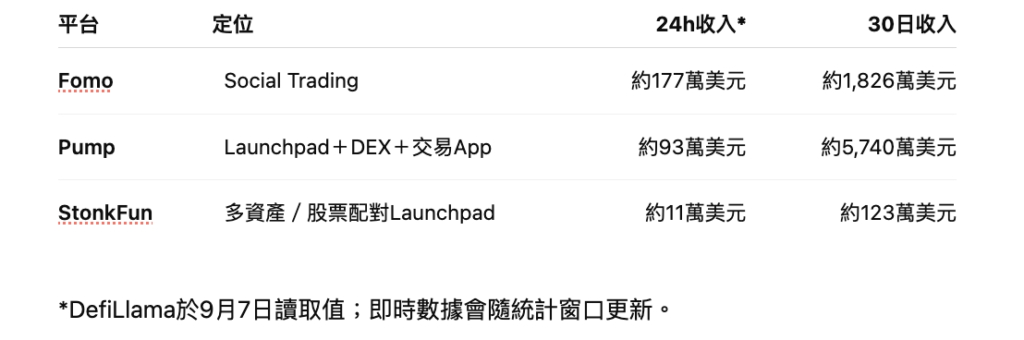
When factoring in Fomo’s parent protocol, including Hyperliquid perpetual contracts, its 30-day revenue climbed to an even more substantial $18.26 million.
While Fomo’s single-day triumph is noteworthy, it’s crucial to contextualize its overall standing. Pump.fun’s ecosystem still commands a significantly larger share, with a 30-day revenue of approximately $57.40 million (roughly three times Fomo’s) and a 7-day revenue of $11.76 million (surpassing Fomo’s $7.06 million). This suggests that while Fomo is a formidable challenger, Pump.fun maintains its broad market presence.
Fomo: Capturing Attention, Not Just Creating Coins
The fundamental distinction between Fomo and Pump.fun lies in their position within the trading value chain. Pump.fun initially streamlined the process of meme coin creation, from rapid deployment to bonding curve trading and liquidity migration. Fomo, however, addresses a different user need: “What’s trending today? What are others buying? How can I participate directly?”
Categorized by DefiLlama as a Trading App rather than a Launchpad, Fomo integrates self-custody trading, social feeds, and copy trading into a seamless mobile experience. Its innovative features, such as Apple Pay integration for first-time crypto purchases (facilitating over 68,000 transactions totaling $25 million), and the addition of Hyperliquid-powered perpetual contracts in June, underscore its focus on accessibility and comprehensive trading solutions. Following a $75 million Series B funding round led by Index Ventures in June, valuing the company at $550 million, Fomo’s strategic intent is clear: to dominate upstream attention and order flow, posing a direct threat to Pump.fun’s traditional model.
Pump.fun’s Strategic Evolution: Beyond the Launchpad
Pump.fun has not been oblivious to these market shifts. Its revenue calculations by DefiLlama now encompass a diversified suite of products, including the original bonding curve, PumpSwap, Terminal, and the Pump.fun Mobile App. This expansion signifies Pump.fun’s transformation from a singular launchpad into a comprehensive ecosystem comprising a launchpad, DEX, trading terminal, and mobile application.
The true battleground is no longer confined to meme coin issuance but extends to determining “which app Solana retail users choose for their transactions.” This broader competitive landscape explains why a simple comparison of “coins launched” between Fomo and Pump.fun would be misleading; the core of their rivalry now centers on user engagement and transaction fees.
StonkFun’s Innovative Disruption: Wall Street Meets Meme Coins
Amidst this evolving landscape, StonkFun has emerged with a distinctive competitive model. Instead of directly replicating Pump.fun, this Solana launchpad empowers developers to create tokens “paired with anything.” These trading pairs can include traditional cryptocurrencies, tokenized stocks, ETFs, foreign exchange, or commodity assets.
A prime example is STONK itself, which is paired with SPYx—a tokenized product designed to track the performance of the SPDR S&P 500 ETF. This innovation introduces a novel market structure: Stocks/ETFs → Tokenized Assets → Meme Coin Trading Pairs, effectively bridging the seemingly disparate narratives of Real World Assets (RWA) and meme coins. It’s crucial to note, however, that meme coins paired with assets like SPYx or NVDAx do not confer ownership or shareholder rights; the tokenized assets merely serve as quoting and liquidity assets within the trading pool.
STONK’s Meteoric Rise: 250% Surge and $135 Million in Daily Volume
This innovative narrative captured significant market attention recently. On September 5th, StonkFun announced its integration with Raydium LaunchLab, meaning new tokens would launch via LaunchLab’s bonding curve before migrating liquidity to Raydium. Following this news, STONK surged to an all-time high of approximately $0.212 on September 6th, settling around $0.16 with a 24-hour gain exceeding 250%. At its peak, STONK’s market capitalization reached $140 million, with a staggering $135 million in 24-hour trading volume. This surge also positively impacted related Solana infrastructure, with Raydium’s RAY token climbing 46% and Jupiter’s JUP rising 21%.
CoinGecko data further confirms STONK’s impressive performance, showing a single-day increase of approximately 267.9% on September 6th.
StonkFun’s Revenue: Promising but Still Niche
While StonkFun’s momentum is undeniable, its current scale remains modest compared to Pump.fun. As of September 7th, DefiLlama reported StonkFun’s revenue figures:
- 24-hour revenue: approx. $111,000
- 7-day revenue: approx. $351,000
- 30-day revenue: approx. $1.23 million
- Cumulative revenue: approx. $1.41 million
These figures represent only about 2% of Pump.fun’s $57.40 million 30-day revenue, indicating that it is premature to declare StonkFun a direct challenger to Pump.fun’s leading position. However, StonkFun’s unique tokenomics are particularly noteworthy. A portion of its platform revenue is used to buy back STONK tokens on Jupiter. DefiLlama’s on-chain tracking shows approximately $756,000 in cumulative STONK buyback and burn to date, with $667,000 occurring in the last 30 days. This creates a compelling crypto-native flywheel: new token launches → increased trading volume → higher fees → STONK buyback → enhanced STONK narrative → attraction of more new tokens. Conversely, this flywheel could reverse if trading activity declines.
The Broader Implications: A Diversified Solana Meme Coin Value Chain
The pressures on Pump.fun are not new. The Block reported in June that Pump.fun’s 7-day average “graduation rate” for tokens had plummeted by 80% over three months to just 0.26%. Daily revenue had also fallen significantly from $4.8 million to $800,000 during that period. While Pump.fun subsequently regained strength, this history underscores the fickle nature of meme coin loyalty.
In 2025, for instance, LetsBonk briefly captured nearly 70% of the “graduated token” market share before Pump.fun reasserted its position.
Has the Solana Traffic War Truly Shifted?
The answer is that change is underway, but the reigning king has not yet been dethroned. From a revenue perspective:
The true transformation isn’t Pump.fun’s disappearance, but rather the disaggregation of the Solana meme coin value chain. The core question of 2024, “Where do I launch a coin?”, is evolving into a more complex inquiry for 2026: “Where do I discover new coins? Where do I issue them? Where do I trade them? Who controls the order flow? And who ultimately collects the fees?”
Pump.fun maintains control over “issuance + early trading,” while Fomo strategically enters through “social + trading.” StonkFun carves out a niche by creating new issuance themes with “RWA + Meme,” and platforms like Raydium and Jupiter provide essential liquidity and transaction routing infrastructure. Therefore, Fomo’s single-day revenue surpassing Pump.fun is not merely about an extra $660,000 earned on a particular day. Its true significance lies in proving that control over meme coin traders can be achieved even without controlling meme coin issuance.
If this trend persists, the ultimate measure of victory in the next Solana traffic war may no longer be “how many coins were launched in a day,” but rather: when the next 100x meme coin emerges, which app will traders instinctively open first?
Disclaimer: This article is for informational purposes only and does not constitute investment advice. All content and opinions expressed are for reference only and do not represent the views or positions of the author or BlockTempo. Investors should conduct their own due diligence and make independent investment decisions. The author and BlockTempo shall not be held responsible for any direct or indirect losses incurred by investors.