
Bitcoin (BTC) has once again experienced significant volatility ahead of crucial U.S. inflation data and the Federal Reserve’s (Fed) interest rate decision. On Tuesday, the leading cryptocurrency briefly dipped below the $78,000 mark, hitting a low of approximately $77,603, before a swift influx of buying interest propelled its price back above $78,600.
As Wednesday’s Asian trading session unfolded, Bitcoin continued to hover around $78,700, indicating a temporary but notable level of support near $78,000. However, a deeper dive into on-chain data reveals a brewing concern: as the supply of profitable coins increases, the potential selling pressure above the $82,000 threshold is simultaneously growing more substantial.
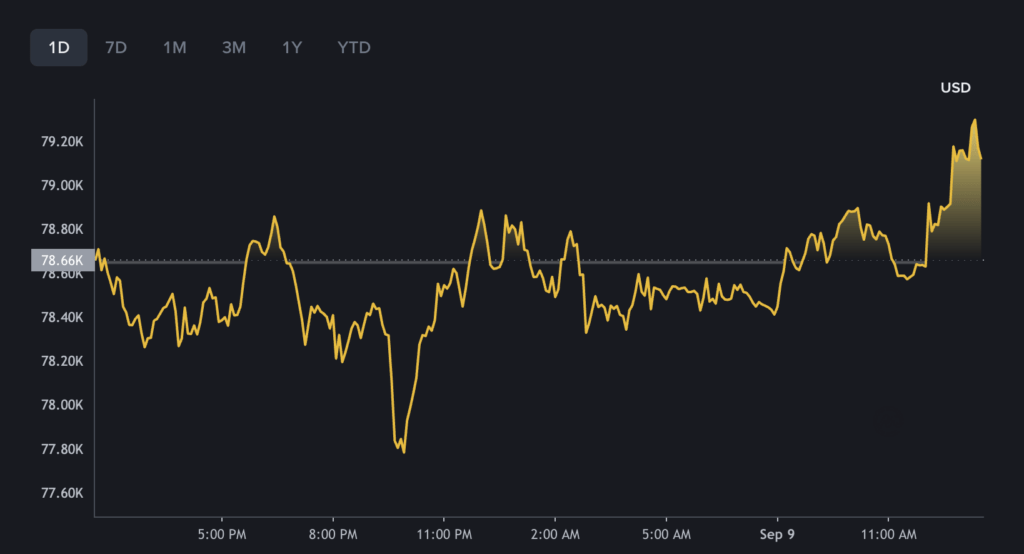
Rebound from $77,603: Leverage Amplifies Market Swings
Market data highlights Bitcoin’s intraday low of $77,603 on September 8th, followed by its recovery to approximately $78,600. This sharp move triggered significant liquidations across the cryptocurrency market, totaling around $264 million. Bitcoin-related positions accounted for roughly $79 million of these liquidations, underscoring how leveraged trading amplified the downward price movement.
Despite the rebound, current market sentiment suggests this recovery is best viewed as a “quick reclaim after breaching support,” rather than a definitive signal for a new uptrend. A recent Glassnode market report indicates that Bitcoin largely remained within the $77,300 to $81,300 range over the past week. Spot momentum metrics declined by 30% to 54.6, with spot trading volume at approximately $5.3 billion. This suggests an absence of widespread panic selling, yet also a lack of significant proactive buying interest.
The $82,000 Conundrum: Why 71% Profitability Could Signal Overhead Pressure
A critical element in understanding Bitcoin’s current dynamics lies in its on-chain supply structure. Analysts at Bitfinex point out that over 71% of the total Bitcoin supply is currently in a state of profit, nearing the long-term historical average of 74.7%. “Supply in Profit,” as defined by Glassnode, refers to BTC that was last moved on-chain at a price lower than its current market value, thus representing unrealized gains.
While this metric might initially appear bullish, indicating a healthier market cost structure, its implications shift dramatically as prices approach previous highs. In such scenarios, a high percentage of profitable supply can paradoxically transform into significant selling pressure.
Bitfinex elaborates: in May, when Bitcoin was trading above $82,500, the supply in profit stood at approximately 67%. Today, with BTC at around $78,000, more than 71% of the supply is already in profit. This means that if the price were to revisit the $82,000 region, a substantially larger volume of on-chain supply would be poised to realize profits compared to May. Analysts describe this phenomenon as a deeper “potential seller liquidity pool,” where the same price level now triggers a greater amount of profitable supply.
$82,000: From Resistance to a Formidable Supply Pressure Zone
Recent price action corroborates this on-chain observation. In early September, Bitcoin briefly surged to $82,164, marking a more than three-month high. However, it failed to sustain this level and swiftly retreated below $80,000.
Technical analysis from Reuters further highlights the significance of the ~$82,793 level. This price point not only approximates the May high but also aligns with the 61.8% Fibonacci retracement level and various long-term technical indicators, establishing it as a formidable resistance zone. A decisive breakthrough above this region could pave the way for a push towards $90,000. Conversely, a sustained inability to surpass this level suggests that the $82,000 to $83,000 range may continue to function as a crucial profit-taking area.
The market is currently navigating a unique structure: while Bitcoin’s price is not far from $82,000, the potential selling volume required to absorb a renewed challenge at this level could be considerably higher than what was observed in May.
ETF Inflows Persist, But Macro Headwinds Intensify
The funding landscape isn’t entirely bearish. U.S. spot Bitcoin ETFs recorded consecutive net inflows from September 2nd to 4th. September 3rd alone saw an inflow of approximately $730.8 million, followed by an additional $174.6 million on September 4th. Bitfinex statistics indicate cumulative ETF net inflows of about $1.01 billion over these three trading days, signaling that institutional demand continues to provide a degree of price support.
However, the more immediate short-term pressure emanates from the broader macroeconomic environment. As of September 9th, Brent crude oil prices were nearing $100 per barrel, while the U.S. 10-year Treasury yield hovered around 4.8%. The market is also actively assessing the likelihood of another Fed interest rate hike on September 16th. Rising oil prices fuel concerns of rekindled inflation, while elevated bond yields increase the opportunity cost of holding non-yielding assets. Both factors collectively constrain the valuation of risk assets, including Bitcoin.
The market’s immediate focus will now shift to upcoming U.S. inflation data and the Fed’s policy outlook. Should ETF capital inflows persist despite a high-yield environment, Bitcoin retains the potential to retest the $80,000 to $82,000 range. Yet, without a corresponding surge in spot demand, even a return to $82,000 could first encounter a significantly larger wave of profit-taking than witnessed in May.
The true test at this juncture is not merely whether Bitcoin can rebound from $78,000, but rather if fresh buying momentum is robust enough to absorb the increasingly dense layer of profitable supply above $82,000. This will be the deciding factor in determining whether the current phase is merely a period of range-bound consolidation or a genuine catalyst for Bitcoin’s next upward breakout.
Disclaimer: This article is for informational purposes only. All content and opinions are for reference and do not constitute investment advice. They do not represent the views or positions of the author or BlockTempo. Investors should make their own decisions and trades. The author and BlockTempo will not bear any responsibility for direct or indirect losses incurred by investors’ trading activities.