
Unmasking Bitcoin’s True Macro Triggers: Why US Employment Data Outperforms the Fed and BTC’s Evolving Correlation with Gold
For many market observers, the Federal Reserve’s (Fed) interest rate decisions have long been considered the paramount macroeconomic catalyst for Bitcoin’s price movements. However, a groundbreaking new study from Coin Metrics challenges this conventional wisdom. Their latest research reveals that when focusing on the immediate 30 minutes following an announcement, it is actually U.S. employment data that most consistently triggers abrupt shifts in BTC’s valuation.
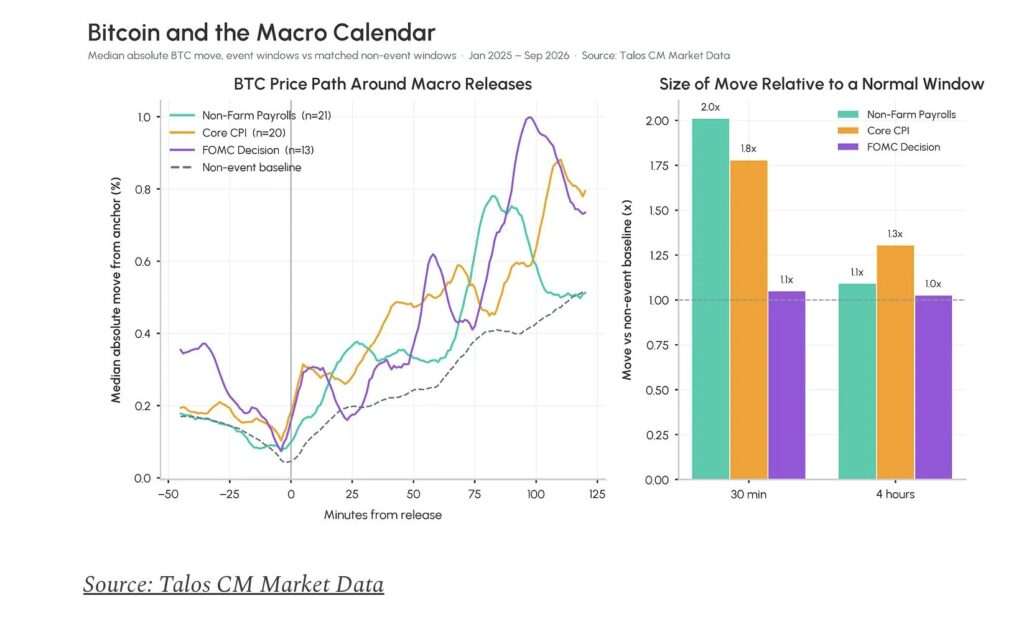
Published on September 8th, Coin Metrics’ comprehensive report, “Bitcoin’s Shifting Macro Identity,” meticulously analyzed Bitcoin’s volatility around key economic announcements, including Non-Farm Payrolls (NFP), Core Consumer Price Index (Core CPI), and Federal Open Market Committee (FOMC) decisions. The study, which covered a period from January 2025 to September 2026 (Note: These dates appear to be a typo in the original source and likely refer to a past analytical period), yielded compelling results. In the initial 30 minutes post-release, the median absolute price change for BTC following employment reports was approximately double that of non-event periods. Core CPI announcements followed closely, showing roughly 1.8 times the typical volatility. Surprisingly, the highly anticipated FOMC interest rate decisions, often deemed the market’s primary focus, exhibited volatility levels that largely remained consistent with normal baseline periods across both observation windows.
NFP: The Immediate Catalyst; CPI: The Sustained Driver
This finding does not, however, diminish the importance of Core CPI.
Coin Metrics specifically highlights that while employment reports deliver the most significant immediate price shock, the impact of Core CPI tends to be more enduring. The rationale is clear: employment figures rapidly alter market perceptions regarding economic overheating and the Fed’s potential for further rate hikes. In contrast, inflation data directly influences real interest rates and the broader monetary policy trajectory, leading to a more prolonged period of price repricing.
In essence, if the question is “which data point is most likely to send BTC in a specific direction within half an hour?”, the current answer is Non-Farm Payrolls. But if the query shifts to “which data point is more likely to prompt a re-evaluation of the interest rate path over several weeks?”, Core CPI’s significance may well rival that of NFP.
So, why do FOMC decisions appear less dramatic than one might expect? A plausible explanation is that interest rate decisions are often gradually priced in by the market well in advance, influenced by preceding employment data, CPI figures, official statements, and interest rate futures. The true price impact, therefore, may have already unfolded long before the Fed’s formal announcement.
A Single NFP Report Triggers a 2.32% BTC Drop in 30 Minutes
The U.S. August employment report, released on September 4th, serves as a vivid illustration of this dynamic.
The report revealed a robust addition of 162,000 non-farm jobs, significantly surpassing market expectations of approximately 56,000. These strong figures quickly fueled market expectations for a Fed rate hike. Reuters reported that following the data release, the probability of a September rate hike briefly surged to around 60%.
Coin Metrics’ analysis shows that BTC experienced a 2.32% decline within 30 minutes of the data’s release, a magnitude approximately six times greater than the typical 30-minute reaction to NFP reports.
The derivatives market concurrently underwent a deleveraging event: BTC open interest dropped by roughly 3% within half an hour. Long liquidations amounted to approximately $119 million, while short liquidations were a mere $24 million, a ratio close to 5:1. This underscores that while macro data acts as a “trigger,” the extent to which a downturn rapidly expands is ultimately determined by the accumulated leverage in the market at that moment.
A Profound Shift: Bitcoin’s Growing Resemblance to Gold, Not Tech Stocks
Even more noteworthy than short-term event volatility is the evolving relationship between Bitcoin and traditional assets.
Coin Metrics’ latest data indicates that the 90-day return correlation coefficient between BTC and gold has surged to +0.56, marking its highest level since 2020. Concurrently, Bitcoin’s correlation with both the Nasdaq 100 and the U.S. dollar has plummeted to near zero.
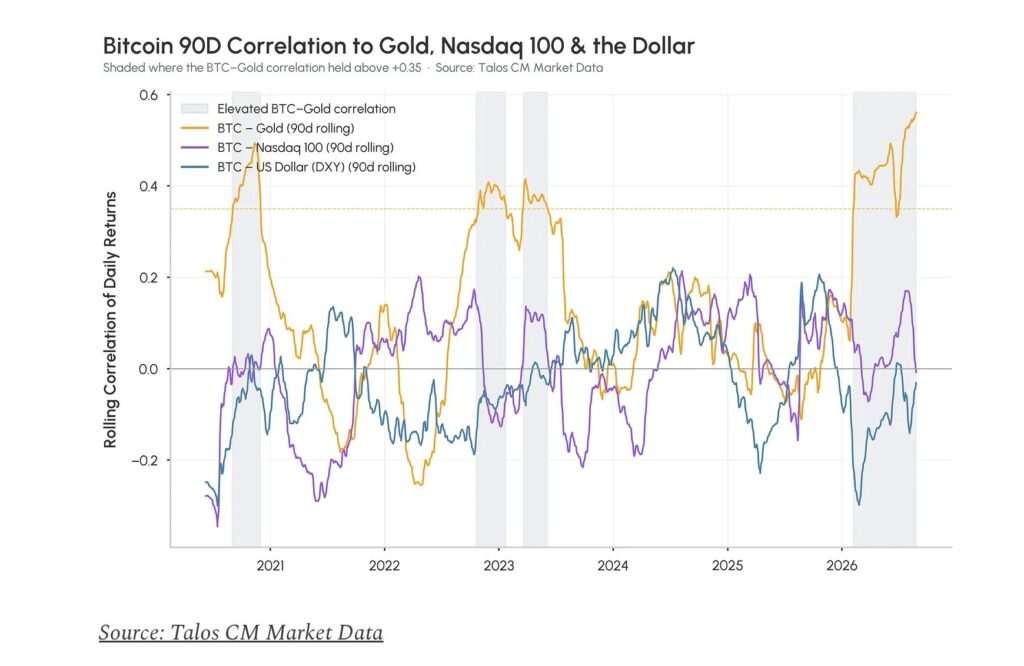
This starkly contrasts with the prevailing market perception of BTC as a “high-beta tech stock” in previous periods.
Coin Metrics posits that Bitcoin and gold are currently being propelled by similar macroeconomic forces, including anxieties over monetary purchasing power, escalating government debt, widening fiscal deficits, and real interest rate trends. When markets become apprehensive about fiat currency devaluation and sovereign debt issues, these two scarce assets tend to move in closer alignment.
This phenomenon is not unprecedented. During the extensive monetary and fiscal stimulus following the 2020 pandemic and the U.S. regional banking crisis in 2023, both BTC and gold converged due to concerns about liquidity and financial system risks.
However, a +0.56 correlation does not signify that Bitcoin has permanently cemented its status as “digital gold.” Correlation coefficients are rolling metrics, subject to rapid change with shifts in the market environment. Previous research by Coin Metrics consistently demonstrates Bitcoin’s ability to oscillate between its roles as a “tech stock/risk asset” and a “scarce monetary asset” across different market cycles.
Therefore, a more precise articulation than “BTC has decoupled from Nasdaq” would be: Bitcoin is currently operating within a macro trading regime that is more akin to gold than to tech stocks.
The Next Critical Test: CPI Precedes the Fed
This evolving market structure is poised for its next significant test very soon.
The U.S. Bureau of Labor Statistics is scheduled to release the August CPI report on September 11th at 8:30 AM ET, preceding the Federal Reserve’s FOMC meeting on September 15th-16th.
Coin Metrics’ historical data strongly suggests that the market should not solely fixate on the interest rate outcome announced on September 16th.
Should Core CPI exceed expectations, markets are likely to preemptively drive up rate hike expectations and real interest rates, potentially putting pressure on both BTC and gold. Conversely, if core inflation shows signs of cooling, the hawkish repricing initially triggered by robust employment data could be partially reversed.
Consequently, the true focus of observation should not be a singular FOMC statement, but rather a comprehensive transmission chain: Non-Farm Payrolls influence interest rate expectations → CPI either confirms or refutes these expectations → bond yields and the U.S. dollar are repriced → and finally, the FOMC definitively confirms the policy path.
According to Coin Metrics’ latest research, Bitcoin is no longer simply awaiting the Federal Reserve’s “answer.” The most significant market shifts often commence long before that answer is officially revealed.
As the correlation between BTC and gold climbs to 0.56, while its link to the Nasdaq hovers near zero, the upcoming September CPI and FOMC events will serve as a pivotal test: Is Bitcoin merely taking a temporary hiatus from its tech stock association, or is it truly re-embracing the “digital gold” trading logic once again?
Disclaimer: This article is for market information purposes only. All content and opinions are for reference only and do not constitute investment advice. They do not represent the views or positions of BlockTempo. Investors should make their own decisions and trades. The author and BlockTempo will not bear any responsibility for direct or indirect losses incurred by investors’ transactions.