
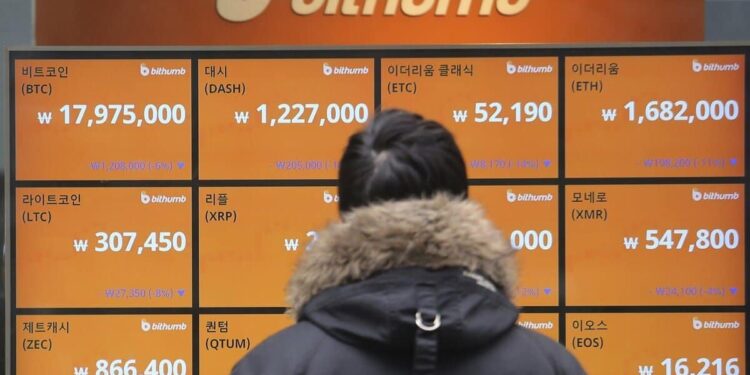
In a stunning display of human error with multi-billion dollar consequences, South Korean cryptocurrency exchange Bithumb recently found itself at the center of a “fat finger” incident that sent shockwaves through the digital asset community. What was intended to be a modest distribution of activity bonuses, totaling approximately 620,000 Korean Won (around $420 USD), spiraled into an accidental giveaway of 620,000 Bitcoins – an astonishing sum valued at roughly 60 trillion Korean Won (approximately $40 billion USD).
The Accidental Windfall: How a Typo Led to a Bitcoin Bonanza
The incident unfolded on the evening of February 6th, when a backend employee, tasked with distributing 2,000 KRW (about $1.37 USD) in rewards to individual users, mistakenly entered “2,000 Bitcoins” into the system. This colossal miscalculation instantly inflated the accounts of 249 fortunate users, each seeing their balance surge by over 210 billion Korean Won (roughly $140 million USD) at the prevailing Bitcoin price.

The “Golden Half-Hour” and Swift User Actions
Bithumb’s internal systems flagged the anomaly a mere 20 minutes after the error occurred, but it took another 15 minutes – a critical “golden half-hour” – before transactions and withdrawals were finally frozen. In this brief window, the platform witnessed a flurry of unusual activity, including a single Bitcoin sell order valued at 100 billion Korean Won (approximately $68 million USD).
According to investigations by Korean media outlet SBS News, while Bithumb claims to have successfully recovered 99.7% of the misallocated Bitcoin on the day of the incident, a significant 125 Bitcoins, worth approximately $8.8 million USD, remain unrecovered.
The Aftermath: Tracing the Missing Millions
SBS News further revealed that over 80 users acted with remarkable speed, liquidating their mistakenly credited Bitcoins before the system lockdown. Approximately 3 billion Korean Won (around $2.05 million USD) from these sales was reportedly transferred directly to personal bank accounts, while another 10 billion Korean Won (roughly $6.83 million USD) was used to acquire other cryptocurrencies.
Bithumb is now engaged in the delicate process of contacting these users individually, urging them to return the funds. The exchange has publicly stated that any unrecovered losses will be absorbed by the company’s own assets, underscoring its commitment to financial stability.
Bithumb’s Commitment to Compensation and Prevention
In a bid to restore trust, Bithumb has announced comprehensive compensation plans for users adversely affected by the market volatility triggered by the incident. This includes full reimbursement for any price differences incurred by those forced to sell Bitcoin at a lower rate, an additional 10% bonus, and a seven-day waiver of trading fees. Furthermore, all users who logged into the platform during the incident will receive a goodwill payment of 20,000 Korean Won (about $15 USD).
Looking ahead, Bithumb is taking proactive steps to prevent future occurrences. The exchange has committed to establishing a permanent “User Protection Fund” with a substantial endowment of 100 billion Korean Won (approximately $68 million USD), designed to act as a robust buffer against unforeseen operational risks.
Technologically, Bithumb pledges a sweeping system overhaul. This includes fortifying asset verification protocols, implementing multi-layered approval processes for payments and distributions, and deploying an AI-powered, 24-hour abnormal transaction monitoring system to detect and thwart irregularities in real-time.
Beyond Human Error: The Question of Exchange Reserves
This “fat finger” blunder has, however, brought to light a more profound concern regarding the operational transparency of cryptocurrency exchanges. Critics question how Bithumb, reportedly holding approximately 42,000 Bitcoins in reserves, could theoretically “issue” 620,000 Bitcoins – an amount more than ten times its actual holdings. This discrepancy suggests that Bithumb, like many exchanges, primarily manages user balances through an internal ledger system, meaning the “balance” users see reflects an internal record rather than a direct, real-time reflection of on-chain assets.
In response to these revelations, South Korea’s financial supervisory authorities have announced a comprehensive audit across all cryptocurrency exchanges. The objective is to scrutinize internal controls and asset verification mechanisms, ensuring robust safeguards are in place to prevent similar incidents and bolster market integrity.
Disclaimer: This article is for market information purposes only. All content and opinions are for reference only, do not constitute investment advice, and do not represent the views and positions of BlockTempo. Investors should make their own decisions and trades. The author and BlockTempo will not bear any responsibility for direct or indirect losses incurred by investors’ transactions.
