

Bitcoin’s Recent Rally: A Bear Market Bounce, Not a Bull Run, Says CryptoQuant
Bitcoin’s robust surge on Thursday, which briefly pushed its price above the $73,000 threshold, ignited a spark of hope among many investors for a swift return to a full-fledged bull market. However, leading on-chain data analytics firm CryptoQuant offers a more tempered perspective, classifying this rally as merely a “rebound from overselling” rather than the dawn of a new bullish cycle.
In a report released on Thursday, Julio Moreno, Head of Research at CryptoQuant, articulated this cautious stance. “Despite the recent price recovery, Bitcoin remains fundamentally within a bear market structure,” Moreno stated. He elaborated, “Both fundamental and technical indicators continue to suggest the market is enveloped by bearish sentiment, making this rally a more accurately interpreted as a brief corrective phase within an ongoing bear market.”
Underlying Dynamics: Improved Demand and Reduced Selling Pressure
Delving into the catalysts behind this upward movement, Moreno’s analysis highlights a significant amelioration in spot demand contraction. Earlier this year, market demand had plummeted to a deficit of approximately 136,000 BTC. This figure has since dramatically improved, now standing at a deficit of roughly 25,000 BTC. Such a substantial reduction signifies a significant release of market selling pressure since early February, paving the way for better price consolidation and potential strength.
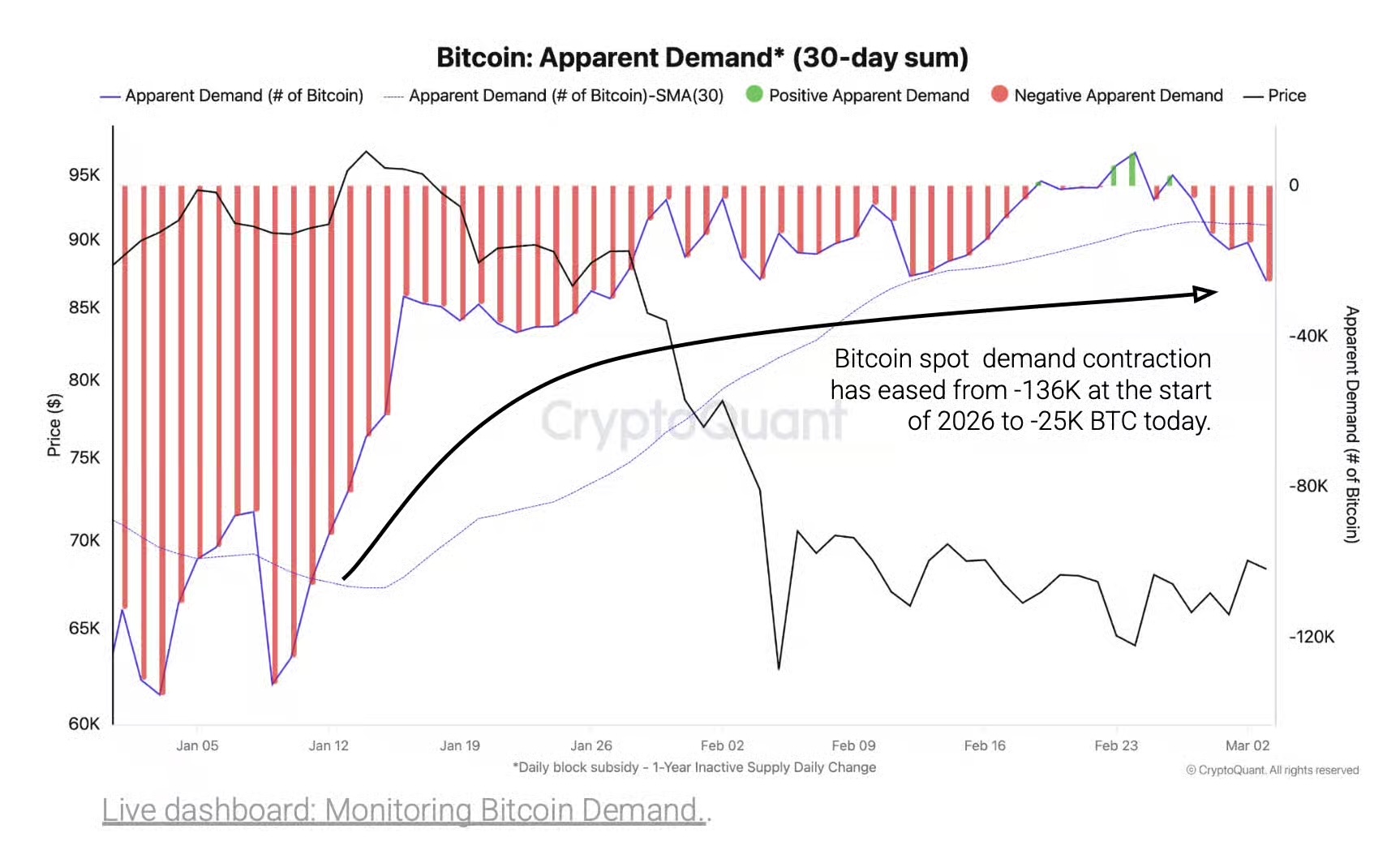
Concurrently, renewed buying interest from US investors is playing a pivotal role. The Coinbase Bitcoin Premium Index, a key metric for gauging the buying intensity of both institutional and retail players in the US, has surged from deeply negative territory in early February to reach its most robust positive premium since last October.
Adding further support, selling pressure from both short-term traders and long-term holders has notably diminished. Moreno points out that Bitcoin traders’ unrealized losses recently peaked at levels not seen since July 2022. Historically, as paper losses deepen, traders tend to become more reluctant to capitulate and close positions, thereby reducing the marginal selling impetus.
This trend is mirrored by long-term holders, whose 30-day selling volume has dramatically decreased from a peak of 904,000 BTC on November 26 last year to approximately 276,000 BTC currently, marking its lowest point in recent memory.
CryptoQuant’s Bull Score Index Signals Caution
Despite these supportive factors, Moreno firmly reiterates that the fundamental market structure remains unchanged. CryptoQuant’s proprietary “Bitcoin Bull Score Index,” a comprehensive measure of bullish sentiment, currently stands at a mere 10 out of a possible 100. This low score underscores that crucial indicators signaling a full bull market resurgence have yet to align.
Key Resistance Levels Ahead
Looking forward, Moreno issues a cautionary note: should Bitcoin sustain its upward trajectory, it will likely encounter formidable resistance at two key price levels: $79,000 and $90,000.
The initial barrier at $79,000 aligns with the lower boundary of the “trader’s on-chain realized price,” a zone historically known to present robust resistance during bearish cycles. The subsequent $90,000 mark represents a broader realized price range for traders. Notably, earlier this January, Bitcoin’s ascent from $80,000 to $98,000 was ultimately thwarted within this very range, leading to a subsequent pullback.
As of the latest CoinGecko market data, Bitcoin has since pared some of its gains, currently trading around $70,800, reflecting a 2.7% decline over the last 24 hours.
Disclaimer: This article is intended solely for market information purposes. All content and opinions are for reference only and do not constitute investment advice. They do not represent the views or positions of the author or the platform. Investors are advised to conduct their own due diligence and make independent trading decisions. Neither the author nor the platform shall be held liable for any direct or indirect losses incurred from investor transactions.




