RWA Tokenization Surges: From Experiment to Institutional Powerhouse – But What’s Next?
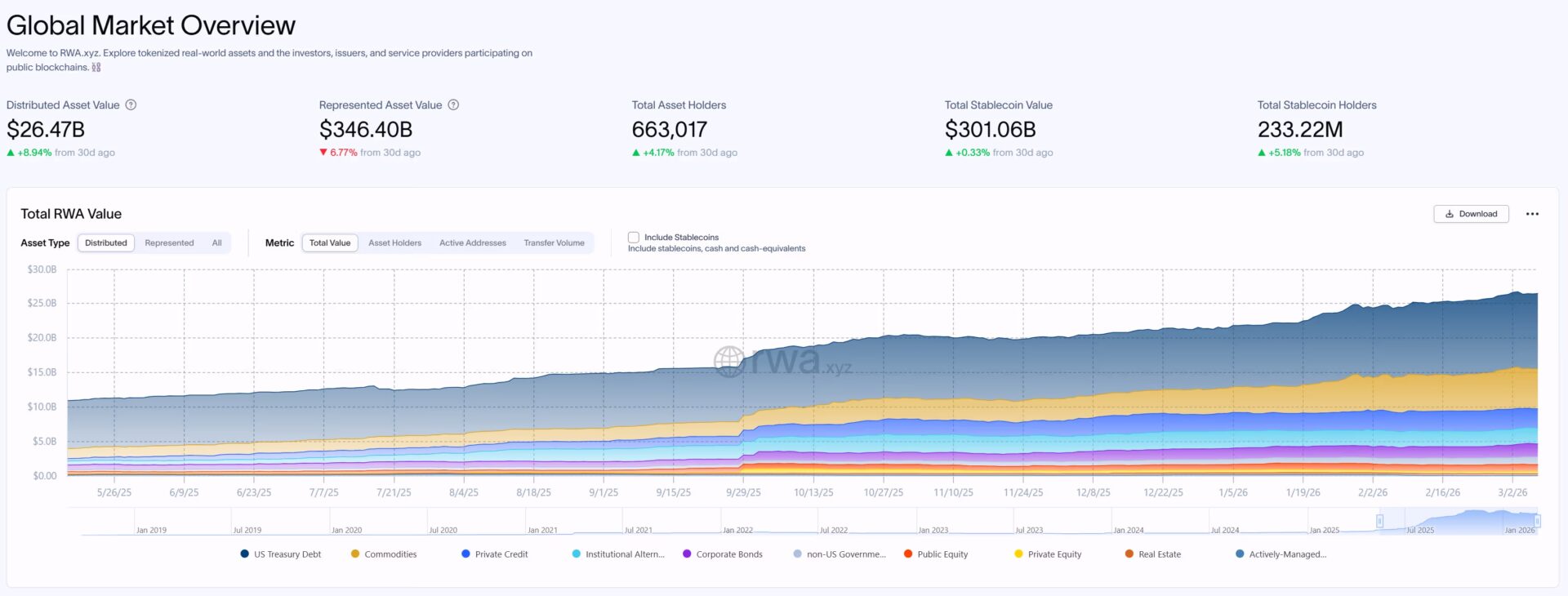
The tokenization of Real-World Assets (RWAs) is rapidly transitioning from a nascent experimental phase to a cornerstone of mainstream finance. Recent data reveals an astounding surge: excluding stablecoins, the tokenized RWA market has soared past the $25 billion mark, a nearly fourfold increase from approximately $6.4 billion just one year ago.
Building on the market’s earlier milestone of surpassing $20 billion, this explosive growth signals a pivotal shift. What was once a landscape dominated by speculative trials is now firmly entering an era characterized by comprehensive deployment of institutional-grade capital.
Over the past year, traditional financial titans have decisively entered the arena. Asset management giants such as BlackRock, Fidelity, and WisdomTree have all launched their own tokenized fund products, underscoring a clear institutional embrace. Concurrently, Nexus Data Labs statistics show that the number of tokenized US Treasury products has expanded significantly, growing from around 35 to over 50 offerings within the same period.
Six Asset Classes Break the Billion-Dollar Barrier On-Chain
As the market undergoes this rapid expansion, an impressive six major categories of tokenized assets have now surpassed the significant $1 billion on-chain valuation threshold, according to rwa.xyz. These include:
- US Treasuries
- Commodities
- Private Credit
- Institutional Alternative Investment Funds
- Corporate Bonds
- Non-US Government Bonds
Despite this impressive growth in overall scale, current on-chain activity predominantly revolves around asset issuance, with actual trading liquidity remaining relatively subdued. Analysis of on-chain transfer data reveals that many substantial RWA transactions typically cluster around the $10 million mark per single transfer. This pattern suggests that institutions are primarily conducting “batch transfers” for strategic asset allocation, rather than engaging in continuous, high-frequency market trading.
This observation is further corroborated by a February report from tokenization platform Brickken. Their survey indicated that a striking 53.8% of tokenized asset issuers prioritize enhancing “capital formation capabilities and fundraising efficiency” as their primary motivation for tokenizing assets. In stark contrast, only 15.4% cited improved “asset liquidity” as their main driver.
Essentially, the market’s current focus remains squarely on the “how” of bringing assets onto the blockchain, rather than optimizing their trading dynamics once on-chain. Even with successful tokenization, the vast majority of these real-world assets have yet to truly integrate into the broader DeFi ecosystem.
The Uncharted Waters: Bridging RWAs to DeFi
The journey from on-chain presence to full DeFi integration remains largely incomplete. Nexus Data Labs estimates that while approximately $8.49 billion in stablecoin supply is backed by RWAs, only a mere $1 billion (roughly 11.8%) is actively deployed and operational within DeFi protocols.
The significant remainder—around 88% of these assets—currently operates outside the vibrant on-chain lending and trading systems. This disconnect largely stems from the inherent compliance requirements tied to these underlying assets, which often include stringent KYC (Know Your Customer) verifications, transfer restrictions, and strict whitelisting mechanisms.
As the tokenization market continues its rapid expansion, the industry faces a critical juncture: What ultimate financial form will these assets assume? Market projections suggest that if the current growth trajectory persists, the RWA tokenization market could potentially skyrocket to over $400 billion by the end of this year.
The decisive factor for the future will be whether these assets remain confined within “permissioned” closed silos, or if they can genuinely integrate into DeFi’s “composable financial system.” The answer to this fundamental question will determine if asset tokenization merely serves as a “parallel settlement layer” for the traditional financial system, or if it truly breaks free to profoundly reshape the global financial landscape as we know it.
Disclaimer: This article is intended for market information purposes only. All content and views expressed herein are for reference only and do not constitute investment advice. They do not represent the opinions or positions of BlockTempo. Investors are advised to make their own investment decisions and conduct their own transactions. The author and BlockTempo shall not be held responsible for any direct or indirect losses incurred by investors as a result of their transactions.