Author: Frank, PANews
For some time, the most vibrant discussion in tech and startup circles wasn’t about a new model launch from a major corporation, but rather the widespread phenomenon of “lobster farming” – a popular euphemism for engaging with OpenClaw.
On one hand, this “lobster farming” craze has significantly boosted related industries, with large language model providers and cloud server companies reaping substantial profits. On the other hand, the actual, tangible benefits OpenClaw delivers to individual users remain shrouded in mystery. While social media abounds with success stories, a closer examination often reveals them to be largely fabricated narratives designed to attract traffic.
So, is “lobster farming” truly profitable? And if so, who are the real beneficiaries?
PANews has meticulously compiled data from the TrustMRR data platform, public social media cases, project official websites, and cross-verified reports. To differentiate “verified real income” from “self-proclaimed online myths,” we have rigorously filtered out numerous claims based solely on unilateral statements or lacking verifiable evidence.
The OpenClaw category page on the startup data platform TrustMRR lists 153 documented projects within this ecosystem, collectively generating approximately $358,600 in revenue over the past 30 days. Further analysis of the top 30 projects reveals they account for a staggering 97.3% of this total. When we deconstruct these projects and their underlying monetization strategies along the “industry value chain,” a striking truth emerges: the initial wave of profitability isn’t being captured by those building products with OpenClaw, but by those who facilitate its setup, teach others how to use it, and individuals leveraging hype for meme coins.
However, this initial insight doesn’t fully answer our central question: how are those genuinely *using* OpenClaw actually generating income? To address this, PANews has identified 5 distinct monetization strategies within the OpenClaw ecosystem.
1. The “Pick-and-Shovel” Playbook: Monetizing the Knowledge Gap
Surprisingly, the most discussed and highest-earning OpenClaw products are rarely specific applications. Instead, they are often packaging tools and one-click hosting services.
OpenClaw functions more as an infrastructure layer than a ready-to-use consumer product, presenting a significant barrier for non-technical users. Where complexity exists, a market for simplification inevitably arises.
Within TrustMRR’s top ~ $350,000 in sample revenue over 30 days, “managed deployment” and “one-click cloud hosting” projects alone contributed approximately $120,100, representing 34.5% of the total sample income.

A prime example is QuickClaw, which encapsulates OpenClaw’s underlying capabilities into a mobile app, priced at $3.99/week or $49.99/year, generating around $8,782 in the past 30 days.
In the Chinese-speaking community, this strategy manifests in a more grassroots form: “lobster installation services” advertised on platforms like Xianyu.
Media reports indicate an explosive growth in “OpenClaw proxy deployment” services on Xianyu and Xiaohongshu. Remote installations typically cost 100-300 RMB, while on-site services range from 400-1000 RMB. During one period, daily transaction volume for these services surged by 150% quarter-over-quarter.
The essence of this monetization strategy lies in capitalizing on “information and cognitive gaps.” Users are willing to pay to avoid 30 minutes of setup hassle. However, this is a “window of opportunity” business; as official one-click deployment tools mature, the profitability of basic installation services is expected to rapidly diminish.
2. The AI Expert Persona: When the Narrative Becomes the Premium Product
Ascending the value chain, another, more lucrative layer emerges within the OpenClaw ecosystem: not merely deploying the system, but expertly fine-tuning the Agent. Among TrustMRR’s top 30 projects, those related to templates, skill packs, and configurations collectively contributed 26.4% of the revenue.
One of the most credible and comprehensively documented business cases in this category is FelixCraft.
In early 2026, creator Nat Eliason initiated an experiment. He named his OpenClaw robot “Felix,” provided it with $1,000 in seed capital, and empowered it to autonomously build a business. Within a week, Felix generated approximately $3,500 in revenue via Stripe. Furthermore, the crypto community launched a dedicated MEME token for this Agent on-chain, directing 60% of daily transaction fees to it, which allowed Felix to accrue up to $100,000 worth of crypto tokens within the same week.
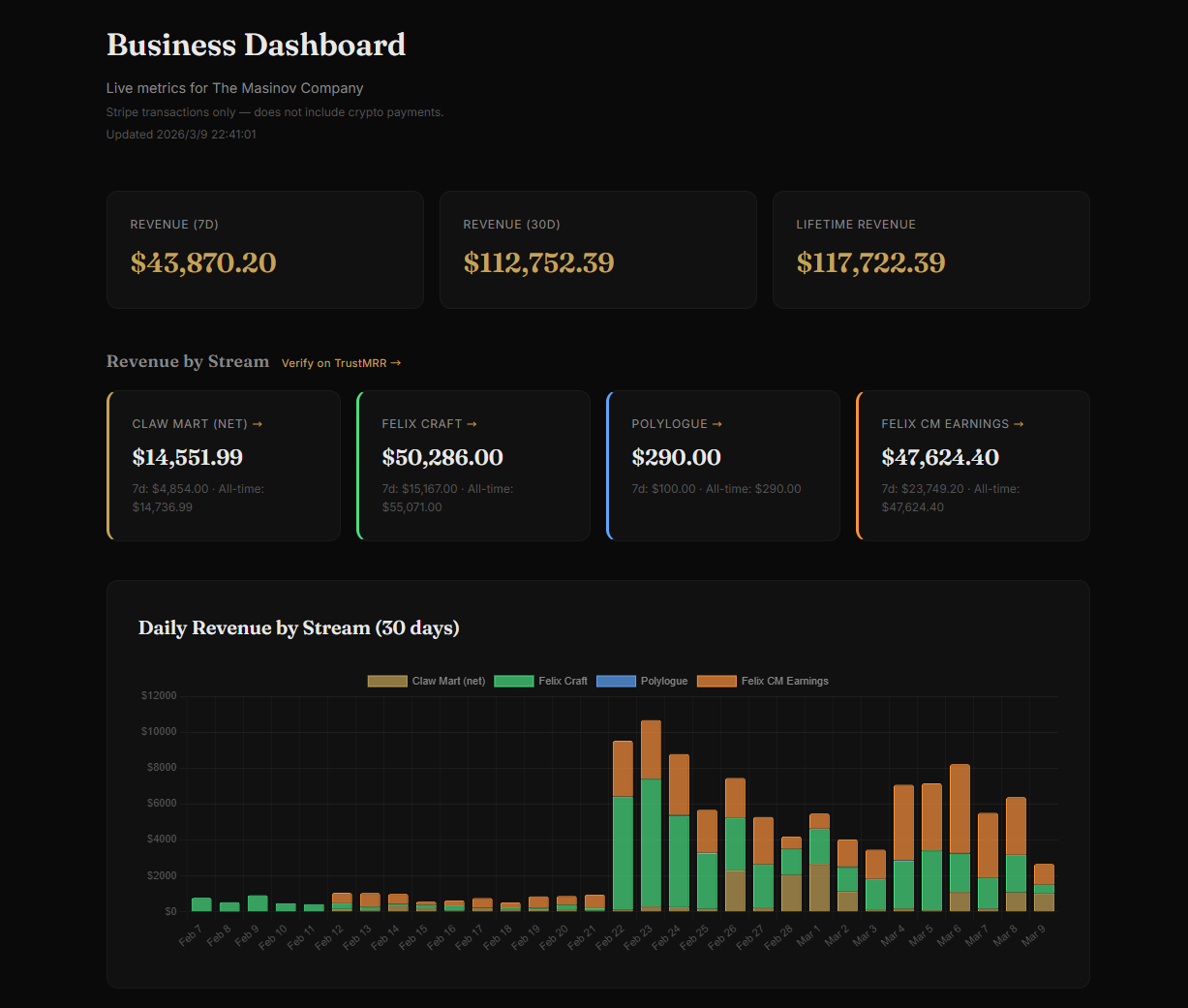
As a pivotal case study, Felix’s success is characterized by several key factors. First, Nat Eliason granted the AI substantial autonomy, enabling the Agent to independently post on Twitter, retweet comments, and engage with the community. Second, Eliason invested significant time prior to launch in meticulously constructing the Agent’s framework, including its memory modules, security settings, and workflow design.
Nat Eliason himself confessed in a podcast interview that Felix’s profitability was somewhat unexpected. Fundamentally, Felix’s primary revenue stream stemmed from packaging and selling the process and results of its own fine-tuning as a product. The meme coin earnings, however, were largely a serendipitous byproduct of the immense buzz and traffic generated by its compelling story.
Notably, Claw Mart, an Agent Skill marketplace and the top-earning project in TrustMRR’s OpenClaw category, was actually created by the Felix Agent itself, with cumulative earnings now exceeding $71,300. A crucial reason for this remarkable success is that the narrative of Felix – an Agent capable of autonomously creating projects and automating work – serves as the product’s most powerful endorsement.

Felix’s triumph illuminates an advanced pathway for OpenClaw commercialization: imbuing Agents with a persistent identity. When OpenClaw is packaged with a specific name (Felix), a marketable guide, a reusable set of skills, and a captivating narrative of “AI entrepreneurship,” it transforms into a potent new personal brand with explosive viral potential. However, the core challenge of this approach lies not in the AI itself, but in Nat Eliason’s exceptional Agent fine-tuning expertise and strategic brand marketing vision.
3. The Efficiency Myth: Leveraging AI for Work, Monetizing the Story
Among all potential income streams, perhaps the most widely accepted pathway is the idea that by replacing human labor with OpenClaw, the resulting savings directly translate into profit.
In the realm of content operations, this has become a tangible reality. Developer Oliver Henry named his Agent “Larry,” entrusting it with full responsibility for his TikTok account. Larry autonomously leverages large language models to generate images, write titles, and upload drafts. Henry’s daily involvement is limited to just 60 seconds, selecting background music and clicking “publish.”
Oliver Henry reported that Agent Larry helped his videos surpass 500,000 views in just five days, generating $588 in revenue (derived from paid revenue of two recommended applications within his videos). Furthermore, Larry generated an additional $4,000 through the issuance of meme coins. Interestingly, Oliver Henry’s tweet recounting this story has accumulated over 7.1 million views, mirroring the Felix case: the compelling narrative itself often holds greater commercial value than the Agent’s raw output.

Fu Sheng, founder of Cheetah Mobile, assembled a team of 8 Agents named “Sanwan.” This team revolutionized his official WeChat account, shifting from a dozen articles annually to daily updates, and achieving a record-breaking 1 million+ reads for the Bosheng account, garnering significant public attention. The viral tweet that garnered millions of views, once again, was a story about how these Agents operate.
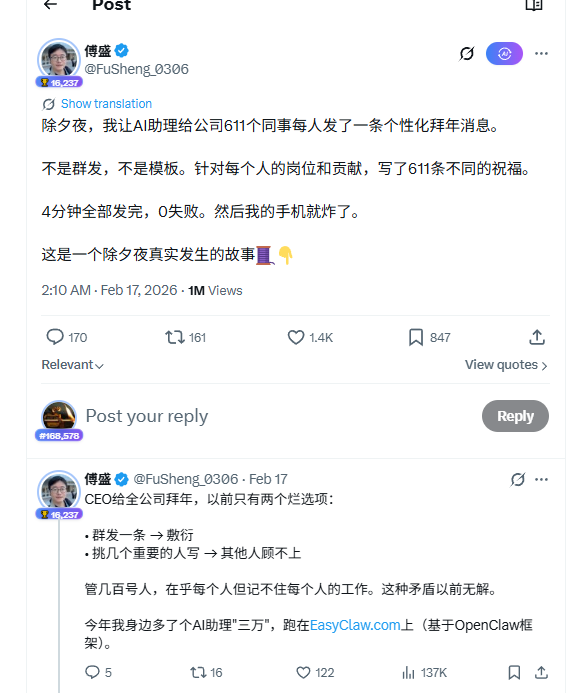
This suggests that in content production, the ability of an Agent’s *own* generated content to achieve viral success remains largely unproven. Instead, the viral phenomena observed thus far are predominantly stories about Agents making money or dramatically improving work efficiency. The act of telling the “OpenClaw story” is currently the most significant focal point in the domain of content creation.
4. Deep Industry Customization: Beyond Tools, Earning Service Premiums
If proxy installation services capitalize on a “barrier to entry,” then extending this to package OpenClaw as a product tailored to personalized needs represents an entirely different proposition.
RoofClaw stands as a prime example of such projects. TrustMRR data indicates its revenue for the past 30 days was approximately $49,800, with cumulative earnings reaching $1.8 million. RoofClaw positions itself as offering “personalized customization and delivery of MacBook Airs equipped with the OpenClaw system.” This business model transcends simple pre-installation; it involves encapsulating OpenClaw within a MacBook and providing bespoke services to fine-tune the “lobster” into an Agent precisely aligned with the client’s specific requirements.
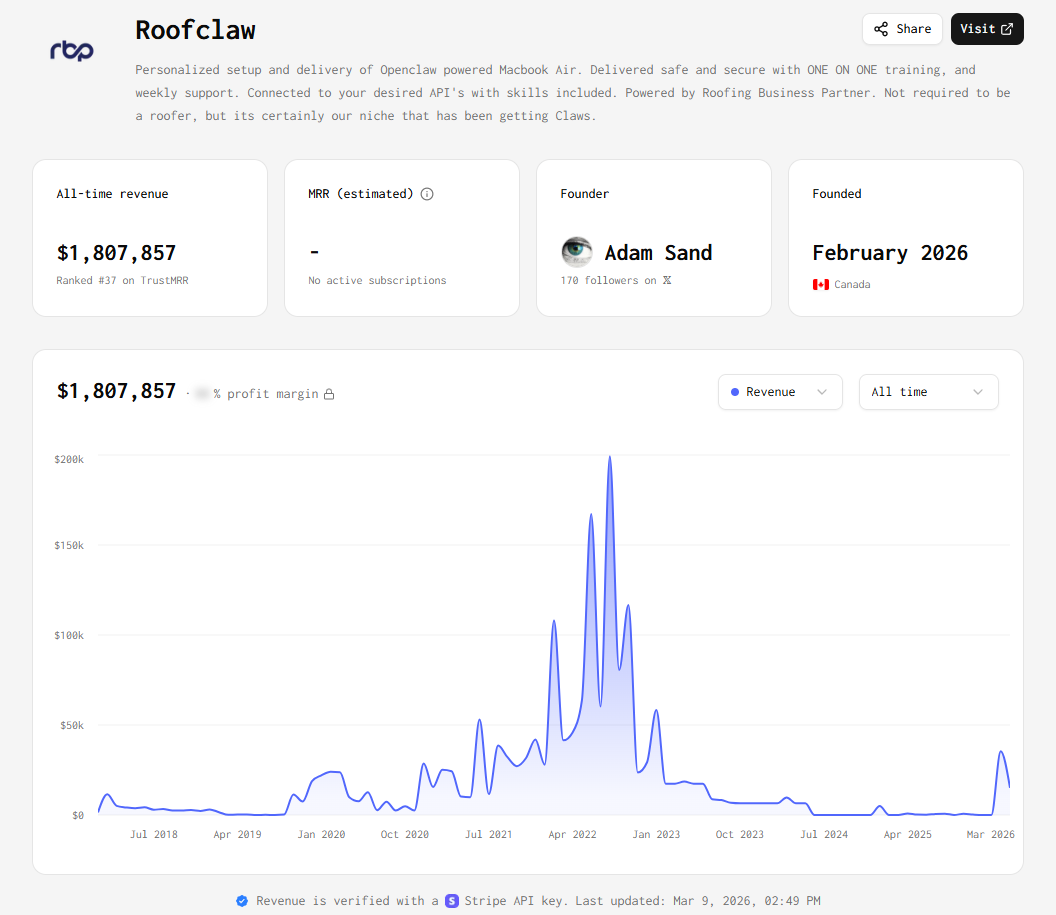
This type of service likely taps into the true future commercial demand for OpenClaw. Users’ ultimate need may not be a merely “functional” OpenClaw, but rather a sophisticated Agent meticulously fine-tuned to their unique operational demands. Underlying this demand is the sale of comprehensive, in-depth services for Agent customization and optimization.
To put it plainly, we can anticipate a future where numerous companies will rely heavily on AI Agents. Consequently, the expertise required to effectively fine-tune or “train” these Agents will become an indispensable and high-demand service.
5. On-Chain Trading Legends: The Allure of the Poisoned Apple
On social media, the most potent OpenClaw narratives are invariably those promising instant wealth and overnight riches.
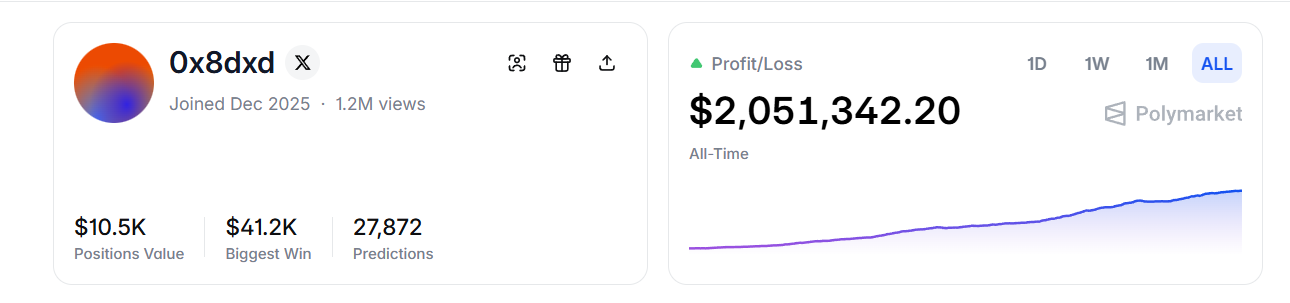
Currently, one of the few cases verifiable via on-chain data is account 0x8dxd on the prediction market Polymarket, which functions as a high-frequency trading bot. While social media is rife with posts speculating that this account leverages OpenClaw for its high-frequency trading prowess, PANews’ analysis reveals that the actual controller behind this address has never made such claims. These narratives, proclaiming “OpenClaw helped me design an automated trading program and earn $100,000 monthly,” are predominantly advertorials, primarily designed to promote their own automated trading programs for single-bot monthly earnings.
This case is highlighted as a crucial cautionary note. As PANews’ previous research consistently indicates, AI Agents and high-frequency trading bots are fundamentally distinct entities. People are frequently misled and captivated by the mystique and speculative fantasies surrounding both.
The Ultimate Insight: Those Who Teach You to Earn Are the Unbeatable Winners
After a comprehensive dissection of the entire OpenClaw ecosystem, we’ve uncovered a phenomenon more profound than any single case: the act of sharing “how much money I made with OpenClaw” on social media is, in itself, the most robust and consistently profitable business model.

When a post like “I made $50,000 monthly with OpenClaw” goes viral, the resulting traffic becomes an irresistible lure. The author then seamlessly funnels these captivated viewers into paid communities, consulting services, or direct product purchase links. “Income bragging” serves as the apex of the customer acquisition funnel, and the “myth of easy money” proves to be the most potent marketing material. This creates a self-perpetuating cycle: selling success stories leads to traffic, traffic is monetized, and then the author, now positioned as a mentor, shares “gold-mining secrets” to leverage even greater gains.
Essentially, OpenClaw has indeed catalyzed a new commercial value chain: the foundational layer consists of installation services and infrastructure; the middle layer involves skill packs and workflow automation; and the top layer comprises specialized industry solutions and high-value consulting services. For individuals with a strong grasp of business, marketing acumen, and an existing audience, OpenClaw can dramatically reduce operational costs and amplify output.
While many are sharing how OpenClaw has optimized workflows and enabled convenient features, it is far from a magical key to instant wealth. The “herd effect” it triggers is the true core of this traffic-driven narrative. When you desperately push through the crowd to reach the front, you might discover nothing there, realizing that you, the eager seeker, were the one being anticipated and exploited.
(PS: This article was not created using “OpenClaw.”)
(The above content is excerpted and reprinted with authorization from partner PANews, original link)
Disclaimer: This article provides market information only. All content and views are for reference only and do not constitute investment advice, nor do they represent Blockcast’s views and positions. Investors should make their own decisions and trades. The author and Blockcast will not be liable for any direct or indirect losses incurred by investors’ transactions.