
Post-Shutdown Jitters: Why Crypto and Stocks Dipped Despite US Government Reopening
After a protracted 43-day hiatus, the United States government finally resumed operations yesterday. However, contrary to widespread expectations of a market surge, both US equities and the cryptocurrency market experienced notable pullbacks. Bitcoin, in particular, saw its price dip below the $100,000 mark again in the evening, leaving many investors bewildered.
Understanding the Market’s Counter-Intuitive Reaction
As previously suggested, the immediate reopening of government services does not equate to an instantaneous flood of liquidity into the markets. A crucial buffer period, typically lasting at least a week, is required for capital flows to normalize. This delay often results in a classic “buy the rumor, sell the news” scenario, which appears to be precisely what unfolded today, as initial optimism gave way to profit-taking and cautious re-evaluation.
The Shadow of Fed Uncertainty and Economic Data
Beyond the expected post-event profit-taking, several negative undercurrents are influencing market sentiment. Recent public statements from various Federal Reserve governors have cast doubt on the certainty of a December interest rate cut. Consequently, prediction markets have recalibrated, showing a decreased probability for such a move. This shift in expectations is a significant contributing factor to the observed downturn in both stock and crypto markets.
Adding to these concerns is the looming uncertainty surrounding key economic data, which remained unreleased during the government shutdown. With the Trump administration repeatedly emphasizing the shutdown’s detrimental impact on the economy, investors are apprehensive that forthcoming data could be disappointing, potentially influencing the Fed’s December policy decisions and overall market stability.
Is History Repeating? Bitcoin’s Performance vs. Nasdaq
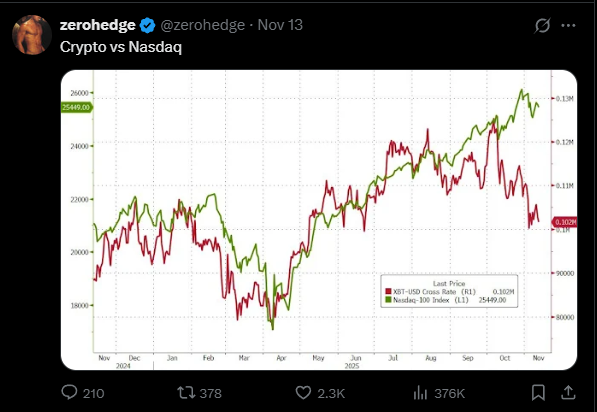
A widely circulated chart, shared by the influential blog Zerohedge, has ignited considerable debate online. The chart visually compares the Nasdaq index (green line) with Bitcoin’s price performance (red line). It clearly illustrates that Bitcoin has been underperforming the Nasdaq over the past two months.
The core of the discussion revolves around the striking resemblance of this trend to a critical period in Bitcoin’s history. In November 2021, Bitcoin reached its then-all-time high of $69,000. Subsequently, it began to lag behind the Nasdaq, which eventually also started its descent, ultimately dragging Bitcoin down to approximately $20,000. The pertinent question now echoing through the investment community is: will history repeat itself?
Disclaimer: This article is intended solely to provide market information. All content and views are for reference only and do not constitute investment advice. They do not represent the views and positions of BlockTempo. Investors should make their own decisions and conduct their own transactions. The author and BlockTempo will not assume any responsibility for direct or indirect losses incurred by investors’ transactions.