Former TPP Chairman Ko Wen-je Sentenced to 17 Years in Jinghua City Case: A Landmark First-Instance Verdict
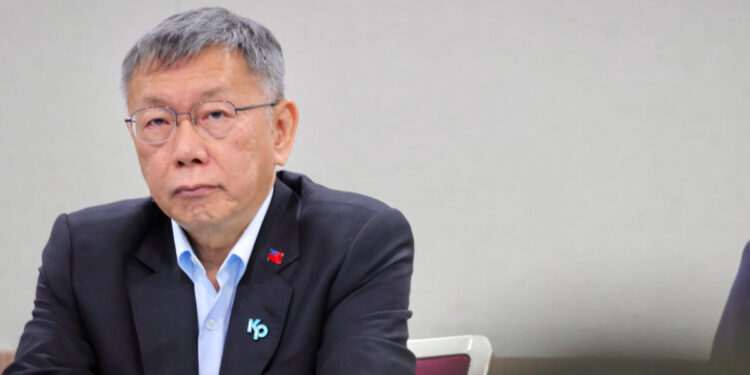
In a significant legal development, former Taiwan People’s Party (TPP) Chairman Ko Wen-je has been sentenced to a combined 17 years in prison and stripped of his civil rights for six years. The Taipei District Court delivered its first-instance verdict today, finding Ko guilty on four charges across three cases, including the high-profile Jinghua City corruption scandal and a political donations case. The ruling, reported by PTS News, is subject to appeal.
Key Defendants Receive First-Instance Sentences
The court also handed down verdicts for other prominent figures involved in the cases:
- Wei-Chuan Group Chairman Shen Ching-ching was sentenced to 10 years in prison.
- Taipei City Councilor Ying Hsiao-wei received a sentence of 15 years and 6 months.
- Former Deputy Mayor Peng Chen-sheng was sentenced to 2 years, with a 3-year probation.
- Former Director of Taipei City’s Department of Urban Development, Huang Jing-mao, was sentenced to 6 years and 6 months.
- Former Chief Engineer of the Department of Urban Development, Shao Hsiu-pei, received a sentence of 1 year and 3 months, with a 3-year probation.
In the political donations case, former Chief Financial Officer Li Wen-tsung was sentenced to 4 years and 6 months, Muko Company负责人 Li Wen-juan to 2 years and 4 months, and accountant Duanmu Zheng to 1 year.
TPP Chairman Huang Kuo-chang Responds to Verdict
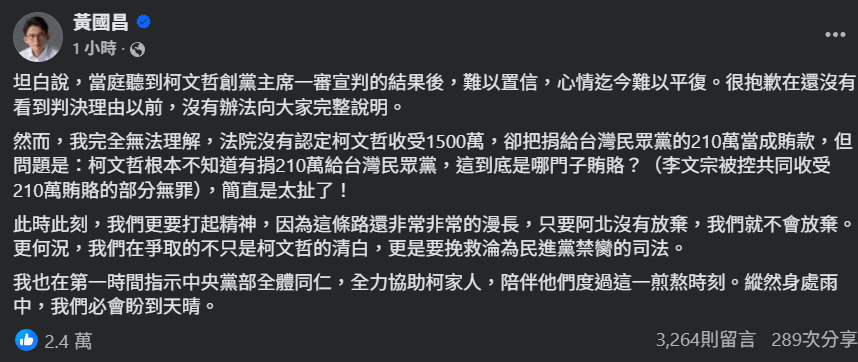
Current TPP Chairman Huang Kuo-chang expressed his profound shock and disbelief following the announcement. Responding to the verdict, he stated:
“Upon hearing the first-instance verdict for founding chairman Ko Wen-je in court, it’s hard to believe, and my mood has not yet recovered. I apologize that I cannot fully explain it to everyone before seeing the reasons for the judgment.”
Timeline and Political Implications: 2028 Presidential Bid Unlikely
The implications of this verdict extend significantly to Ko Wen-je’s political future, particularly regarding the 2028 presidential election. A look back at the case’s timeline reveals its rapid progression:
- May 2024: The Taipei District Prosecutor’s Office initiated an investigation into the Jinghua City case.
- August 2024: Ko Wen-je’s residence was searched.
- September 2024: Ko Wen-je was ordered into detention and barred from contact.
- December 2024: The Taipei District Prosecutor’s Office indicted Ko, seeking a sentence of 28 years and 6 months.
- September 2025: After approximately one year in detention, Ko Wen-je was released on bail.
Prosecutors had initially accused Ko of four crimes, including illicit gains and bribery in the Jinghua City case, alongside embezzlement and breach of trust related to political donations and the Zhongwang Foundation.
According to Taiwan’s Presidential and Vice Presidential Election and Recall Act, individuals who have been sentenced to death, life imprisonment, or a fixed-term imprisonment of ten years or more, and whose judgment has not yet become final, or who have been deprived of civil rights and have not yet been reinstated, are ineligible to register as presidential candidates.
This means that following the first-instance sentencing of 17 years, even if the case remains subject to appeal, Ko Wen-je is legally barred from running in the 2028 presidential election.
Dispelling Cryptocurrency Rumors: Indictment Omissions and Court Findings
During the initial investigation into Ko Wen-je’s case, widespread rumors circulated, particularly concerning allegations that his USB drive contained cryptocurrency.
Previous reports highlighted how certain commentators and media outlets frequently speculated that Ko’s USB might be a cold wallet. Some even claimed that an Excel entry labeled “Xiao Shen 1500” represented 1,500 Bitcoin, while others on political talk shows comically suggested that PowerPoint itself was a “virtual currency,” leading to significant online discussion and ridicule.
However, an analysis by CryptoCity of the indictment and press release issued by the Taipei District Prosecutor’s Office at the end of 2024 revealed a stark absence of any mention of virtual currency, cold wallets, or Bitcoin.
The indictment explicitly stated that the “1500” mark found in an Excel file on Ko Wen-je’s external hard drive was identified as a record of receiving NT$15 million in cash bribes from Shen Ching-ching, with no connection whatsoever to cryptocurrency.
Nevertheless, in today’s court proceedings, the court ultimately found Ko Wen-je guilty of receiving only NT$2.1 million from Shen Ching-ching. The “Xiao Shen 1500” portion of the charge was acquitted. While the workbook file was indeed created by Ko Wen-je and “Xiao Shen” was confirmed to be Shen Ching-ching, the court determined there was insufficient strong evidence to conclusively prove the actual receipt of NT$15 million in bribes by both parties.
(The above content is excerpted and reproduced with authorization from our partner ‘CryptoCity’. Original link)
Disclaimer: This article is for market information purposes only. All content and views are for reference only and do not constitute investment advice, nor do they represent the views and positions of BlockTempo. Investors should make their own decisions and trades. The author and BlockTempo will not bear any responsibility for direct or indirect losses incurred by investors’ transactions.