
From Novice to Elite: A Trader’s Definitive Roadmap to Top-Tier Success
By Koroush AK, Crypto Trader
Compiled by Felix, PANews
Every aspiring trader dreams of reaching the pinnacle of success. But how does one truly evolve from a beginner to a top-tier performer in the high-stakes world of cryptocurrency trading? Renowned crypto trader Koroush AK recently unveiled a comprehensive progression framework, distilling years of experience into a practical system that addresses the critical elements of strategy, risk management, and mindset.
This isn’t the generic advice you’ll find from most online gurus. This is the roadmap Koroush AK wished he had nine years ago when he first started trading. It’s a step-by-step guide designed to illuminate each stage of a trader’s journey, helping you pinpoint your current position, identify the bottlenecks holding you back, and understand precisely what needs to be addressed next.
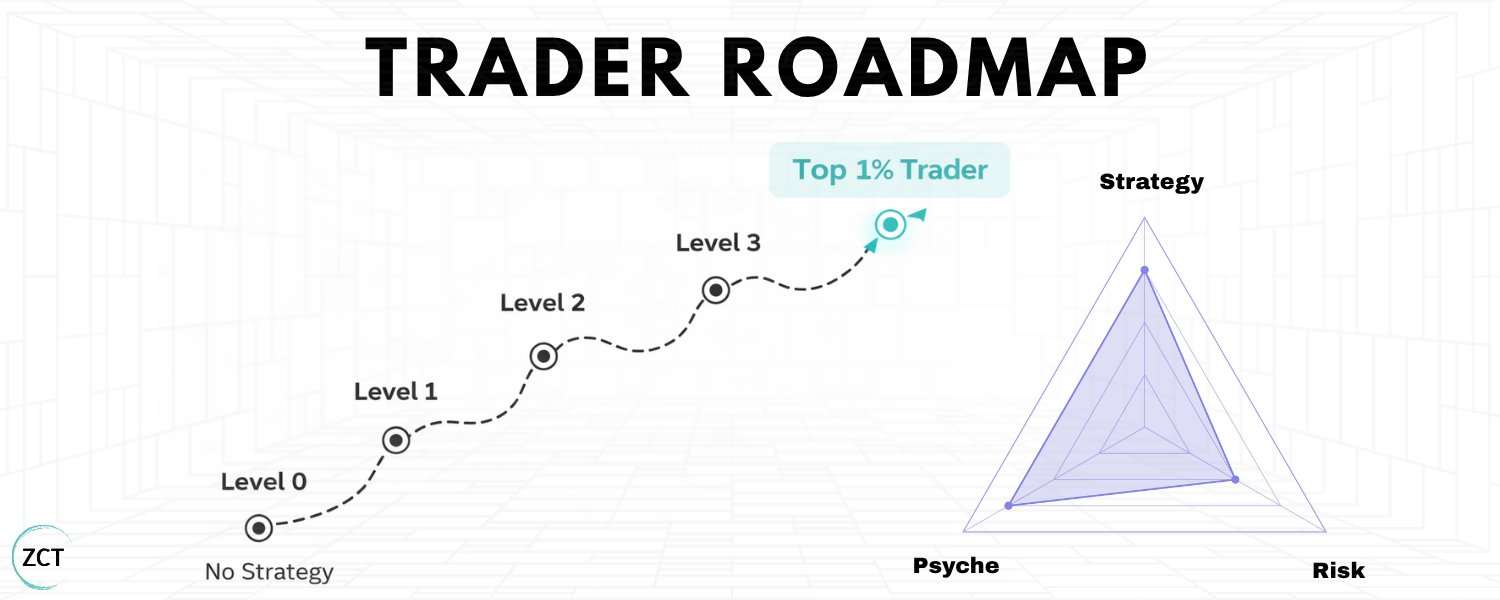
The Three Pillars of Trading Success
If you’re not consistently profitable, your struggles likely stem from one of three areas:
- A strategy that simply isn’t profitable.
- A profitable strategy that you fail to execute under pressure.
- A strategy that isn’t sustainable for long-term gains.
This forms the bedrock of my trading model:
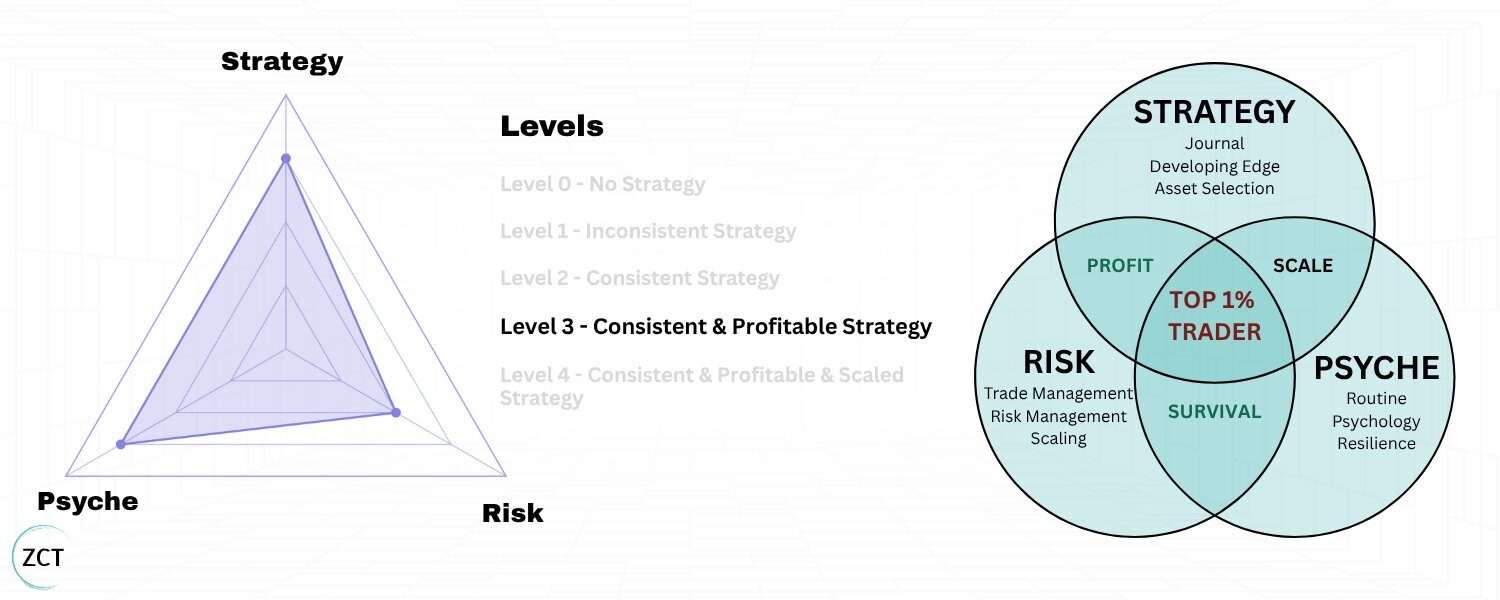
- Strategy: Encompassing your trading journal, edge development, and asset selection.
- Risk: Covering your position sizing, trade management, and scaling.
- Mindset: Pertaining to your psychology, daily habits, and discipline.
When these three pillars intersect, they unlock specific capabilities:
- Strategy + Risk = Profitability
- Strategy + Mindset = Scalability
- Risk + Mindset = Survival
- All Three = Top 1% Trader
At each level of this roadmap, one of these three dimensions will emerge as your primary bottleneck. Ultimately, all trading challenges can be traced back to a fundamental issue in your strategy, risk management, or mindset.
Level 0: No Strategy
This is where every trader begins, and unfortunately, where many remain stuck for longer than they realize.
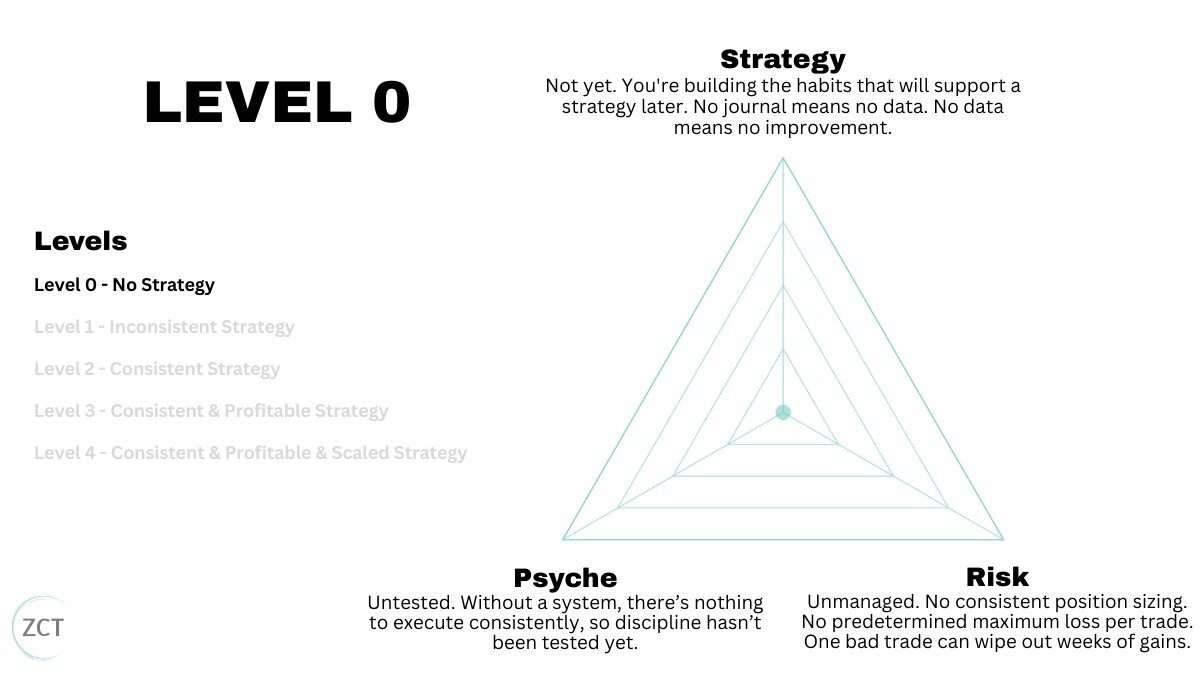
You’re at Level 0 if you:
- Operate without a defined strategy, relying instead on “tips” and “gut feelings.”
- Lack clear, written rules for entry, exit, or stop-loss.
- Maintain no trading journal, screenshots, or data.
- Experience wild portfolio swings (e.g., 1% up today, 10% down tomorrow).
- Attribute profits to skill and losses to bad luck.
Advancing from Level 0 to Level 1:
The objective at Level 0 isn’t to find a strategy. It’s to cultivate three foundational habits: a consistent trading routine, diligent journaling, and unwavering resilience.
Strategy:
Immediately after each trade, start documenting it. Include your entry, exit, trade screenshots, and emotional state.
Note: Your trading journal is the single most crucial tool you possess at any stage of your journey. Without a journal, you have no data… and without data, you can never improve.
Mindset:
Dedicate two hours a day, five days a week, to trading or studying trading, no matter what.
Prioritize adequate sleep, a healthy diet, and regular exercise.
Trading is one of the most challenging games in the world. It will test your mental fortitude before it rewards you financially. If you can’t manage your sleep schedule or consistent meals, your chances of success are virtually zero.
Risk:
- Maximum portfolio size: $100.
Common Mistake: Believing you need to learn everything before you start. You don’t need technical analysis, risk management, or complex strategies yet. You need a trading journal, a daily routine, and the commitment to stick with it.
Your first 30 trades aren’t about making money. They’re about building the foundation upon which everything else will rest.
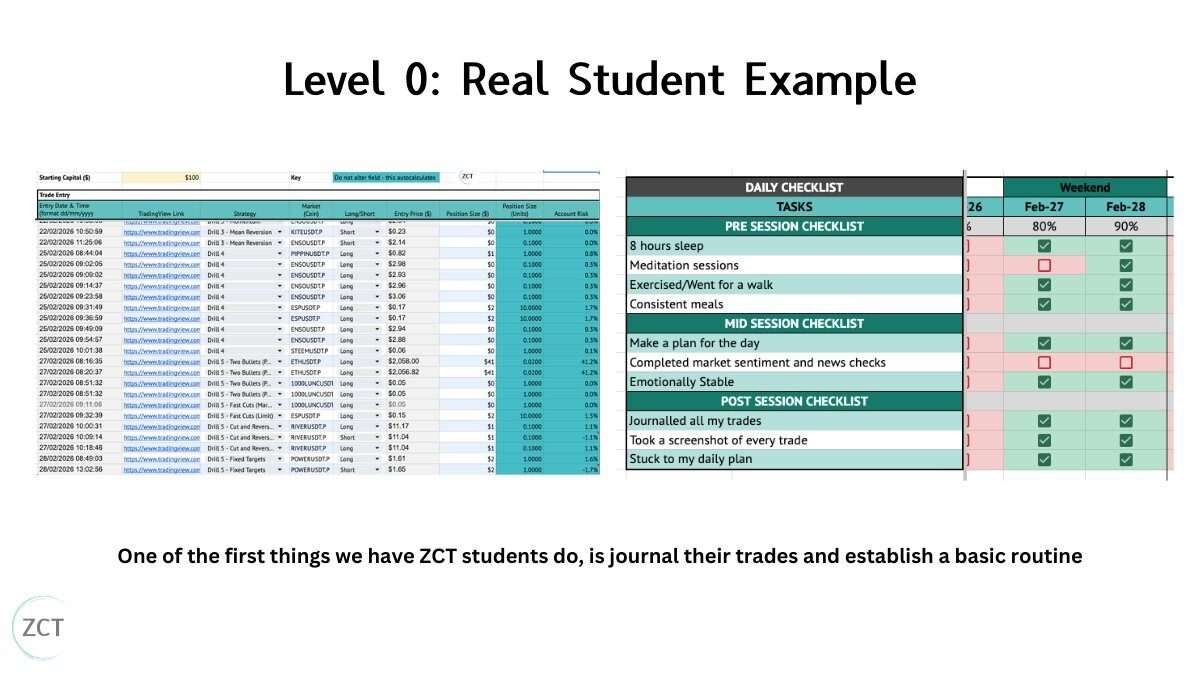
Level 0 Summary:
- Level 0 is not a strategy problem; it’s a structural problem.
- If you lack a fixed routine, a trading journal, and consistency, you’re gambling, even if you’re making money.
- The goal now isn’t to find an edge, but to build the habits that enable continuous improvement.
- Focus: Consistent daily engagement, meticulous trade logging, and maintaining stability.
- Once you’ve logged 30+ trades, you’re ready for Level 1.
Level 1: Inconsistent Strategy
Now that you’ve laid the groundwork, it’s time to develop the skills that form the backbone of a trading strategy.
- Technical analysis provides a framework for interpreting price action.
- Risk management offers a structure for capital preservation.
- Learning trading tools equips you with the infrastructure to execute.
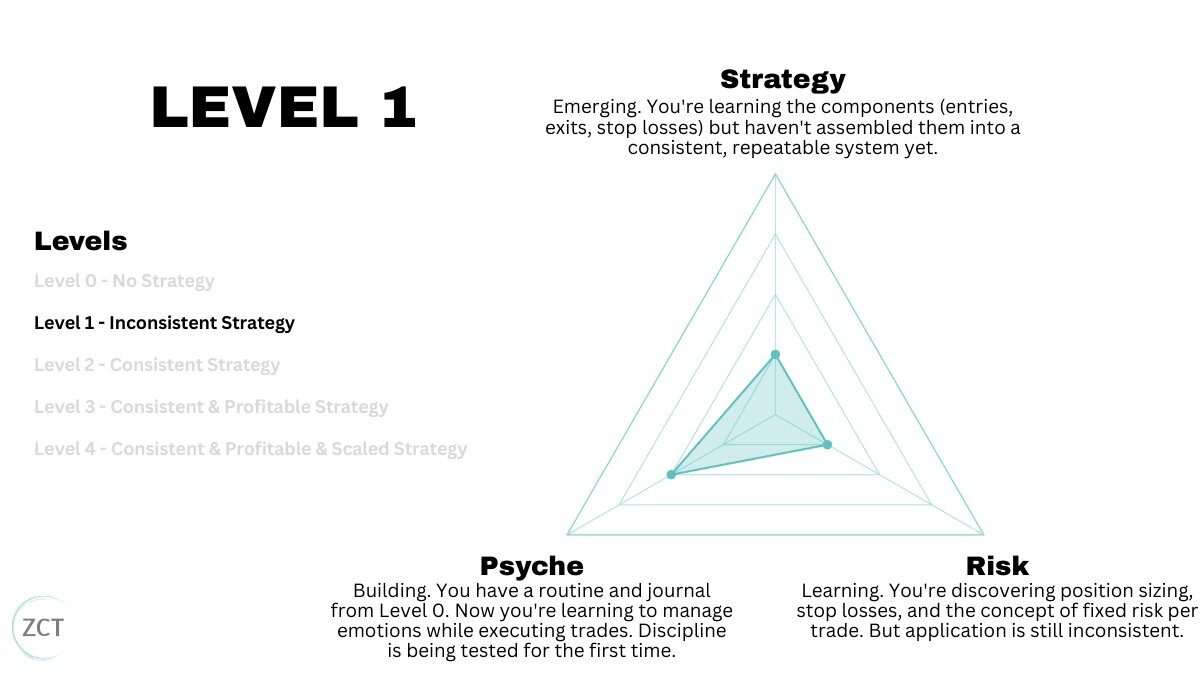
Typical characteristics of Level 1:
- Learning to read charts: support/resistance, candlestick patterns, market structure.
- Setting up your exchange accounts, understanding order types, and securing your funds.
- Beginning to define entry triggers, stop-loss levels, and profit-taking rules.
- Risk per trade is gradually stabilizing but still prone to fluctuations.
- Your trading journal contains data, but execution remains inconsistent.
Advancing from Level 1 to Level 2:
Strategy:
- Learn price action, support/resistance, and volume. I’ve seen traders make over $10,000 a month with just these fundamentals.
- Master your exchange (order types, leverage, trade settings).
- Develop a very basic breakout or reversal strategy. It can be as simple as “I buy the breakout whenever a candle closes above resistance.” (The goal at this stage is consistency, not profitability.)
Risk:
- Maximum portfolio size: $1,000.
You don’t need more capital until you can prove profitability. Set a fixed risk per trade. 1% of your account is a solid starting point. Calculate your position size before every trade: Position Size = Max Risk ÷ (Entry Price – Stop Price).
Mindset:
No new focus. Maintain the habits and journaling started in Level 0.
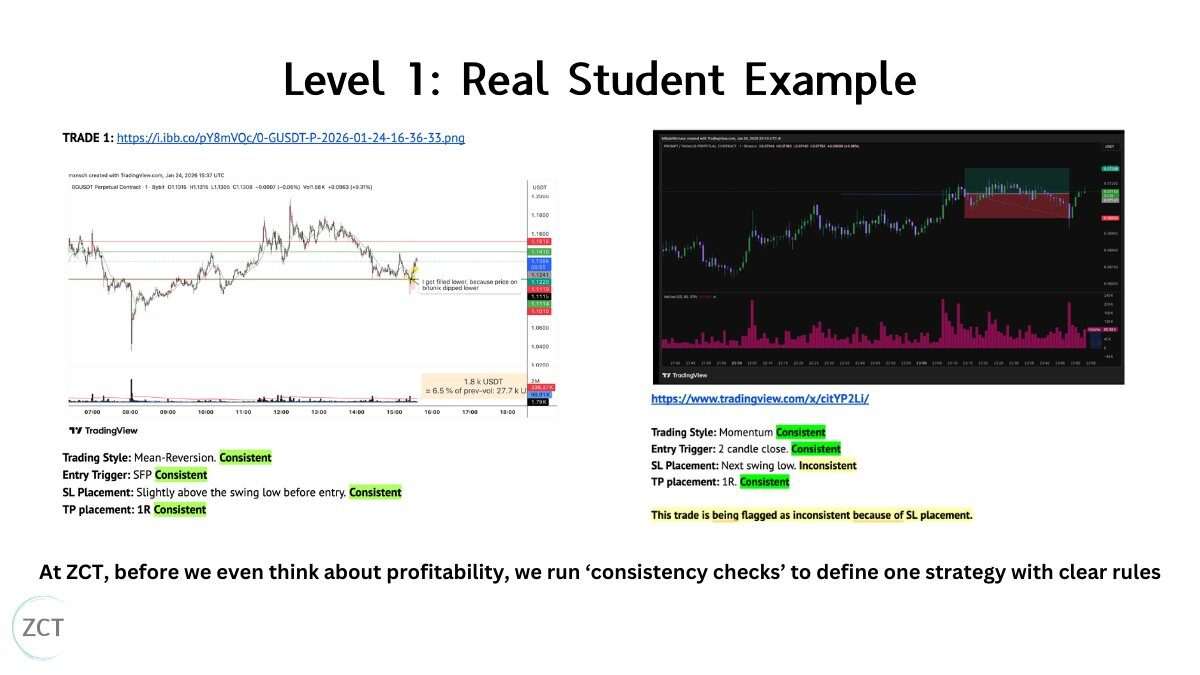
Level 1 Summary:
- Level 1 is where you build your first strategy, but it’s not yet consistent.
- Most traders get stuck here by jumping between strategies instead of refining one.
- The goal is not profitability, but understanding how the market moves and how your system operates.
- Focus: A single strategy, fixed risk, and consistent execution.
- Once your rules are clear and repeatable, you’re ready for Level 2.
Level 2: Stable Strategy
You’ve established your rules, and you’re adhering to them rigorously. This is a stage most traders never reach. Now, you can begin the pursuit of profitability.
[IMAGE-PLACEER-6]
Typical characteristics of Level 2:
- Over 90% of your trades follow your strategy’s rules.
- Every trade is logged with screenshots and notes.
- You have a defined workflow: checklist, scorecard, emotional self-check.
- Your data is clean and reliable.
- You haven’t achieved consistent profitability yet: your equity curve might be flat or slightly negative.
You need to transition from simply following rules to isolating variables and refining them. The improvement process looks like this:
- Losing: Refine ↓
- Less Losing: Refine ↓
- Break-even: Refine ↓
- Slightly Profitable: Refine ↓
- More Profitable
Advancing from Level 2 to Level 3:
Strategy:
- Improve your asset selection. This is the highest leverage improvement you can make. A 10% improvement in asset selection optimizes your entries, stops, and targets simultaneously. A 10% improvement in entry alone only optimizes entries.
- Develop the ability to identify market conditions. Understand which market conditions are favorable for your strategy (Hint: Moving averages are incredibly useful here).
- Understand Expectancy: (Win Rate × Average Profit) – (Loss Rate × Average Loss).
- Learn to analyze your trading journal data. Filter trades into winners and losers. Open all winning screenshots in one tab, all losing screenshots in another, and look for patterns (Hint: Only change one variable at a time). Test over 30 trades and measure the impact, then repeat.
Risk:
No new focus. Just remember your maximum portfolio size remains $1,000.
Mindset:
Continue to maintain your daily habits.
Common Mistake: Changing too many variables at once. Or still chasing perfect entries when asset selection would have a much greater impact. Prioritize changes that yield the biggest returns.
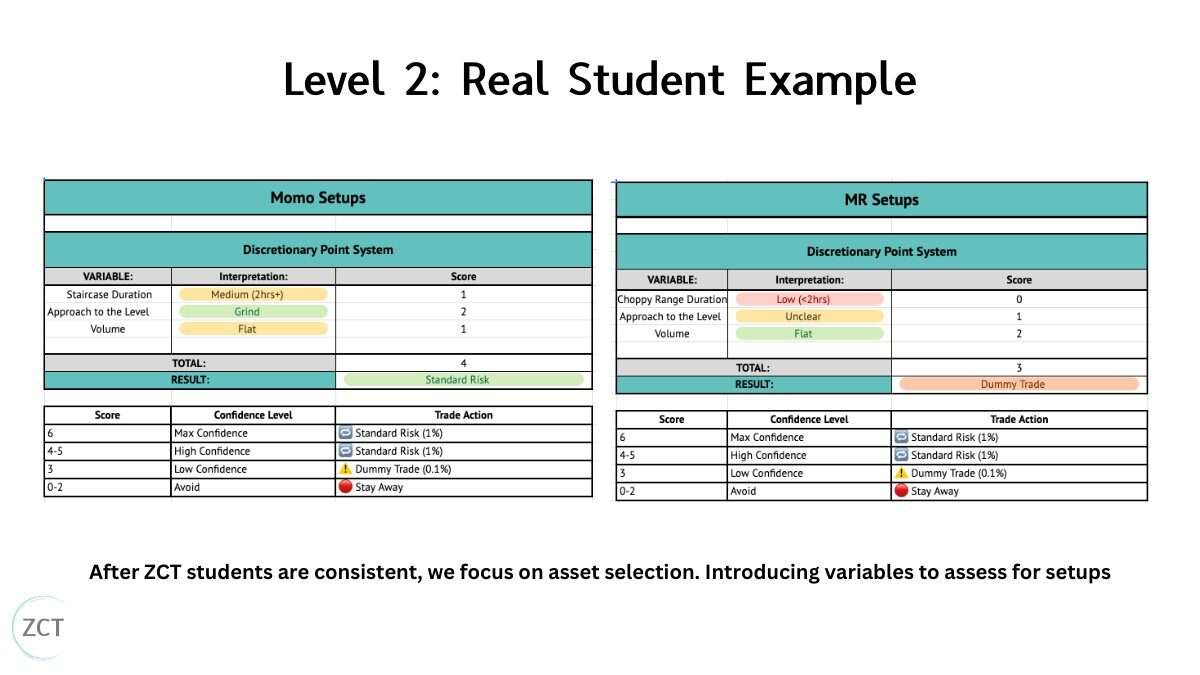
Level 2 Summary:
- Level 2 is all about continuous refinement, where clean data drives progress.
- Most traders stagnate here because they try to change too many variables simultaneously.
- The goal is to iteratively evolve your strategy from break-even to profitable.
- Focus: Analyzing your journal, testing one variable at a time, and improving asset selection.
- Once your expectancy is positive, you’re ready for Level 3.
Level 3: Consistently Profitable Strategy
Congratulations, you’re consistently profitable, placing you among the top 5% of traders. This is a true milestone. Everything you’ve built is working, but only on a small portfolio. The question now is: Can you scale without breaking your strategy?
At Level 2, you learned how to trade. At Level 3, you learn how to deepen your edge and actively manage trades.
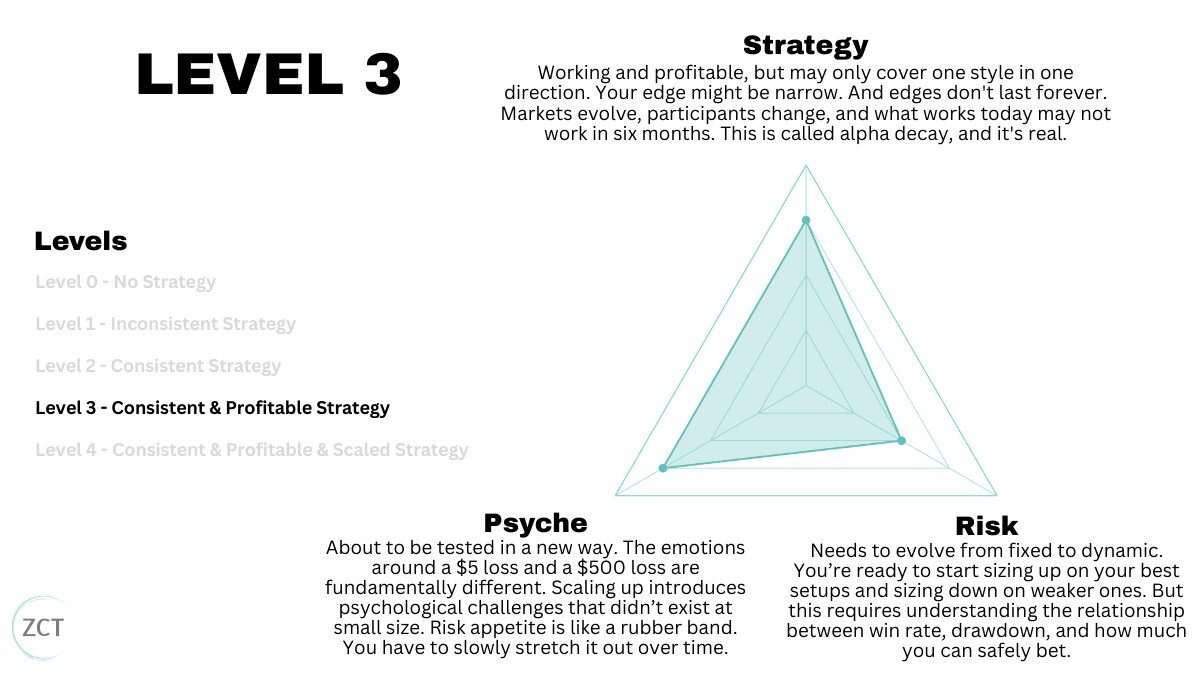
Typical characteristics of Level 3:
- Positive expectancy over 30+ trades.
- An upward-trending equity curve.
- Ability to differentiate between good trade setups and excellent trade setups.
- Beginning to introduce discretionary decisions based on data.
- Profitable, but not yet at a substantial scale.
Why You Might Get Stuck Here:
You need two things to move forward:
- Active Trade Management: Protecting profits and smarter stop-loss placements.
- Continuous Edge Enhancement: Evolving your strategy as market conditions change. Your edge isn’t permanent; alpha decay is real.
Advancing from Level 3 to Level 4:
Strategy:
Expand your repertoire. If you’ve been trading breakouts, learn breakdowns. Then explore reversals. Each new trading style provides you with tools for different conditions and reduces your time spent waiting for setups.
Risk:
Introduce active trade management. Start by logging the candle that made you lose conviction and write down why. Build the identification skill before adding execution action.
Build conviction-based position sizing. Not all setups are equal. Score each setup based on key variables. Your best setups can take higher risk; your worst can take lower risk.
Mindset:
Prepare for the psychological shift that comes with scaling. The emotional experience of losing $5 versus losing $500 is fundamentally different. Scaling introduces challenges that didn’t exist with smaller capital. Risk appetite is like a rubber band; stretch it slowly. The psychological challenge of scaling is one of the hardest parts of trading.
Level 3 Summary:
- Level 3 signifies consistent profitability, but at a smaller trading scale.
- Most traders get stuck because they fail to evolve their edge or actively manage trades.
- The goal is to strengthen your edge and prepare for scaling.
- Focus: Active trade management, expanding your strategy, and building conviction-based position sizing.
- Once your system can withstand pressure, you’re ready for Level 4.
Level 4: Stable, Profitable, and Scaled
You’re now generating a substantial income from trading, whether full-time or part-time.
At Level 4, you’re no longer building the trading machine; you’re maintaining it, upgrading it, and running it at full capacity.
Typical characteristics of Level 4:
- Consistently generating four to five-figure income (or more) monthly.
- Scaled to a significant portfolio size.
- Utilizing multiple strategies across different market environments.
- Execution is fluid and highly automated.
- Maintaining emotional stability under large positions.
- Continuous edge development is a habit, not a project.
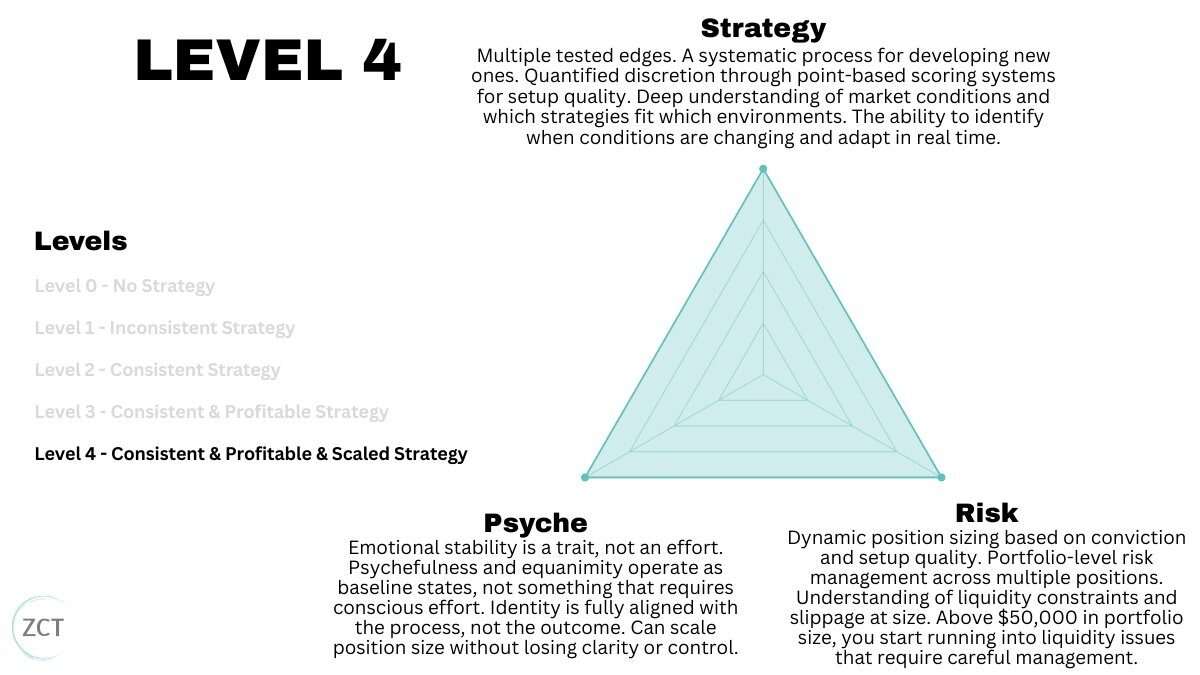
The psychological journey evolves differently at each stage:
- At Level 0, you’re building habits.
- At Level 1, you’re managing emotions for the first time in live trading.
- At Level 2, you’re following rules under moderate stress.
- At Level 3, you’re integrating systems with judgment while staying calm.
- At Level 4, execution becomes incredibly fluid.
Ongoing Challenges:
Markets are dynamic. What works today may not work forever. Your true edge lies in your trading process itself.
The skill of developing an edge is more valuable than any single edge you currently possess.
Key Focus Areas for Level 4 Traders:
- Psychological Mastery: Daily meditation, lifestyle optimization, structured emotional self-checks.
- Systematic Scaling: $1,000 → $2,000 → $5,000 → $10,000+, scaling up only after 30+ trades at each level.
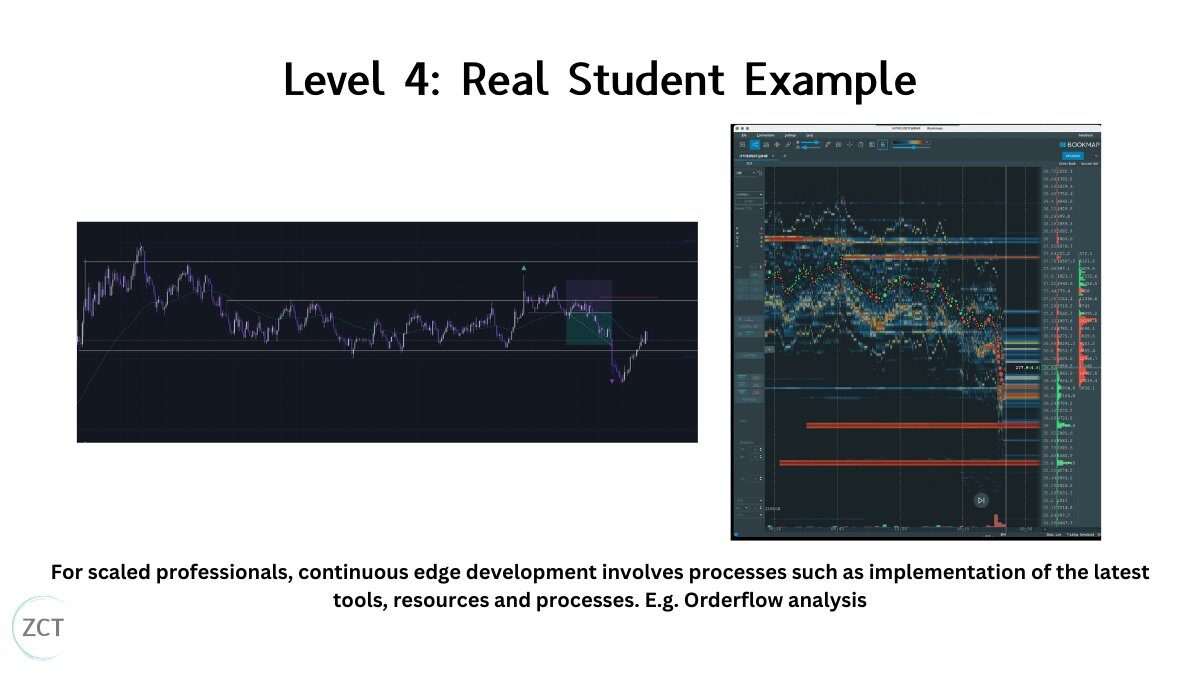
- Continuous Edge Enhancement: Through structured testing.
- Seeking New Edges: Proactively identifying new opportunities.
- Portfolio-Level Risk Management: Across multiple strategies.
- Addressing Liquidity Constraints: As your scale grows.
Level 4 Summary:
- At Level 4, trading becomes a scalable income stream, but the challenges are continuous.
- Most traders fail at this stage due to an inability to adapt to market changes.
- The goal is to maintain and evolve your edge.
- Focus: Continuous testing, disciplined scaling, and portfolio-level risk management.
- Your real edge is your ability to consistently develop new edges.
(The above content is an authorized excerpt and reprint from our partner PANews. Original link)
Disclaimer: This article is for market information purposes only. All content and views are for reference only and do not constitute investment advice. They do not represent the views and positions of BlockTempo. Investors should make their own decisions and trades. The author and BlockTempo will not bear any responsibility for direct or indirect losses incurred by investors’ transactions.