Fed Governor Barr Issues Stark Warning: Stablecoin Regulation Must Go Beyond Legislation
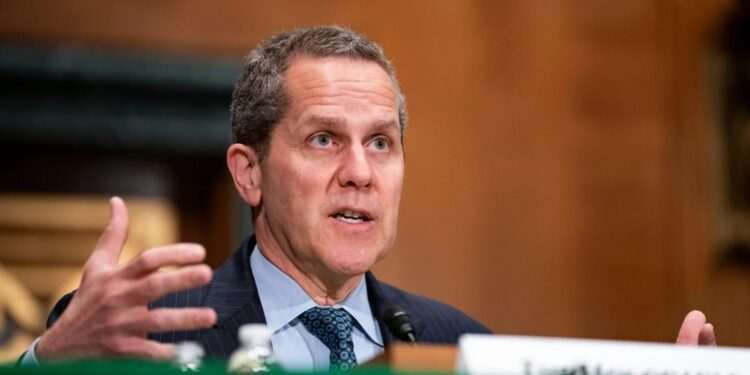
Federal Reserve Governor Michael Barr recently delivered a powerful public address, underscoring a critical message for the rapidly evolving digital asset market: while stablecoins are heralded as essential infrastructure, their inherent stability is precarious without rigorous regulation and robust institutional design. Barr cautioned that failing to move beyond mere legislative frameworks risks repeating historical “private money failures” and unleashing significant financial instability. He highlighted a recurring pattern of market turmoil stemming from inadequate oversight, a fate stablecoins could share if not properly safeguarded.
Barr specifically referenced the GENIUS Act, acknowledging its role in establishing an initial legal foundation for stablecoins. However, he stressed that this act, while a necessary first step, does not inherently resolve the underlying vulnerabilities. The true challenge, Barr asserted, lies not in the legislation itself, but in how regulators translate it into concrete, enforceable rules. Without this crucial implementation, the system remains susceptible to critical loopholes.
The Core Vulnerability: Reserve Assets and Redemption Capacity
At the heart of stablecoin stability, Barr explained, is the unwavering ability to maintain a 1:1 peg and facilitate instant redemptions under all market conditions. This capability hinges not only on the issuing institution’s asset management prowess but, more critically, on the quality and liquidity of its underlying reserve assets.
Barr issued a stark warning: even seemingly secure government bonds, often considered bedrock assets, can experience significant liquidity issues during periods of market stress. Such scenarios could severely impair a stablecoin’s ability to meet redemption demands. Should market confidence falter, the risk of a “run” – akin to historical bank runs or challenges faced by money market funds during financial crises – becomes alarmingly high. Furthermore, Barr pointed out the inherent conflict of interest: issuing institutions, driven by profit motives, may be tempted to pursue higher-risk asset allocations to boost returns, inadvertently compromising the very security stablecoins are meant to provide.
Addressing Illicit Finance and Money Laundering Risks
Beyond concerns for financial stability, Governor Barr also brought into sharp focus the pervasive threat of illicit financial flows. He noted that stablecoins’ ability to circulate freely in secondary markets, often with transactions lacking robust user identification, positions them as potential conduits for money laundering and the financing of illegal activities.
Barr argued that traditional regulatory mechanisms alone are insufficient to counter these sophisticated risks. He advocated for a future where regulatory frameworks are seamlessly integrated with advanced technological solutions, such as on-chain monitoring and comprehensive compliance tools, to effectively mitigate the potential for abuse.
These illicit finance concerns have emerged as a significant point of contention in ongoing U.S. legislative debates, directly impacting the progression of other vital market structure bills, including the proposed CLARITY Act.
The Path Forward: Detailed Rules and Coordinated Oversight
Concluding his remarks, Barr emphasized that the GENIUS Act merely marks the beginning of a complex journey. The true test, he stated, lies in the subsequent development of detailed regulatory specifics and robust inter-agency coordination. He highlighted numerous critical areas that remain undefined, including precise reserve asset standards, stringent capital and liquidity requirements, comprehensive consumer protection mechanisms, and clear limitations on the business scope of issuing institutions.
Barr also delivered a critical warning: divergent standards adopted by various regulatory bodies or state governments could inadvertently foster “regulatory arbitrage.” This scenario would incentivize operators to migrate to jurisdictions with looser oversight, ultimately exacerbating systemic risks across the financial ecosystem.
As stablecoins continue their expansion beyond simple trading instruments into critical applications like cross-border payments, corporate treasury management, and trade finance, their footprint within the global financial system is growing exponentially. The paramount challenge for U.S. regulatory policy in the coming phase will be to meticulously balance the imperative of fostering innovation with the unwavering commitment to maintaining financial stability.
(The above content is an excerpt and reproduction authorized by our partner “CryptoCity”, original link)
Disclaimer: This article provides market information only. All content and views are for reference only and do not constitute investment advice. They do not represent the views and positions of BlockTempo. Investors should make their own decisions and trades. The author and BlockTempo will not bear any responsibility for direct or indirect losses resulting from investor transactions.