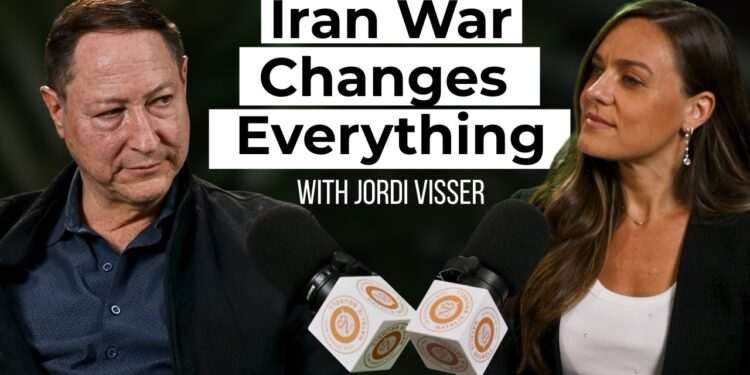
Source: Natalie Brunell Podcast
Compiled by: Felix, PANews
Navigating the Nexus: Geopolitics, AI, and Bitcoin’s Ascendancy
In a compelling return to the Coin Stories podcast, veteran macro investor and author of “The Macro AI Nexus,” Jordi Visser, offered profound insights into the current maelstrom of global events. From the escalating geopolitical tensions surrounding Iran and the Strait of Hormuz to the seismic impact of artificial intelligence on white-collar employment, Visser meticulously dissected the landscape, revealing its potential implications for Bitcoin’s future. PANews has distilled the essence of this enlightening discussion.
Unraveling the Macroeconomic Maze: A World Adrift?
The conversation opened with a pivotal question from the host: are global leaders executing a strategic plan, or are we witnessing a cascade of reactive decisions by the incompetent? Visser’s response painted a nuanced picture:
“I think they have a plan; it’s just not going as expected. What’s happening in the energy sector right now is absolutely not a good idea. Any leader making complex decisions, including war-related ones, references past similar decisions – Venezuela, Mexico, the Panama Canal, even Greenland. So, I think this situation might be spiraling out of control, and it’s far worse beneath the surface than people realize, making it incredibly difficult to reverse.”
He noted a significant shift in public perception over the past three months, evolving from initial dismissal (“it’s just like tariffs, it’ll blow over”) to growing concern about irreversible damage, and now, a full realization of the crisis’s profound impact.
The Strategic Chessboard: Hormuz, Rare Earths, and Energy Dominance
The host questioned the feasibility of prolonged global conflict given Western reliance on Chinese rare earths and limited ammunition. Visser explained this through the lens of strategic leverage:
“Rare earths were a card China played last year to halt the world. Now, everyone realizes China controls global rare earths. Before, nobody talked about it. The Panama Canal and Venezuela are critical energy chokepoints. The former is about transport, ensuring US energy market control – something Trump heavily emphasized. Now we add Greenland, rich in rare earths, and Iran.”
Visser highlighted the immense US energy surplus, contrasting it with Asia’s reliance on oil transported through the Strait of Hormuz. He suggested the current situation is less about direct warfare and more about asserting control over energy markets, given China’s dependence on the Strait. He projected that while inflation would remain elevated (potentially 4-5% year-over-year) for the next three months, the latter half of the year could see an improvement.
The Hormuz Impasse: A Low-Cost Warning
When pressed on why reopening the Strait of Hormuz is so challenging, Visser pointed to Iran’s strategic leverage:
“It’s a question nobody can answer for sure, especially in a country where we don’t even know who the leader is. But if you’re governing a country and have always governed in a certain way, the only way to maintain leadership might be to stay tough and inflict as much pain as possible on your opponents. Every day this continues, the pressure on Trump increases due to midterm elections and rising gas prices, nearing $7 in places like California.”
Iran, he explained, can sustain the blockade at minimal cost using drones and mines, while continuing to ship oil to India and China. This serves as a potent warning against further intervention.
Escalation Risks and Treasury Market Resilience
Visser acknowledged the growing risk of ground troop intervention, though likely limited to clearing the Strait. Surprisingly, he noted the US Treasury market’s relatively mild reaction to these mounting pressures and rising inflation expectations:
“It’s actually been quite mild, considering the numerous issues and the significant rise in inflation expectations. 10-year rates have only risen 40 basis points. The volatility is mostly in the short term, as the Fed is now expected not to cut rates. But long-term rates are actually quite stable, which is somewhat unexpected.”
He attributed this stability possibly to hedge fund short covering, but cautioned that risks increase with the duration of the crisis.
AI’s Disruptive Force: Reshaping Markets and Labor
Shifting to investor strategy, Visser emphasized the profound, often overlooked, impact of AI:
“My research focus is currently AI, advising some long-time Wall Street acquaintances. The message I want to convey is very clear: software stocks plummeted before the Iran incident. The disruptive impact of AI is becoming a reality. Software stocks fell, and financial stocks followed because their debt is often tied to the software industry. AI is an incredibly disruptive force that will bring uncertainty to all investment areas over the next three years.”
Bitcoin: The Growth Asset in an AI-Driven World
Visser argued that Bitcoin’s true potential emerges in this new paradigm. He noted the inevitable trend of traditional investors allocating 1-3% of their portfolios to Bitcoin. He drew an analogy:
“People eat food they don’t like only when they have no other food. Currently, they have plenty of alternative investments besides Bitcoin to make money. Ultimately, people invest to make money. So, ‘store of value’ is a very interesting term. A house is a store of value, gold is, even any asset can be. You put money into something, expecting it to retain or increase value when you need it in the future.”
While Bitcoin was initially dragged down by the software crash, Visser sees its unique strength:
“Bitcoin’s biggest advantage is that when software stocks may no longer be investable, Bitcoin remains a growth asset. Commodities are cyclical; I believe silver will go higher but eventually come back down. I don’t see that with Bitcoin. I’ve always believed that investors worldwide will eventually be forced to say, ‘I need to put some money in my growth asset basket because it works.'”
He optimistically predicted a market normalization by year-end, with continued corporate profits, an improving economy despite inflation, and falling oil prices. He foresees the AI trade continuing, with market sentiment bottoming in May, leading to strong Bitcoin performance thereafter.
AI’s Subtle Yet Profound Impact on the Labor Market
Addressing widespread anxiety about AI-driven job losses, Visser offered a nuanced perspective:
“Strictly speaking, there hasn’t been a true ‘wave of job losses’ yet. People are losing their current jobs but quickly finding others. The US currently faces a ‘recruitment difficulty,’ not a ‘layoff wave.’ We’ve had zero net job creation in the past 12 months.”
He highlighted a demographic challenge: many retire, few replace them, and immigration has slowed. While some sectors like healthcare still face labor shortages, others, like accounting, are directly competing with AI. Visser emphasized the shift towards white-collar disruption, mirroring the blue-collar disruption of manufacturing decades ago. He noted a psychological toll:
“People are forced to do jobs they don’t want. This is the problem with AI. It’s a displacement where people can’t pursue what they envisioned and invested heavily in. There are jobs, but if your job has a ceiling, and you expected to earn a lot, and you’re no longer in a field you love, I think this psychological impact is very destructive for the country right now.”
Visser believes the most secure employment lies in mastering AI applications, suggesting that these tools can empower individuals in various aspects of life, from learning to cooking, if one simply takes the initiative to integrate them.
The AI-Crypto Convergence: A New Financial Frontier
Visser sees the intersection of AI and Bitcoin as already underway, categorizing the crypto space into three pillars: stablecoins, Ethereum, and Bitcoin. He views Bitcoin as the ultimate destination for capital within this ecosystem.
“We need to bring money from the fiat world into crypto, and stablecoins are the bridge. Currently, stablecoin transaction volume is immense, network effects are emerging, meaning more capital is circulating faster. Simultaneously, regulatory frameworks are gradually improving, and transactions are becoming compliant.”
The need for speed in crypto, he argued, necessitates AI agents. He envisions a future dominated by “robot consumers” interacting with the blockchain:
“The future crypto market needs more robot consumers than humans. Robots will be the primary interface, as we’ll tell our phones, ‘Hey, go buy this, or handle that, figure it out.’ This will happen more and more frequently every day.”
As AI agents proliferate, more capital will flow into crypto, potentially bypassing traditional regulatory hurdles. Ethereum, he noted, benefits from this surge in transaction volume and serves as an entry point for hedge funds due to its analyzable yield and cash flow. However, Bitcoin’s ultimate benefit stems from the overall ecosystem’s growth:
“Bitcoin’s benefit lies in the expansion of its ecosystem. As more capital flows in from any direction, whether initially into Ethereum or stablecoins, the increasing number of wallets, stablecoins, and transaction volume will ultimately converge into the Bitcoin ecosystem.”
Crucially, Bitcoin remains the preferred asset for institutional allocation. Visser confirmed that pension funds inquire about Bitcoin, not Ethereum, highlighting its status as the most desired institutional crypto asset. He concluded: “AI agents will begin to bring more and more transaction volume into this space.”
Bitcoin’s Path to a Billion Holders: Spot vs. ETFs
Addressing the current dip in retail enthusiasm compared to 2021, Visser asserted that price drives retail sentiment. He pointed to Bitcoin’s resilience, holding between $68k-$72k while “Magnificent Seven” tech stocks have seen significant year-to-date declines. Spot ETFs, he stressed, are vital, as they signify institutional accumulation even in bear markets. Private wealth managers, he explained, strategically allocate to falling assets with long-term value, a category where Bitcoin stands out as traditional growth assets falter.
“Bitcoin has a growth narrative. We invest in it because it could reach a trillion dollars. I believe that. It’s only $70,000 now. I don’t believe Microsoft will rise that much. I don’t believe Google will rise that much; they’ve already surged. It’s hard for people to find assets that can do that now.”
For retirement funds needing returns to offset growing liabilities (especially with increasing lifespans), long-duration assets like Bitcoin become essential as private credit, private equity, venture capital, and software underperform due to AI disruption.
Regarding the distribution of ownership among a projected billion Bitcoin holders, Visser believes a significant portion will opt for spot Bitcoin, rather than ETFs. He confidently declared the “quantum computing will destroy Bitcoin” narrative will end this year, ironically due to AI:
“AI clusters will breach the seemingly impenetrable security of banks. This is the problem that will emerge this year. Due to the advent of OpenClaw and the ability to create vast numbers of AI agents and dispatch billions of agents to infiltrate systems, there will be a massive surge in hacking this year.”
This, he argued, will force every bank to embrace crypto security measures, potentially even more robust than Bitcoin’s. Consequently, holding money in traditional bank accounts will become riskier, making self-custody of spot Bitcoin an increasingly important and accessible defense against such sophisticated attacks.
The Greatest Opportunity: Bitcoin in an AI-Transformed World
Looking ahead 12-24 months, Visser unequivocally identified Bitcoin as the greatest opportunity. His conviction stems from a fundamental shift in global dynamics:
“I can’t imagine that with AI, AI agents, humanoid robots, and so on developing so rapidly, we still have to settle a check in a few days, as we did in the past. It just doesn’t make sense. The world’s pace of development is accelerating dramatically. For those not paying close attention to AI, Opus 4.5 changed the world. It accelerated AI’s development, making it evolve in the way you see now, disrupting all these companies – not just software, financial, and transportation companies.”
He foresees humanoid robots revolutionizing manufacturing, impacting even heavy industry. Visser shared a chilling realization from a recent dinner:
“You must soberly realize that we are no longer at the top of the food chain. This is a huge shift: a super-intelligent being, physically and intellectually surpassing the smartest person ever, will emerge within five years. You cannot imagine the changes that are coming.”
In this transformed world, Visser concluded, traditional companies and stocks alone cannot sustain value. The focus must shift to assets that are immune to disruption, that possess true scarcity. Echoing Michael Saylor, he stressed:
“We need scarce assets. We need things that are truly valuable because we can print anything with AI – Picasso paintings, anything we want. We can print anything we want in 5 to 10 years. So this means Bitcoin is the best opportunity, not because it’s the best asset, but because it won’t be destroyed by AI.“
Disclaimer: This article is for market information only. All content and views are for reference only, do not constitute investment advice, and do not represent the views and positions of BlockTempo. Investors should make their own decisions and trades. The author and BlockTempo will not bear any responsibility for direct or indirect losses resulting from investor trades.