
The Great Stablecoin Reshuffle: How Regulation is Redefining Yield Generation
By Jae, PANews
The landscape of stablecoin yield generation is undergoing a profound transformation, marked by escalating regulatory scrutiny. What was once a straightforward path to “passive earning” is rapidly evolving into a model of “active acquisition,” fundamentally reshaping how users can generate returns from their digital assets.
At the heart of this shift is the proposed CLARITY Act (Digital Asset Market Clarity Act). This landmark legislation threatens to dismantle the passive yield channels long offered by Centralized Exchanges (CEXs) for stablecoins like USDC, while simultaneously carving out a legitimate space for activity-based rewards within the DeFi ecosystem. Should the CLARITY Act pass as currently drafted, the era of earning 4% APY on USDC held on platforms like Coinbase could soon be a relic of the past.
This regulatory pivot signals the twilight of a golden age for centralized stablecoin dividends. Yet, for innovative DeFi-native stablecoins such as USDe and USDS, it presents an unprecedented opportunity to expand and thrive within newly defined regulatory boundaries.
The Banking Sector’s Stance: A $56.7 Million Lobbying Effort Against “On-Chain Deposits”
The journey towards federal stablecoin regulation began with the GENIUS Act, set to take effect in July 2025. This act established foundational rules, including a 1:1 reserve requirement and restrictions on direct interest payments by issuers. However, it inadvertently created a “distributor loophole,” allowing platforms like Coinbase to funnel U.S. Treasury yields back to users as “rewards” through revenue-sharing agreements with issuers like Circle. Essentially, stablecoins quietly transcended their role as mere “payment tools,” morphing into yield-generating “on-chain deposits.”
The CLARITY Act emerges precisely to seal this loophole. The March draft text broadens the prohibition from just issuers to encompass all “digital asset service providers,” including CEXs, brokers, and their affiliates. This expansive restriction underscores regulators’ apprehension regarding the inherent conflict between a stablecoin’s “monetary” and “security” attributes. Regulators largely view payment-oriented stablecoins as “Narrow Bank” instruments, designed for payment and settlement, not as investment vehicles for capital appreciation.
Behind the CLARITY Act’s stringent stance on yield distribution lies a formidable defense mounted by the U.S. banking industry. The American Bankers Association (ABA) alone has reportedly spent a staggering $56.7 million on lobbying efforts to prevent stablecoins from offering competitive yields. Banks fear that if stablecoins offer treasury-like returns of 4-5% without traditional banking oversight or deposit insurance, up to $1.5 trillion in low-cost retail deposits could flee the commercial banking system. This “deposit flight” poses a significant threat, particularly to U.S. community banks, which rely heavily on these deposits to fund local loans for agriculture, small businesses, and mortgages. Standard Chartered estimates suggest a potential $500 billion funding gap for the banking system by 2028 if stablecoin yields remain unchecked.
However, PANews offers a nuanced perspective: these projections are based on several assumptions. The actual pace and scale of deposit migration will likely be influenced by a multitude of factors, including user behavior, platform security, and regulatory clarity. The overlap between stablecoin users and traditional retail banking customers is relatively limited, suggesting that the estimated $1.5 trillion outflow is an extreme scenario, with the actual impact likely to be far less severe. Furthermore, stablecoins and bank deposits differ fundamentally in their risk profiles and use cases, making them imperfect substitutes.
The Verdict: Passive Yields Out, Activity-Based Rewards In
Crucially, the CLARITY Act does not impose a blanket ban on all rewards. Instead, it introduces a critical distinction through “Identifiable Activity” screening standards, strategically sidestepping the “expectation of profit” criteria central to the Howey Test.
The Act explicitly forbids interest payments on “idle balances,” directly impacting the long-standing revenue-sharing model between Coinbase and Circle. For years, Coinbase has offered 3.5-5% rewards to USDC holders, funded directly by the interest earned on U.S. Treasuries held in Circle’s reserves. Data reveals a striking 98.7% correlation between USDC rewards and the 3-month U.S. Treasury yield. By severing this direct link, regulators are effectively disarming CEXs of a powerful user acquisition tool.
Conversely, the CLARITY Act validates incentives for “active behavior.” Section 404(b)(2) outlines three categories of compliant, activity-generated rewards:
- Platform Activities: Rewards from loyalty programs, promotional lotteries, subscription discounts, and similar engagements.
- Transactional & Consumption Activities: Incentives for using stablecoins for payments, transfers, and cross-border remittance settlements.
- On-Chain Infrastructure Contributions: Rewards for participating in protocol validation, staking, governance voting, or providing liquidity.
This framework introduces a new legal paradigm: if a yield is earned through specific risks or labor, rather than being “freely given,” it transitions from a “deposit” to a “Payment for Service.” While USDC’s path to yield generation isn’t entirely blocked – users can still participate in activities to earn rewards – the necessity of active engagement and associated costs will inevitably diminish the net returns compared to the previous “passive earning” model. Consequently, USDC’s utility will likely revert more squarely to its core functions of payment, settlement, and consumption.
This regulatory redefinition precisely opens a clear compliance pathway and significant growth opportunities for DeFi-native stablecoins.
DeFi’s Strategic Maneuver: Derivative Hedging and Protocol Revenue Sharing
As CEXs navigate a challenging “regulatory minefield,” DeFi-native stablecoins like USDe and USDS are leveraging their distinct yield mechanisms to exploit these newfound compliance gaps.
Consider USDe, which eschews traditional bank-held USD reserves in favor of a “synthetic dollar” derivative structure, underpinned by a Delta-neutral hedging strategy. USDe’s yield stems from two independent activities, both interpretable as “activity-based rewards” under the CLARITY Act:
- Staking Yield: Derived from Ethereum network consensus layer rewards by holding staking certificates like stETH. This is explicitly recognized as a compliant activity of “participating in validation or staking” by the Act.
- Derivative Layer Yield (Funding Rates): Generated by maintaining equivalent perpetual futures short positions on trading platforms. In bullish markets, the funding fees paid by long positions to short positions become a primary source of USDe’s yield.
Within the CLARITY Act’s framework, USDe holders’ earnings are not interest based on idle deposits, but rather rewards for engaging in specific “risk management and hedging operations.” Given USDe’s inherent volatility and exposure to counterparty and smart contract risks, its yield will legally differentiate it from “bank deposit equivalents.”
USDS exemplifies another adaptive approach. Users deposit USDS into the Sky protocol, which then deploys these funds into various lending protocols or liquidity pools. Returns, including income, fees generated on Sky, and Real World Asset (RWA) yields, are then distributed back to users. USDS, therefore, incentivizes users through “protocol revenue sharing” rather than direct “interest payments.” The CLARITY Act’s provision for rewards for “providing liquidity” offers a crucial legal safeguard for DeFi protocols employing models similar to USDS.
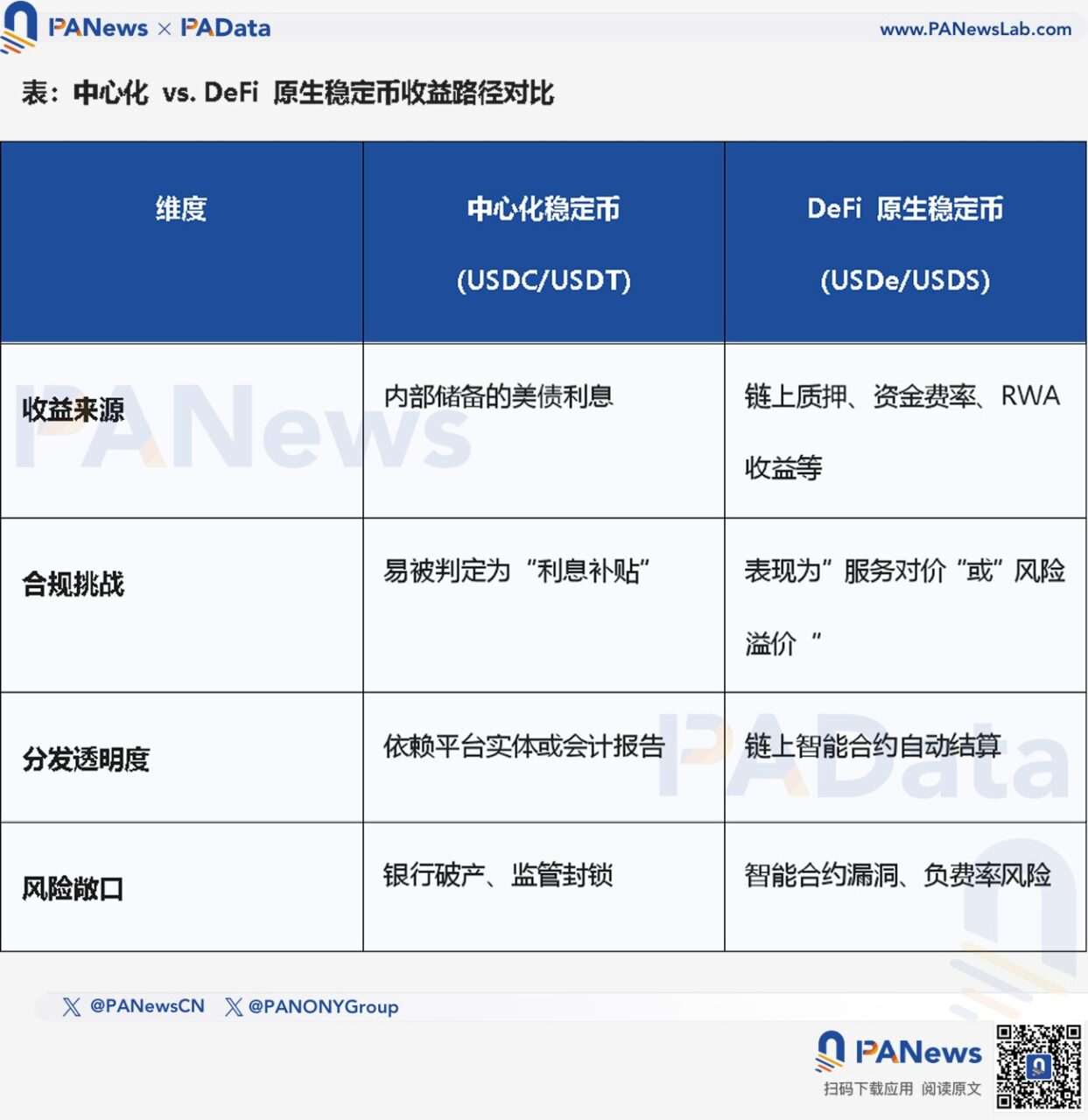
The progression of the CLARITY Act signals the end of the stablecoin market’s wild west era. Under the glare of regulation, the market is bifurcating into a clear dual-track structure. There are no absolute winners, only survivors who successfully adapt to the new rules.
Centralized stablecoins like USDC are poised to become “instrumentalized,” returning to their foundational roles in payment and settlement. Their competitive edge will no longer be yield, but rather their compliance, liquidity, extensive ecosystem coverage, and seamless cross-border transfer capabilities, making them the preferred digital cash for most users and businesses.
Conversely, DeFi-native stablecoins like USDe are positioned to inherit the demand for wealth management within the crypto space, emerging as the market’s “yield engines.” They cleverly circumvent regulations targeting “bank deposits” by deeply integrating asset value with complex on-chain activities such as Delta-neutral hedging and liquidity mining.
This differentiation within the stablecoin sector is an inevitable outcome as the market seeks optimal solutions within a robust compliance framework. For investors, understanding the deeper logic behind this migration is paramount: future stablecoin yields will no longer be the preserve of passive “holders,” but rather the reward for active “contributors” who engage with protocol activities.
This transformative shift is both a consequence of regulatory constraints and a catalyst for DeFi innovation to adapt and thrive.