
Authored by Felix, PANews
As the United States and Israel launched joint airstrikes against targets in Iran, global attention wasn’t solely fixed on the escalating conflict. It also turned sharply towards Polymarket, the decentralized prediction platform.
While traditional financial markets remained closed and slow to react over the weekend, Polymarket, with its 24/7 trading capabilities, swiftly became an instantaneous “barometer” for observing geopolitical shifts. However, as traders flocked to capitalize on the unfolding events, allegations of “insider trading” emerged, suggesting some individuals exploited privileged information for significant gains amidst the crisis.
This global geopolitical flashpoint has starkly illuminated both the promise and peril of prediction markets.
High Stakes: Over Half a Billion Dollars Wagered on US-Iran Tensions
Following the commencement of the attacks, Polymarket witnessed a surge in new contracts, spanning a wide range of outcomes from potential ceasefire timelines to the stability of the Iranian regime.
Notably, a series of Polymarket contracts titled “How will the US strike Iran?” has generated an astounding total trading volume exceeding $529 million since its inception. This made it the largest market within the “World” and “Geopolitics” categories, and the fourth largest in the broader “Politics” category, surpassed only by certain Trump-related contracts during the 2024 election cycle.

On February 28th alone, these contracts saw $89.6 million in trading volume. All daily contracts from February 28th to early March were settled as “Yes,” indicating that individuals who purchased these specific date contracts before the attacks successfully profited by betting on the timing of the US airstrikes.
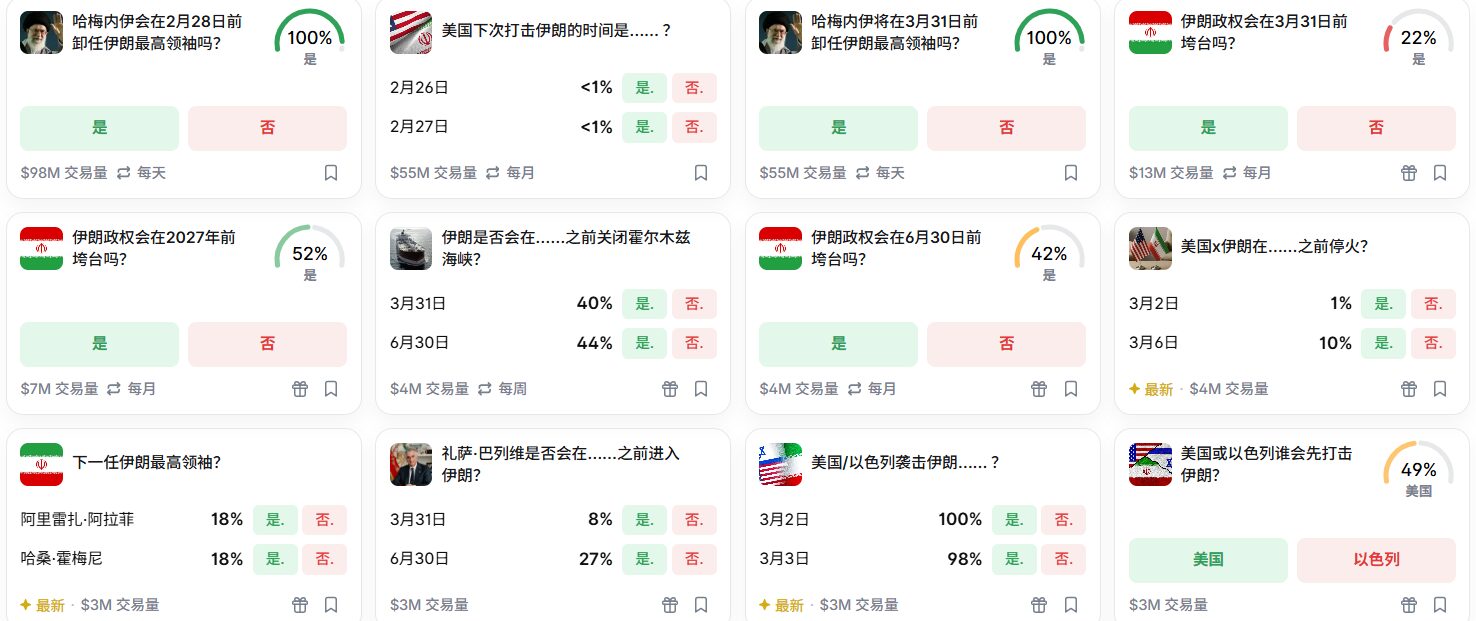
Among the largest completed markets on Polymarket were those predicting “Khamenei to step down as Iran’s Supreme Leader by Feb 28?” and “Khamenei to step down as Iran’s Supreme Leader by March 31?”. These markets garnered volumes of $98 million and $55 million respectively, making them some of the most actively traded geopolitical markets last week.
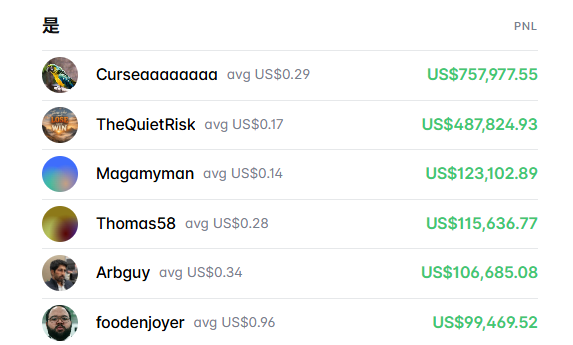
One prominent trader, operating under the account name “Curseaaaaaaaa,” reportedly profited $757,000 by betting “Yes” on key outcomes. Four other traders also secured six-figure gains.
However, for every winner, there is a loser. Blockchain analytics firm Lookonchain monitored a trader identified as “anoin123,” who had previously profited $2 million by shorting the possibility of airstrikes over several months. Yet, within a single day following the actual attacks, this account incurred a staggering $6.5 million loss, transforming a substantial profit into a significant deficit.
Precision Bets Spark Insider Trading Allegations
While proponents champion Polymarket as a testament to “the wisdom of the crowd,” its open nature has also raised concerns about potential illicit activities.
According to monitoring by on-chain analysis company Bubblemaps, six distinct Polymarket wallets collectively profited $1 million by accurately betting on the US launching military strikes against Iran. These wallets purchased “Yes” shares for the Polymarket contract “US strikes Iran by Feb 28?” just hours before the joint US-Israeli airstrikes commenced in the early morning. Such precise timing has ignited widespread suspicion and accusations within the community.
Polymarket, in response, issued a statement asserting, “The strength of prediction markets lies in their ability to aggregate the wisdom of the crowd, producing accurate and unbiased forecasts for society’s most critical events.” The platform further claimed that, based on conversations with individuals directly affected by the conflict, prediction markets “provide them with the answers they need in ways that traditional media like TV news and X (formerly Twitter) cannot.”
This isn’t an isolated incident. Similar allegations of “insider trading” on Polymarket’s geopolitical markets have surfaced before:
- In January, a newly opened account wagered approximately $32,000 on Venezuelan President Nicolas Maduro stepping down. This account reportedly purchased shares at about 7 cents each before any public announcement of US military action, turning a profit of over $400,000 within a day. This incident prompted a US Congressman to propose the “Public Integrity in Financial Prediction Markets Act of 2026,” aiming to prohibit federal officials from trading on prediction market contracts tied to government policy.
- Earlier this month, Israeli prosecutors filed charges against an Israel Defense Forces reservist and a civilian for allegedly using classified military intelligence to place bets on Polymarket. The pair reportedly profited over $150,000 by betting on the timing of an Israeli attack on Iran.
- Just days prior, Lookonchain identified several suspected insiders who profited over $1 million by betting on Polymarket contracts related to crypto detective ZachXBT’s investigation into the crypto trading platform Axiom. The most successful wallet transformed a five-figure wager into nearly $500,000.
The core question remains: Does Polymarket truly offer a more transparent and immediate source of information, or does it inadvertently provide a lucrative channel for those with privileged, classified knowledge to cash in? This contentious debate is set to intensify as global geopolitical dynamics continue to unfold.