A bombshell report from The Wall Street Journal alleging $1.7 billion in funds flowed to sanctioned Iranian entities via Binance, coupled with claims of compliance officers being dismissed for “knowing too much,” has ignited a fierce legal battle. This escalating dispute raises critical questions: Is this a failure of an exchange’s compliance framework, or a misinterpretation of on-chain data by the media? As Binance launches a defamation lawsuit, this geopolitical, financial sanctions, and on-chain forensics ‘Rashomon’ is exposing the most intense struggles of the cryptocurrency industry’s transformation.
Before delving into the deeper implications of this controversy, let’s trace the events along a timeline and highlight the key points of contention to understand the full scope of the dispute.
Timeline of the Dispute
- February 13: Fortune breaks the story, accusing Binance of dismissing internal investigators who were pursuing potential violations involving Iranian financial flows.
- February 23: The Wall Street Journal and The New York Times follow up. The WSJ specifically alleges Binance facilitated up to $1.7 billion in funds to sanctioned Iranian entities and claims senior management “forcibly halted investigations” and “suppressed compliance reports.”
- February 23: Binance issues a statement, publicly detailing its internal investigation processes and refuting media reports as based on “incomplete and materially mischaracterized narratives.” The statement emphasizes that funds did not flow directly to sanctioned entities.
- March 11: Binance officially files a defamation lawsuit against The Wall Street Journal. On the same day, the WSJ publishes another article, stating the U.S. Department of Justice is investigating the matter, to which Binance responds, “unaware of any such investigation.”
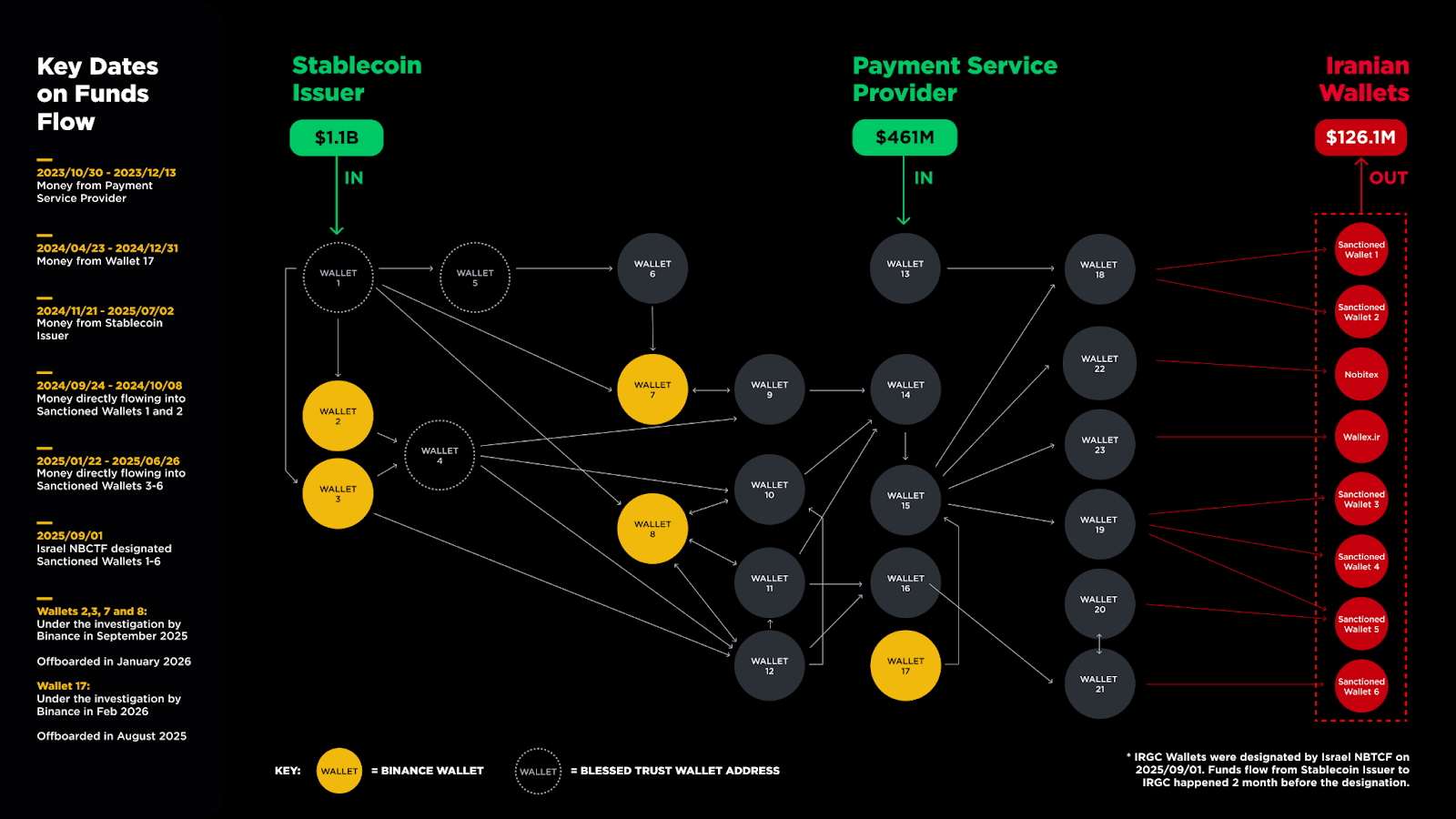
- March 11: Binance releases a statement, directly labeling the foreign media’s four major accusations as “false” and revealing a detailed on-chain fund flow diagram showing the $1.7 billion went through “at least 3 layers away” from Binance.
The Media’s Thriller Narrative: “The Disappearing Investigation”
According to reports from The Wall Street Journal and The New York Times in February, Binance’s compliance investigation team discovered last year that two companies, “Blessed Trust” and “Hexa Whale Trading,” allegedly transferred hundreds of millions of dollars in cryptocurrency through the Binance platform for Iran-linked organizations, including the Islamic Revolutionary Guard Corps (IRGC).
The most explosive revelation centered on personnel changes. The reports claimed that after investigators escalated their concerns to senior management, they were successively suspended, and the entire investigation team was disbanded shortly after founder Changpeng Zhao (CZ) received a pardon.
This narrative perfectly aligns with public perceptions of “large corporations covering up the truth”: internal whistleblowers expose a shocking scandal, only to face retaliatory purges, with massive financial flows linked to terrorist organizations. The plot is tight, full of dramatic tension. For a time, Binance appeared to be an uncontrolled financial behemoth, willing to cross sanction red lines for profit.
The Genesis of the Storm: Binance’s Counter-Narrative
The incident garnered widespread attention not merely due to the “large scale of funds” but, more critically, because it touched upon two highly sensitive issues: “alleged assistance to Iran in evading sanctions” and “the integrity of cryptocurrency exchange compliance.”
However, as Binance released more details of its internal investigation, a different version of the story began to emerge.
To uncover the true genesis of the storm, how exactly did this investigation begin? According to Binance’s statement, the investigation commenced in mid-2025, initially as a “request for assistance from law enforcement agencies.” It was through this collaboration that they discovered suspicious connections within a complex chain of funds, leading to certain wallets.
Binance immediately launched an internal investigation, which led to the identification of the two implicated accounts: “Blessed Trust” and “Hexa Whale.” The statement emphasizes that Binance promptly blocked these accounts and proactively reported the relevant intelligence to law enforcement. This, Binance argues, is the full factual picture intentionally omitted from the sensational headlines.
The $1.7 Billion Enigma: Direct Pipeline to Tehran or On-Chain Labyrinth?
How did the “alleged $1.7 billion in funds” reported by the media flow on the blockchain? After months of investigation, the Binance team gradually reconstructed a financial activity model spanning Asia, the Middle East, and other regions. This involved multiple actors and primarily included three key stages:
- Fund Origin: The funds originated from a regulated large stablecoin issuer and a Singapore-regulated digital payment and banking services provider.
- Intermediate Transfers: After leaving Binance, the funds were disbursed to multiple wallet addresses. Further investigation revealed that many of these wallets were likely controlled by the same owner and belonged to a larger criminal group.
- Final Recipients: After multiple “multi-hop” transfers on the blockchain (meaning funds moved between several addresses), approximately $126.1 million eventually reached Iran-related wallet addresses, with the actual amount flowing to “Islamic Revolutionary Guard Corps (IRGC)” related wallets being $24.1 million.
Binance pointed out that the users involved were not listed on any international sanctions lists at the time, and their transactions on the Binance platform did not trigger any industry-standard on-chain monitoring tool alerts. The transactions and wallets related to the IRGC were, in fact, only unearthed by Binance through proactive cooperation with law enforcement after initiating its own investigation.