The RAVE Mirage: Unmasking a $16 Billion Crypto Manipulation Masterclass
By Jae, PANews
The past week witnessed a palpable buzz across the altcoin market, with trading volumes surging and investor sentiment heating up. Projects like RAVE, Binance Life, GENIUS, and ENJ captivated traders, delivering multi-fold, even dozens-fold, returns within a mere seven days. Yet, amidst this frenzied activity, one token stood out, orchestrating a truly spectacular — and deeply unsettling — performance: RAVE (RaveDAO).

In an astonishing seven-day span, RAVE’s price catapulted from $0.25 to an all-time high of $19.66, marking an almost 80-fold increase. Its Fully Diluted Valuation (FDV) briefly soared past $16 billion, overshadowing even established public chains like Avalanche and SUI, and cementing its status as a viral “wealth myth” across the crypto sphere.
However, this was no inspiring tale of a grassroots community triumphing against the odds. A closer examination of the fundamentals behind the dazzling price chart reveals a stark reality: the project lacked innovative technological breakthroughs, possessed no revenue-generating capabilities commensurate with its valuation, and instead exposed a meticulously orchestrated, interconnected chain of on-chain market manipulation.
90% Token Monopoly: A $3 Million Revenue “Supports” a Multi-Billion Dollar Valuation
RaveDAO emerged from a 200-person after-party during Istanbul’s Devconnect in November 2023, positioning itself as a decentralized organization (DAO) dedicated to fusing electronic music culture with Web3 infrastructure. The project introduced NFT tickets, built on an upgraded ERC-721 contract, serving as “Proof-of-Participation” NFTs for event access and digital identity within the DAO, granting members community rewards and governance rights.
Financially, RaveDAO reported $3 million in event revenue for 2025 – a respectable figure for a nascent project. The glaring issue, however, is the insurmountable chasm between this modest revenue stream and a staggering $16 billion valuation. The seeds of RAVE’s manipulation were sown during its initial token allocation design.
According to Arkham’s analysis, out of a total supply of 1 billion RAVE tokens, only 24.8% were in circulation, with the remaining 75.2% locked. On-chain data painted an even more alarming picture: the top 10 wallet addresses commanded a staggering 99.95% of the total token supply.
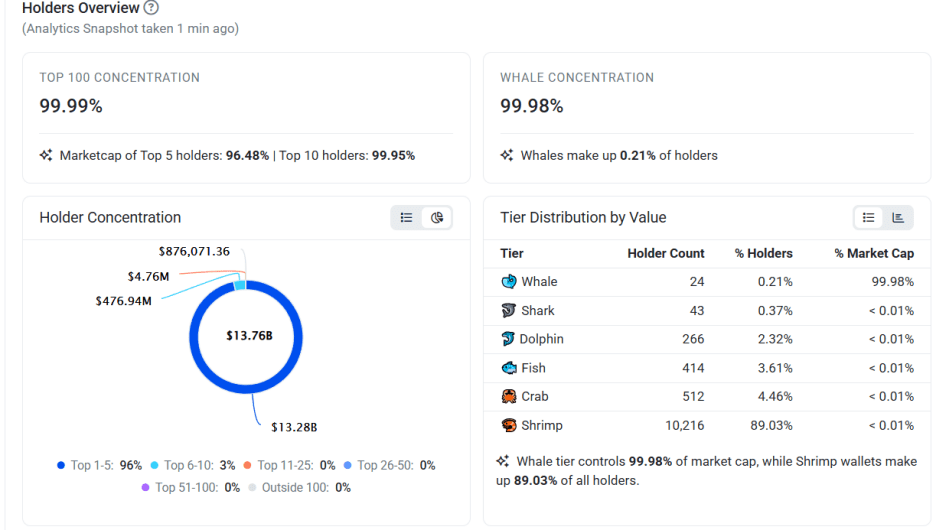
Specifically, three Gnosis Safe multi-signature wallets, widely attributed to the project team, held 75.2%, 9.87%, and 4.67% of the total supply, respectively. This implies that approximately 90% of RAVE tokens in the market were effectively controlled within a black box managed by a single entity.
This extreme concentration of tokens engineered an absurd FDV. At its zenith, RAVE’s FDV hit $16.06 billion, more than four times its circulating market capitalization. A project generating only a few million dollars in annual revenue, yet boasting a valuation far exceeding public chains like Avalanche and SUI (which secure billions in Total Value Locked), unequivocally signifies a valuation detached from fundamental pricing logic – a blatant case of market manipulation.
Danny, founder of Pundi AI, emphasized to PANews that the “circulating supply control rate” is paramount, as it dictates the capital cost for manipulators to accumulate tokens and their subsequent payback period. An extremely low circulating supply combined with an iron grip on control created the perfect environment for manipulators to “pump at minimal cost and harvest with maximum leverage.”
A Textbook Hunt: Fake Dumps Lure Shorts into a Liquidation Trap
From April 13th to 15th, RAVE orchestrated a precise and intricate hunt against short sellers across the network, serving as a textbook example of crypto market manipulation.
Ten hours before the dramatic price surge, unusual on-chain activity was detected. Two addresses directly linked to the project deployer transferred 18.58 million RAVE tokens to Bitget. At the prevailing market price of $0.43 per unit, this amounted to approximately $8 million. Crypto KOL “Koduck” highlighted that Bitget was RAVE’s primary spot trading venue, accounting for 88% of its exchange spot volume.
In conventional trading, substantial deposits to an exchange are often perceived as a precursor to a large sell-off. This move rapidly disseminated across social media and alert channels, enticing a multitude of traders to open short positions. Coinglass data confirmed this sentiment, showing that 74% of trading accounts on Binance held RAVE shorts just before the surge, pushing short positions to a critical mass.
Once the short positions were sufficiently stacked, the manipulators executed a swift reversal. The team’s multi-signature address withdrew 29.78 million RAVE from Bitget. This “deposit-then-withdraw” maneuver effectively drained any potential selling pressure from the exchange. With over 90% of tokens locked and the market’s floating supply exceptionally scarce, on-chain spot price increases faced virtually no resistance.
In the final phase of their harvest, manipulators didn’t solely rely on spot price appreciation. They further amplified their gains through a “funding rate bomb.” Evening Trader Group underscored that the true windfall for manipulators came from the liquidation of short positions triggered by the price surge.
Danny further clarified that the perpetual futures market operates on data. By controlling the spot circulating supply, manipulators dictate the spot price, which in turn governs the mark price of perpetual futures. During the peak period of April 13-15, RAVE’s annualized funding rate plummeted to an astonishing -1000% to -4000%. This meant short sellers were bleeding massive holding fees to longs every eight hours – a relentless, slow bleed for anyone holding a short position.
Koduck also revealed that OKX served as the primary battleground for RAVE perpetual contracts, capturing over 60% of the Open Interest (OI).
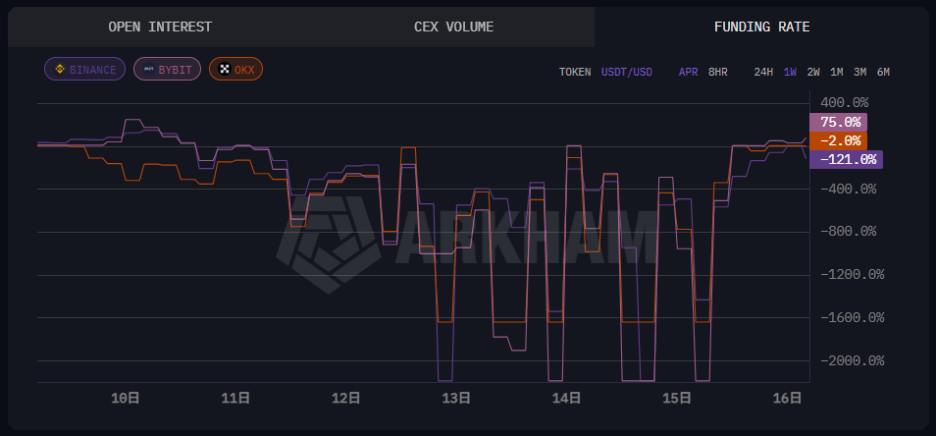
The “funding rate bomb,” coupled with the spot squeeze, ignited a cascade of liquidations. On April 13th alone, RAVE witnessed over $37 million in network-wide liquidations, with shorts accounting for more than 80% – wiping out countless traders instantly.
In essence, the manipulators not only generated nearly 80 times paper appreciation on the spot market but also directly siphoned tens of millions of dollars in short margin through punitive funding rates and forced liquidations. For them, absolute control over the token meant this “left-hand-to-right-hand” gamble translated into almost zero-cost, exorbitant profits.
On-chain detective ZachXBT unequivocally labeled RAVE as “insider manipulation,” noting that eight hours before his public exposé, he had contacted RaveDAO’s co-founder, who read the message but maintained a conspicuous silence.
Navigating the Storm: How Investors Can Escape the FOMO Trap
The RAVE saga serves as a stark illustration of how centralized supply, psychological engineering, and derivative amplification can be leveraged by teams to achieve massive gains at virtually no cost. Such “precise hunting of shorts” tactics expose the profound vulnerabilities of retail investors, often grappling with information asymmetry and liquidity traps. In a market riddled with such pitfalls, investors must cultivate an insight that transcends mere price fluctuations. RAVE’s “rave” leaves an indelible warning for all crypto participants.
Key Lessons for Prudent Investing:
- Beware the “FDV Trap”: Do not solely fixate on current market capitalization. If a project exhibits an extremely low circulating supply and an absurdly high FDV that dramatically deviates from its fundamentals, any sudden price surge could be a deceptive bull trap engineered by manipulators for a massive distribution.
- Validate Revenue-to-Valuation Alignment: Investors must establish robust screening models based on metrics like “Revenue/FDV” and “OI/MCap.” RaveDAO’s annual revenue of only a few million dollars supporting a $10 billion FDV, with a revenue/FDV ratio below 0.01%, fundamentally indicates a speculative scheme.
- Reconstruct Intuitive Logic for On-Chain Flows: Large deposits to an exchange do not automatically signal an impending dump. Resist the subconscious urge to blindly short. Instead, scrutinize the asset’s perpetual contract open interest distribution. If network-wide short sentiment is excessively bullish, manipulators are highly likely to orchestrate a “short squeeze,” turning short liquidations into fuel for further price escalation.
- Recognize “Exit Liquidity”: In the RAVE scenario, many investors who bought at elevated prices might have subconsciously believed they were still “early” in the price ascent. However, with the team’s multi-signature addresses controlling 90% of the tokens and the circulating supply monopolized, all market movements were controlled by whales. Chasing high prices meant becoming the “exit liquidity” for insiders.
As of April 16th, RAVE’s price had retreated over 25% from its peak. Yet, in highly controlled projects like this, technical indicators such as moving averages or support levels can be arbitrarily manipulated by large holders at any given moment, rendering them unreliable as reference points.
Without the shrewdness to navigate the intricate dance with market makers, investors are highly susceptible to falling into meticulously crafted hunting traps. It is imperative to cultivate an instinctive vigilance against “low circulation, high control” projects. Before the next “rave” begins, ensure you are not the one left holding the bag.
In the grip of FOMO, maintaining rationality often proves to be the rarest and most valuable ability.