
Author: HIBIKI, CryptoCity
Vercel Suffers Data Breach: A Critical Wake-Up Call for Crypto Projects
Vercel, a leading cloud hosting and deployment infrastructure platform widely adopted by developers for its serverless functions, edge computing, and continuous integration/deployment pipelines, has confirmed unauthorized access to some of its internal systems. This breach, which has impacted a subset of its clientele, sends ripples of concern, particularly within the blockchain and cryptocurrency sectors that heavily rely on Vercel for deploying their crucial frontend interfaces.
Vercel is renowned for developing Next.js, a popular React framework, making it a cornerstone for many modern web applications. Its pervasive use by blockchain projects – from decentralized exchange (DEX) frontends to wallet interfaces and dApp dashboards – amplifies the potential fallout from this security incident.
According to Vercel CEO Guillermo Rauch, who addressed the incident on social media platform X, the breach originated from a security vulnerability within Context.ai, a third-party AI tool. A Vercel employee’s Google Workspace account was compromised during Context.ai’s data leak, subsequently granting attackers unauthorized access to Vercel’s internal environment.
Vercel employs robust encryption for all customer environment variables at rest, alongside a feature allowing variables to be designated as non-sensitive. Unfortunately, the attackers exploited this distinction, using an enumeration technique to gain access to unencrypted, non-sensitive environment variables.

Ransom Demand: $2 Million for Allegedly Stolen Vercel Data
Adding another layer of complexity to the incident, cybersecurity news outlet Bleepingcomputer reported that an individual claiming to be a member of the notorious ShinyHunters hacking group posted on the BreachForums platform. This individual alleged to have acquired Vercel’s internal data and is demanding a $2 million ransom from the company.
The alleged stolen data showcased by the hacker includes critical assets such as access keys, source code, database records, and internal deployment API keys for NPM and GitHub. Furthermore, the cache reportedly contains personal details for 580 Vercel employees, including names, email addresses, account statuses, and activity timestamps.
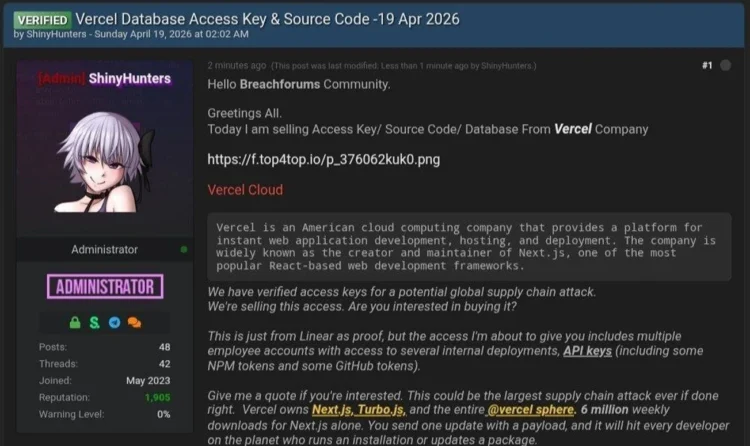
However, representatives from the core ShinyHunters organization have since denied any involvement in the Vercel attack. This group has a history of high-profile breaches, including the attack on Rockstar Games, developers of the Grand Theft Auto series.
- Related Report: GTA6 Developer Hacked! Hackers: Leak Player Data If Not Paid by 4/14. How Did Rockstar Respond?
Vercel’s Proactive Response and Urgent Client Recommendations
In response to the breach, Vercel has taken decisive action, engaging external cybersecurity experts, notifying law enforcement agencies, and rolling out updates to bolster its security management protocols.
The company strongly urges administrators to meticulously review activity logs for any suspicious behavior. Google Workspace administrators are specifically advised to immediately check for the installation of any potentially compromised OAuth applications. Crucially, Vercel recommends all clients conduct a comprehensive review and replacement of existing environment variables. Furthermore, enabling the sensitive variable feature is critical to ensure that all sensitive data benefits from static encryption protection.
Profound Implications for Blockchain and Cryptocurrency Projects
This incident poses a significant threat to the cryptocurrency industry. As reported by The Block, blockchain projects frequently deploy essential components like wallet interfaces, decentralized exchange (DEX) frontends, and decentralized application (dApp) dashboards on Vercel. The critical concern arises if projects stored sensitive information, such as private RPC endpoints, third-party API keys, or wallet-related confidential data, within variables designated as “non-sensitive.” These crucial secrets are now at high risk of exposure.
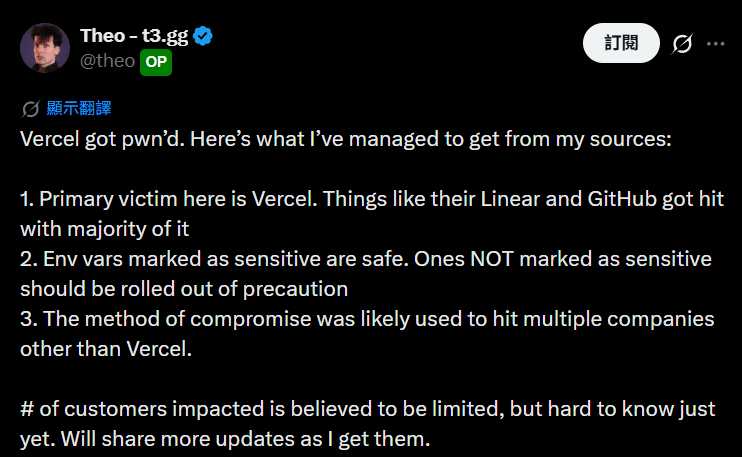
Prominent developer community figure Theo Browne also highlighted on X that sources suggest Vercel’s internal Linear and GitHub integration systems were most severely affected, potentially broadening the scope of compromised data.
The cryptocurrency sector has previously grappled with frontend security vulnerabilities, including domain system hijacking incidents affecting projects like CoW Swap, Aerodrome, and Velodrome. Such attacks typically redirect users to phishing sites to steal assets. However, The Block points out that the Vercel breach, occurring at the hosting and deployment layer, introduces an entirely new and more insidious attack surface. This vector bypasses traditional domain system monitoring, creating a worst-case scenario where attackers could directly tamper with a project’s actual frontend build output, leading to potentially devastating consequences for user funds and trust.
(The above content is an excerpt and reproduction authorized by our partner CryptoCity. Original link)
Disclaimer: This article is for market information purposes only. All content and views are for reference only, do not constitute investment advice, and do not represent the views and positions of BlockTempo. Investors should make their own decisions and transactions. The author and BlockTempo will not bear any responsibility for direct or indirect losses resulting from investor transactions.