
Author: Jae, PANews
In a dramatic turn of events, as Aave grappled with a multi-billion dollar liquidity crisis, Spark Protocol emerged as an unexpected beneficiary, absorbing a significant influx of capital. This on-chain disaster, triggered by a critical vulnerability involving Kelp DAO and LayerZero’s cross-chain bridge, starkly divided the DeFi lending landscape into two distinct realities.
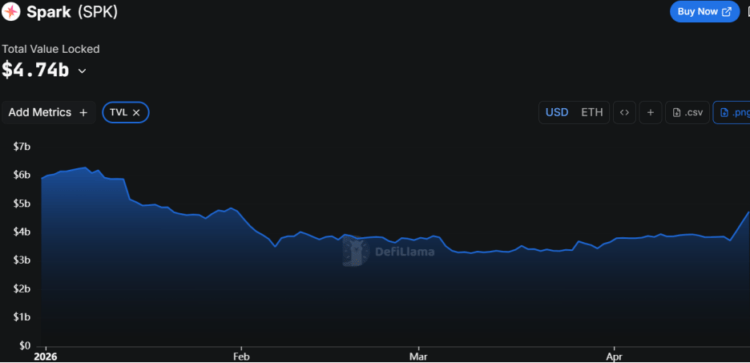
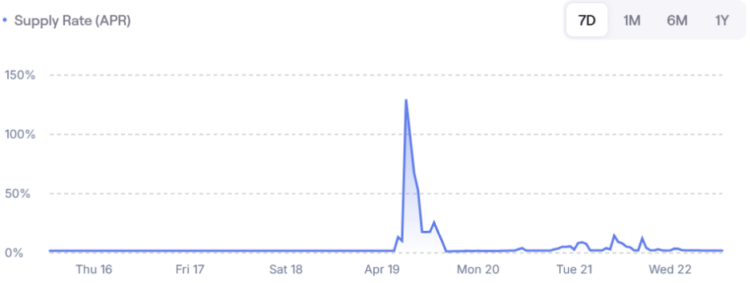
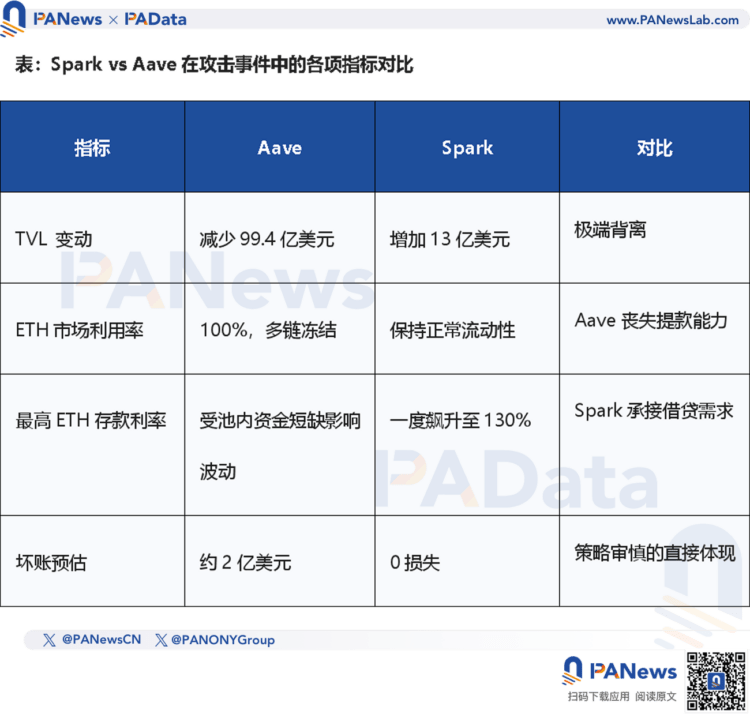
The infamous “toxic” rsETH asset flooded into Aave, precipitating approximately $200 million in bad debt. This led to a severe depletion of liquidity across the network, prompting a panicked exodus of billions in capital. Yet, amidst this widespread apprehension, Spark Protocol, another prominent lending giant, seized its moment. Its Total Value Locked (TVL) soared by $1.3 billion, and ETH deposit interest rates briefly skyrocketed to an astonishing 130%, cementing its status as the preferred safe haven for institutional investors and whales seeking refuge.
This “black swan” event has effectively recalibrated the hierarchy of the DeFi lending space, spotlighting the protocols best equipped to navigate extreme market volatility.
Aave’s Liquidity Crisis: A $15 Billion Exodus Fuels Spark’s Ascent
The breach in the rsETH cross-chain bridge brought Aave’s lending market to an abrupt halt. Malicious actors exploited the vulnerability by minting illicit rsETH, using it as collateral on Aave to borrow substantial amounts of WETH, thereby siphoning off clean assets and leaving behind a pool of unrecoverable debt.
Panic propagated rapidly throughout the ecosystem. Within a mere three and a half days, Aave witnessed an unprecedented $15.1 billion withdrawal, with total deposits plummeting from $48.5 billion to $30.7 billion – a staggering one-third of its total capital. WETH utilization rates on several chains hit 100%, rendering depositors unable to withdraw funds and liquidators unable to execute their functions.
A notable move came from Justin Sun, who swiftly withdrew 65,584 ETH, valued at approximately $154 million, from Aave. This decisive “first-mover” action spurred a significant herd effect, as investors, prioritizing capital preservation over high yields, scrambled to secure their assets.
While Aave became an exit point for exploiters, Spark Protocol transformed into a critical escape route for legitimate users. Contrary to the prevailing market trend, Spark’s TVL surged by $1.3 billion, pushing its total valuation to $4.74 billion – a clear vote of confidence from the market expressed through tangible capital inflows.
The massive surge in borrowing demand on Spark, coupled with heightened liquidity scarcity, led to an extraordinary spike in ETH deposit interest rates, peaking at an annualized 130%. This phenomenal rate underscored the immense premium placed on secure assets during times of crisis.
Spark’s remarkable resilience and ability to absorb this liquidity wave are deeply rooted in its distinctive ecosystem architecture. Unlike Aave, Spark operates as the primary lending engine within the Sky ecosystem, bolstered by substantial USDS reserves. As Sky’s strategic liquidity outpost, Spark not only relies on external deposits but also benefits from direct stablecoin replenishment via Sky’s dedicated credit lines. This “central bank-level” liquidity backstop proved instrumental, ensuring uninterrupted withdrawal channels even amid severe market turbulence.
Strategic Foresight: How Spark Protocol Delisted rsETH and Avoided Disaster
Spark’s successful navigation of the rsETH crisis can be directly attributed to a prescient, counter-trend decision made three months prior.
On January 29, two major lending platforms adopted diametrically opposed strategies concerning Liquid Restaking Tokens (LRTs):
- Aave’s Aggressive Expansion: The protocol enthusiastically launched rsETH E-Mode, enabling users to engage in leveraged lending with an exceptionally high Loan-to-Value (LTV) ratio of 93%. Aave’s objective was to attract an anticipated $1 billion rsETH inflow, aiming to restore WETH utilization and boost its TVL and revenue figures.
- Spark’s Prudent Retreat: Conversely, Spark Protocol, through a decisive governance “Spell” operation, completely halted new rsETH supply and initiated its gradual removal from the platform’s asset list.
At the time, Spark’s conservative stance drew criticism from ETH looping leverage users, who often profited from interest rate differentials by repeatedly collateralizing staking assets like stETH or rsETH. The delisting compelled many to migrate their positions, with a significant portion flowing to Aave, which offered more permissive policies and lower rates.
The community initially questioned Spark’s team, branding them “overly conservative” or “sacrificing growth.” Few could have predicted that this seemingly cautious step would ultimately safeguard the entire protocol.
In a post-mortem analysis, monetsupply.eth, Spark’s Head of Strategy, elucidated that the decision to delist rsETH was predicated on a stringent, safety-oriented tightening mechanism:
- Marginal Cost vs. Marginal Benefit: Assets whose maintenance costs surpassed their risk-adjusted benefits to the protocol were slated for removal.
- Concentration of Risk Exposure: rsETH’s utilization on Spark was minimal and largely monopolized by a single wallet address, posing an undiversifiable risk.
- User Preference Analysis: The sole significant rsETH user on Spark expressed a willingness to transition to more established collateral types like wstETH or weETH, providing a timely opportunity for the protocol to divest the asset smoothly.
This commitment to transparent, disciplined decision-making, prioritizing genuine security over the “vanity metric” of TVL, enabled Spark to completely circumvent all potential losses stemming from the rsETH exploit.
Spark’s Multi-Layered Defense: Rate Limits, Dynamic Interest Rates, and Isolated Architecture
Even without the foresight to delist rsETH, PANews contends that Spark’s robust architectural design would have been sufficient to withstand such an attack. In contrast to Aave’s pursuit of capital efficiency, which sometimes compromises safety redundancy, Spark has meticulously engineered a multi-layered, deep defense system:
-
Strict Rate-Limited Caps: Spark enforces stringent deposit and borrowing rate limits, ensuring that the volume of assets deposited and borrowed grows incrementally over fixed periods. This mechanism would have prevented an attacker from depositing $290 million in collateral at once, as occurred on Aave. By capping maximum single-event risk exposure, potential losses are forcibly contained within manageable thresholds.
-
Sustained High Interest Rate Ceilings: Spark consistently maintains relatively high interest rate caps. In stable markets, elevated borrowing rates naturally deter excessive leverage, while simultaneously attracting more depositors by offering superior returns. This strategy ensures that the liquidity pool always retains sufficient capital, preventing scenarios where funds are entirely loaned out and withdrawals become impossible. Critically, during market downturns, this prevents liquidity depletion from triggering a bank run.
Furthermore, when pool utilization rises, Spark’s interest rate curve exhibits a steeper slope compared to Aave, yielding two critical outcomes:
- Forced Deleveraging: The escalating cost of borrowing compels users to proactively seek liquidity to repay their loans.
- Rapid Liquidity Influx: High annualized deposit returns swiftly attract external arbitrage capital, effectively resolving 100% utilization bottlenecks.
-
Modular Isolation Architecture: Spark’s design offers superior controllability in risk management through its modular isolation architecture. When handling high-risk synthetic assets like USDe, Spark adopts a cautious approach, segregating them into specific, isolated primary risk vaults. This ensures that any issues arising from a particular sub-asset remain contained, preventing contagion to the platform’s main lending pools.

The significant liquidity migration from Aave to Spark underscores a fundamental shift in investor sentiment within DeFi: a pivot from aggressive pursuit of yield towards a greater emphasis on safety and stability.
Aave’s multi-billion dollar outflow serves as a stark warning to all protocols prioritizing high capital efficiency. When safety margins are compromised, even minor external risks can quickly escalate into systemic challenges, threatening the integrity of the entire protocol.
Conversely, Spark Protocol’s ascendancy demonstrates that in volatile market environments, disciplined risk governance and the unwavering execution of a “risk-first” strategy are the most enduring competitive advantages. These principles form the bedrock of long-term value and resilience in decentralized finance.
(The content above is an authorized excerpt and reproduction from our partner, PANews. Original Article Link)
Disclaimer: This article is provided for market information purposes only. All content and opinions are for reference and do not constitute investment advice. They do not represent the views or positions of BlockTempo. Investors should make independent decisions and conduct their own trades. The author and BlockTempo assume no responsibility for any direct or indirect losses incurred by investors’ trading activities.