Author: Ariel, CryptoCity
Pokémon’s 30th Anniversary Ignites Tokenized Card Market, Driving Millions in Revenue
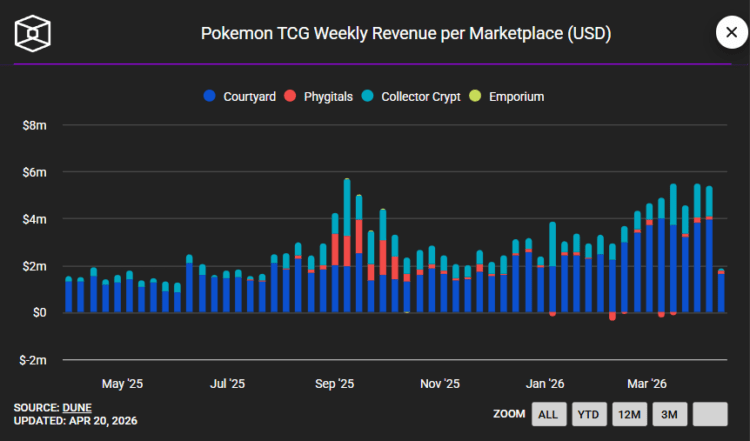
As the iconic Pokémon franchise approaches its momentous 30th anniversary, a remarkable resurgence is sweeping through the market for tokenized Pokémon cards, often recognized as Pokémon card NFTs. This burgeoning sector recorded an astonishing $5.38 million in revenue for the week ending April 6th, a figure that places it tantalizingly close to its all-time high achieved in September 2025.
However, the current market dynamism represents a distinct structural evolution compared to the peaks observed just six months prior. According to external analysis by The Block, the September 2025 surge was predominantly a singular, intense spike triggered by a token issuance from the platform Collector Crypt. In stark contrast, the recent robust growth has demonstrated sustained momentum over six consecutive weeks, with the lion’s share of this impressive revenue now flowing through the established digital collectibles platform, Courtyard.
The revitalized interest in the tokenized Pokémon card market is intrinsically linked to the impending 30th-anniversary celebrations. With Nintendo officially confirming the global release of special 30th-anniversary commemorative products in 2026 – expected to feature classic card back designs and highly sought-after cards from across generations – the NFT market has proactively begun to reflect the anticipated demand surrounding these landmark events.
Tokenized Pokémon Cards: A Groundbreaking Frontier for Real-World Assets (RWA)
This latest surge in tokenized Pokémon cards diverges sharply from the purely speculative enthusiasm that characterized the virtual avatar-based NFT trend of previous years. The innovative process of transforming physical Pokémon cards into “tokenized collectibles” for on-chain trading has firmly established itself as a viable and rapidly expanding subcategory within the Real World Assets (RWA) domain.
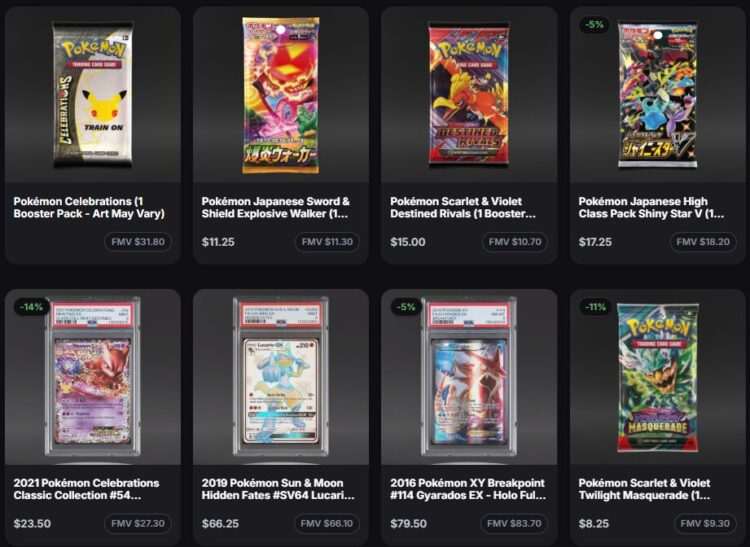
Platforms such as Courtyard perfectly exemplify this forward-thinking approach. They operate by securely depositing physical Pokémon cards into accredited third-party vaults, subsequently issuing corresponding redeemable tokens that digitally represent ownership. This ingenious model successfully attracts discerning collectors who seek enhanced liquidity for their valuable assets while simultaneously mitigating the inherent speculative risks often associated with purely crypto-native investments.
- Related Report: Selling a Pack Every 4 Seconds! The Rapid Rise of the TCG Market: Who Are Collector Crypt and Courtyard’s Audiences?
The sophisticated tokenization technology deployed by these platforms, which facilitates seamless Pokémon card trading, primarily functions as a powerful instrument for providing liquidity. This marks a significant and welcome departure from the speculative-driven trading models that defined earlier NFT cycles. As physical Pokémon cards are consistently redeemed and physically settled, the on-chain market’s pricing mechanism gains substantial validation, thereby establishing a successful blueprint for the tokenization of diverse intellectual property and other high-value collectibles.
It is imperative to underscore that the tokenized Pokémon card market operates as an independent secondary market and maintains no official affiliation with The Pokémon Company, Nintendo, or any other official entity.
Courtyard Poised for $200 Million Annual Revenue Amidst Pokémon’s 30th Anniversary Hype
Projections from The Block indicate that if current revenue levels are sustained, Courtyard’s annual revenue for the 2026 fiscal year could reach an impressive $200 million. This substantial figure would eclipse the scale of most mid-sized NFT trading platforms observed in 2021. Furthermore, Courtyard benefits from remarkably reduced marketing expenditures, as its demand directly capitalizes on the robust enthusiasm within the physical card market, thus eliminating the need to re-market avatar-style NFTs from the ground up.
While a short-term risk for Courtyard involves a potential stagnation of the physical card bull market, the long-term outlook remains exceedingly promising. The prevailing trends unequivocally demonstrate that “tokenized collectibles” have successfully identified a strong product-market fit, paving the way for the establishment of entirely new and innovative business models across various asset classes, including highly coveted sports cards and luxury watches.
Tokenization Offers a Secure Haven Amidst Rising Physical Card Thefts
The recent surge in Pokémon card values, significantly propelled by the 30th-anniversary anticipation, has regrettably brought with it considerable security challenges for physical retail establishments. Reports from the BBC highlight a concerning proliferation of smash-and-grab robberies targeting Pokémon card shops across the United Kingdom. Numerous establishments in regions such as Cheshire and Bristol have fallen victim to these audacious attacks, with some retailers reporting devastating losses amounting to tens of thousands of pounds in valuable inventory.
- Related Report: Not Jewels, But Pokémon Cards! UK Hit by Wave of Smash-and-Grab Robberies, Stores Suffer Heavy Losses
In direct response to the escalating risks of theft faced by physical Pokémon card collections, the tokenized market presents a contact-free and comparatively secure alternative for both ownership and trading. By entrusting high-value cards to professional, secure custodians and subsequently converting them into verifiable on-chain tokens, collectors can actively participate in the vibrant card trading market while significantly mitigating the ever-present risk of physical loss or theft.
(The above content has been excerpted and reproduced with authorization from our partner CryptoCity. Original Link)
Disclaimer: This article is for market information purposes only. All content and views are for reference only and do not constitute investment advice. They do not represent the views or positions of Blockcast. Investors should make their own decisions and trades. The author and Blockcast will not be held responsible for any direct or indirect losses incurred by investors’ transactions.