Taiwan’s FSC Blocks Union Bank’s Direct Investment in Crypto Giant MaiCoin
Union Bank’s ambitious plan to directly invest in MaiCoin, a leading Taiwanese virtual asset service provider, has hit a regulatory roadblock. The proposed acquisition of a 9.67% stake in MaiCoin’s offshore holding company, Modernity Financial Holdings, Ltd., for approximately US$27.817 million (NT$850 million), was originally approved by Union Bank’s board last August. The plan also included transferring existing shares held by its subsidiary, Union Venture Capital, to the bank.
However, Union Bank announced on May 11 that Taiwan’s Financial Supervisory Commission (FSC) has rejected the investment. The FSC determined that Modernity Financial Holdings, Ltd. does not qualify as a “financial-related business” and lacks “substantive operational facts,” making the direct investment non-compliant with existing regulations. Union Bank stated that this decision would not significantly impact its financial performance or business operations.
Banking Act Article 74: The Decisive Factor in FSC’s Rejection
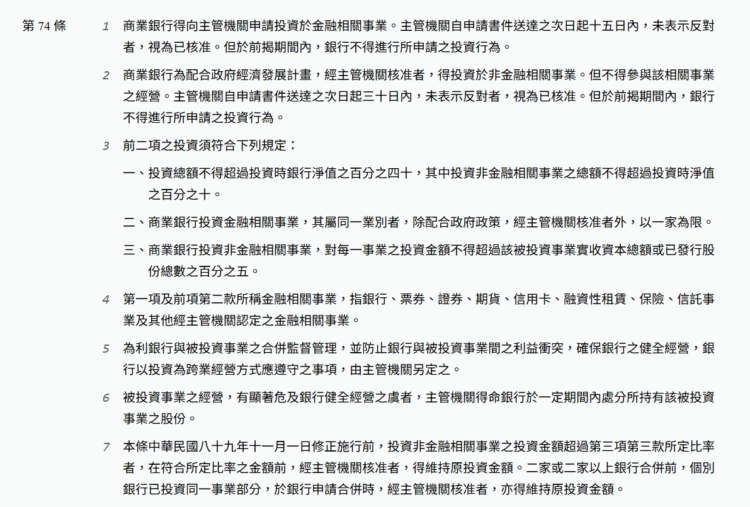
The core reason behind the FSC’s rejection lies squarely with Article 74 of Taiwan’s Banking Act. This crucial regulation mandates that commercial banks seeking to invest in either financial or non-financial related entities must first secure approval from the competent authority.
Crucially, the investee company must demonstrate “substantive operational facts.” Furthermore, if the investment target is classified as a non-financial related business, the bank’s equity stake is legally capped at 5% of the company’s total issued shares.
Following a thorough internal review, the FSC concluded that Modernity Financial Holdings, Ltd., registered in the British Cayman Islands, operates solely as an offshore holding company. It neither qualifies as a financial-related business nor possesses any substantive operational activities. Consequently, the proposed investment failed to meet the fundamental prerequisites outlined in Banking Act Article 74.
Union Bank’s Steadfast Expansion into the Crypto Ecosystem
Despite the recent setback, Union Bank has been a proactive pioneer among Taiwanese financial institutions in embracing the burgeoning virtual asset sector. With the FSC actively promoting the Virtual Asset Service Act draft and a Virtual Asset Service Provider (VASP) licensing regime, Union Bank has already made significant strides.
The bank has become the first financial institution in Taiwan to officially launch virtual asset custody services, receiving regulatory approval. Further demonstrating its commitment, Union Bank recently introduced the nation’s first co-branded credit card offering cryptocurrency rewards, allowing cardholders to convert their spending rewards directly into popular digital assets like Bitcoin, Ethereum, Tether, and USDC.
Union Bank General Manager Hsu Wei-wen has outlined an ambitious four-phase strategy for the bank’s virtual asset custody business. Initially, the focus will be on safeguarding assets for trading platforms. Subsequent phases will extend services to professional institutional investors and high-net-worth individuals, ultimately aiming to meet the future custody demands for cryptocurrency ETFs potentially launched by investment trusts.
While the direct equity investment in MaiCoin has been halted, the partnership between Union Bank and MaiCoin appears set to continue. According to reports from the Economic Daily News and Commercial Times, the investment plan is expected to proceed through personal related enterprises of Union Bank’s major shareholders. This alternative arrangement suggests that the existing collaborative model between the two entities will remain largely unaffected. Union Bank has reiterated its full respect for the regulatory authority’s decision.