Cardano (ADA) finds itself at the heart of a curious contradiction: an ever-tightening grip of its supply by a select few “whale” investors, starkly contrasted by a visibly receding on-chain ecosystem. Data reveals that these deep-pocketed entities have been systematically accumulating ADA for two years, now commanding a staggering nearly 70% of the token’s total circulating supply.
On-chain analytics firm Santiment reports that whale wallets holding a minimum of 1 million ADA tokens collectively own an impressive 25.09 billion ADA. This accounts for 67.47% of the total circulating supply, marking the highest concentration of whale holdings observed since July 2020. This relentless accumulation trend, notably, has remained unbroken since December 2023.
🤑 Cardano’s key stakeholders have slowly but surely accumulated, consistently adding more and more of the existing supply to their bags, dating back to December, 2023.
🐳 Wallets with at least 1M tokens now hold 25.09B $ADA, which translates to 67.47% of the current existing… pic.twitter.com/knuSbfYtaE
— Santiment Intelligence (@SantimentData) May 13, 2026
ADA’s Price Plunge Meets Relentless Whale Accumulation
This fervent whale accumulation paints a striking picture against the backdrop of ADA’s dismal price performance and its shrinking ecosystem. Over the past nine months, ADA’s market capitalization has plummeted by a significant 71%. This suggests that major holders are strategically employing a classic “buy the dip” approach, actively increasing their positions as the asset’s value declines.
Concurrently, Cardano’s decentralized finance (DeFi) ecosystem is experiencing a sharp contraction. According to data from DeFiLlama, Cardano’s Total Value Locked (TVL) has dwindled to a mere $137 million. This represents a dramatic 80% collapse from its peak of approximately $686 million recorded in December 2024.
Faltering On-Chain Activity: Fees Below $2,000
The overall vibrancy of on-chain transaction activity on Cardano has also notably diminished. Daily average trading volume on Cardano’s decentralized exchanges (DEXs) currently hovers around a modest $1.95 million. Furthermore, on-chain fees collected over the past 24 hours amounted to a paltry $1,767 – a stark contrast when compared to other top 10 market capitalization cryptocurrencies such as Ethereum and Solana. In a similar vein, Cardano’s on-chain revenue for the past day was a mere $353, with active addresses numbering just 15,975.
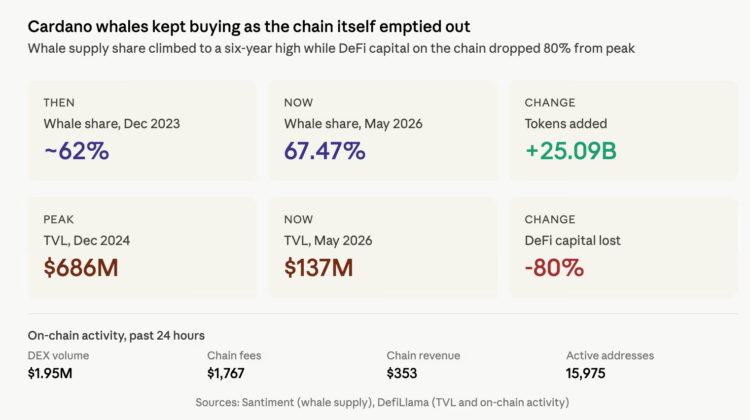
This confluence of data presents an intriguing scenario: while large investors are heavily acquiring ADA, their actions appear to be driven by a long-term “holding” strategy, rather than active engagement with Cardano’s ecosystem applications or participation in arbitrage opportunities.
As of May 15, during Asian trading hours, ADA was trading around $0.267, with a market capitalization of approximately $9.87 billion. Since the broader cryptocurrency market’s peak in late 2024, ADA has, without a doubt, been one of the weakest performers among the top 10 cryptocurrencies.
While the continuous accumulation by whales may provide a psychological floor for ADA’s price, a critical question looms large: without a revitalized on-chain application landscape capable of attracting developers and users back to the ecosystem, can this significant “chip migration” truly translate into sustainable price appreciation? The answer remains highly uncertain.
Disclaimer: This article is intended solely for the purpose of providing market information. All content and views expressed herein are for reference only and do not constitute investment advice. They do not represent the views or positions of BlockTempo. Investors are encouraged to make their own informed decisions and conduct their own due diligence. The author and BlockTempo shall not be held liable for any direct or indirect losses incurred by investors’ trading activities.