Author: Nancy, PANews
In a period of just a few months, the Ethereum Foundation (EF) has witnessed a series of high-profile departures from its core team, a development that has further dampened the morale of the Ethereum community, especially amidst a period of relatively subdued Ether (ETH) price performance.
Ethereum Foundation’s Pivotal Transformation Amidst Veteran Exodus
Mid-2025 marked the beginning of a significant internal overhaul for the Ethereum Foundation (EF). Facing persistent criticism regarding sluggish execution efficiency, inadequate ecosystem support, and a lack of governance transparency, the Foundation initiated a comprehensive restructuring of its research and development teams, alongside its first public layoffs. This bold move was widely perceived as a necessary, albeit belated, act of self-correction.
Further solidifying its evolving mandate, the EF published an extensive 38-page mission statement in March 2026. While reaffirming Ethereum’s foundational vision, the document explicitly articulated a shift in the Foundation’s role: from being the “primary guardian” to becoming “one of many guardians.” To dramatically illustrate this commitment, the EF even created a humorous “SOURCE SEPPUKU LICENSE” meme, signaling its readiness to face severe consequences – to “self-destruct” – should it fail in its promise to Ethereum.
Yet, even as these organizational changes unfolded, the EF has contended with a steady stream of core talent departures. Since February of this year, a notable seven core members or senior contributors have announced their exit.
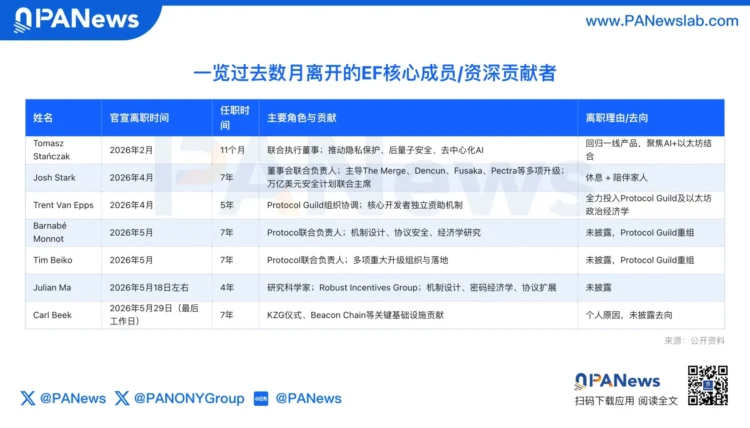
Notable Departures from the Ethereum Foundation
- Tomasz Stańczak (Co-Executive Director): In February, Stańczak stepped down as Co-Executive Director after less than a year in the role. During his tenure, he championed advancements in privacy protection, post-quantum security, and decentralized AI. He cited the Ethereum ecosystem’s current healthy state as an opportunity to return to hands-on product development, focusing on AI-Ethereum integration. Stańczak also noted a diminishing scope for independent execution within the EF, suggesting his continued presence felt more like a transitional phase. He was succeeded by Bastian Aue, who joined the EF in 2019 and previously focused on organizational coordination and operational optimization.
- Josh Stark (Key Figure & Upgrade Contributor): Mid-April 2026 saw the departure of Josh Stark, a pivotal figure who dedicated seven years to the Foundation. Stark was instrumental in numerous critical Ethereum upgrades, including The Merge, Dencun, Fusaka, and Pectra, and co-chaired the Trillion Dollar Security Program. His stated reason for leaving was to “plan for rest and spend time with family.”
- Trent Van Epps (Protocol Guild Coordinator): On the same day as Stark, Trent Van Epps also announced his exit. Van Epps was a long-standing coordinator for the Protocol Guild, a crucial initiative for establishing funding mechanisms for Ethereum’s core developers and managing network upgrades. Post-departure, he plans to dedicate his efforts to the Protocol Guild and research into Ethereum’s political economy. Notably, he had previously voiced his perplexity regarding the connection between EF leadership and the Milady NFT series.
- Alex Stokes (Protocol Research Co-Lead): As May began, Alex Stokes, co-lead of Protocol Research, announced a leave of absence.
- Barnabé Monnot, Tim Beiko, Carl Beek, Julian Ma (Senior Researchers & Protocol Guild): Following Stokes, former Protocol Guild co-leads Barnabé Monnot and Tim Beiko, along with senior researchers Carl Beek and Julian Ma, also left the Foundation. The reasons for their departures have not been publicly disclosed.
Unconfirmed Mandate and Growing Ecosystem Concerns
While most departing members have remained silent on their specific reasons, unconfirmed reports suggest a potential factor: the Ethereum Foundation’s alleged requirement for internal members to sign a document called “Mandate.” This mandate, reportedly rooted in the EF’s “censorship resistance principle,” stipulates that any entity should not interfere with legitimate use or system operation through persistent and exclusive control over key mechanisms. Failure to sign, according to these rumors, would result in immediate dismissal. The Ethereum Foundation has not officially confirmed these claims.
Regardless of the underlying causes, this exodus of talent from the EF has ignited broader concerns across the Ethereum ecosystem. Cheeky-gorilla, a contributor to the Protocol Guild, issued a stark warning: the health of Layer 1 (L1) core development is the bedrock of Ethereum. He highlighted that core developers’ salaries are significantly lower – 50% to 60% below market rates for similar roles – while aggressive competitors like new high-performance chains such as Monad and leading Layer 2 (L2) projects are actively poaching talent with offers exceeding 10 times current compensation. Cheeky-gorilla cautioned that the loss of senior researchers, intimately familiar with the intricate logic of the underlying protocol, poses a substantial risk of stalling Ethereum’s critical roadmap.
Protocol Team Undergoes Leadership Reshuffle, Raising Upgrade Delay Concerns
The rapid succession of senior departures, spanning both executive and research functions within a mere four months, has amplified the uncertainty surrounding the Ethereum Foundation’s ongoing reforms, particularly concerning its critical Protocol team.
The Protocol team is the bedrock of Ethereum’s infrastructure, tasked with the fundamental design, research, development, and coordination of the base layer. Its purview includes vital areas such as security, cryptography, zkEVM, and peer-to-peer networking. As a cornerstone of the Ethereum Foundation, this team holds immense sway over the long-term evolution, security, and scalability of the Ethereum protocol.
In response to these significant personnel shifts, the Ethereum Foundation has moved swiftly to restructure the Protocol team. This month, it announced the appointment of three new Protocol co-leads: Will Corcoran, Kev Wedderburn, and Fredrik Svantes. Each brings substantial experience, having served the Ethereum Foundation for durations ranging from two to seven years.
Meet the New Protocol Co-Leads
- Will Corcoran (Protocol Research Coordinator): Corcoran brings extensive experience in cross-team coordination and a deep understanding of Ethereum’s overall architecture. His focus will be on pioneering research areas such as zkVM proving systems, post-quantum consensus, and the Fast Confirmation Rule.
- Kev Wedderburn (zkEVM Team Lead): A seasoned expert in zero-knowledge proofs and zkEVM implementation, Wedderburn has a strong track record of integrating research with engineering. He will continue to spearhead zkEVM initiatives, driving the profound integration of the execution layer with zero-knowledge technology.
- Fredrik Svantes (Protocol Security Research Lead): Svantes has been a long-term leader in core Ethereum security efforts, including the Trillion Dollar Security Program, the Ethereum Bug Bounty Program, and organizing audit competitions. His role will involve extensive cross-team collaboration to bolster Ethereum’s security posture.
Under the guidance of this new leadership, the Protocol team’s immediate priorities include pushing forward the launch of the Glamsterdam upgrade, laying the groundwork for the subsequent Hegotá upgrade, and steadily advancing the broader Strawmap roadmap.
Glamsterdam Upgrade Faces Delays Amidst Personnel Shifts
The Glamsterdam upgrade represents Ethereum’s next monumental network enhancement, primarily aimed at significantly boosting the mainnet’s transaction throughput. Key changes include a proposed increase in the Gas limit from approximately 60 million to 200 million, alongside refinements to transaction processing mechanisms and state database management.
However, the Glamsterdam upgrade, initially slated for June 2026, has now encountered delays. Latest testnet progress and feedback from Interop meetings indicate that the actual mainnet deployment is more realistically pushed back to Q3 2026. This postponement has fueled anxieties among some community members and developers, who fear that the recent flurry of core personnel changes could further impede the upgrade’s timeline and overall execution efficiency.
A Broader Perspective: Decentralization and Resilience
Conversely, some observers posit that this wave of personnel changes is a natural evolution within the Ethereum Foundation’s restructuring. They argue that certain members are departing after fulfilling their specific mandates, while others are aligning with new strategic directions. Crucially, a new leadership cadre is now in place, and the fundamental roadmap for Ethereum remains unaltered. More significantly, as the Ethereum ecosystem matures, the Foundation itself is consciously working to diminish its central role. This intentional decentralization aims to mitigate single-point control risks, address external skepticism regarding the Foundation’s influence, and reinforce Ethereum’s core identity as a neutral, foundational infrastructure.
This perspective resonates deeply with Vitalik Buterin’s “Walkaway Test” concept. The test proposes that a truly robust and decentralized protocol should be able to operate securely, predictably, and stably over the long term, even if its core developers were to completely withdraw and cease maintenance. The current transitions, therefore, could be seen as a step towards achieving this ultimate state of resilience for Ethereum.
(The above content is excerpted and reproduced with authorization from partner PANews, original link)
Disclaimer: This article is provided for market information purposes only. All content and views are for reference only, do not constitute investment advice, and do not represent the views and positions of the publisher. Investors should make their own decisions and trades. The author and publisher will not bear any responsibility for direct or indirect losses incurred by investor transactions.