Author: Ariel, CryptoCity
Taiwan Intensifies Crackdown on Polymarket Election Betting: Court Orders Blockade and Legal Action
As the 2026 local elections draw nearer, the decentralized prediction market Polymarket has become a focal point of controversy in Taiwan due to the emergence of betting pools related to the upcoming elections. This has led to a significant crackdown by authorities, with several Taiwanese citizens participating in these bets reportedly arrested and even prosecuted.

Polymarket Blocked by Court Order, Confirmed Inaccessible Across Taiwan
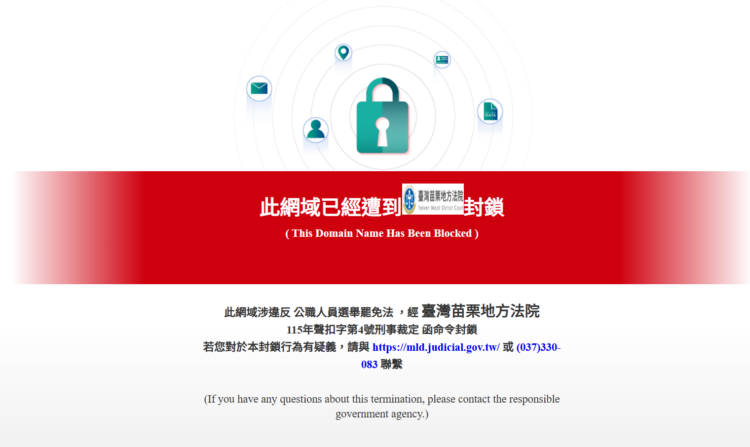
In early May, reports began surfacing from users across Taiwan indicating that the Polymarket website had been blocked. Attempts to access the platform via Taiwanese mobile networks or Wi-Fi connections now display a stark warning: “This domain is suspected of violating the Public Officials Election and Recall Act, and has been ordered blocked by Miaoli District Court Criminal Ruling No. 4 of 115.” This judicial order effectively renders the site inaccessible within the country.
A recent test conducted by a CryptoCity editor on May 21st using a mobile network confirmed the persistent blockage, verifying the inaccessibility of the site. While Polymarket has experienced temporary unblocks in the past, even during those periods, Taiwanese users were typically restricted to viewing prediction contract odds and trading volumes, with betting functionalities remaining disabled.
Developer’s Automated Trading Bot Triggers Election Bet, Leading to Police Interrogation
The reach of this legal crackdown extends beyond manual bettors, serving as a cautionary tale for developers leveraging automated trading solutions. Even unintentional involvement in Taiwan’s election markets can lead to severe consequences.
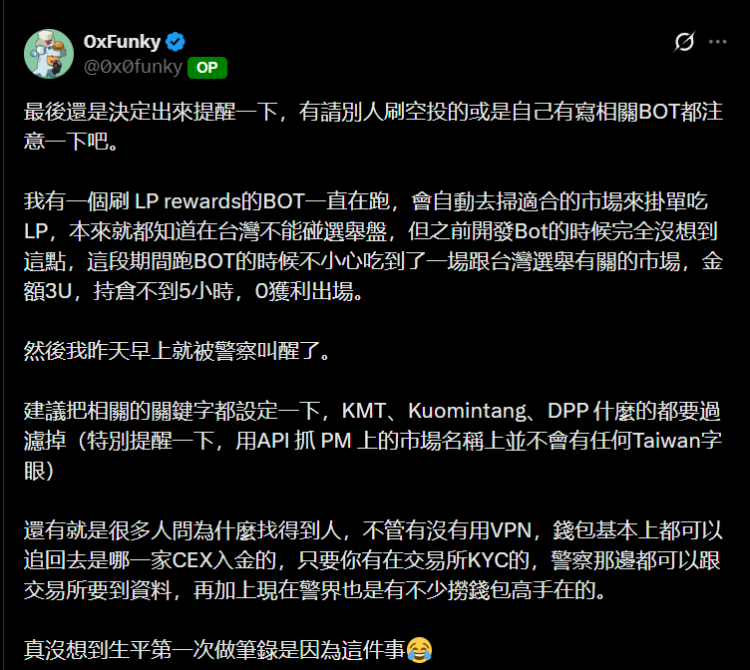
0xFunky, a Taiwanese developer and founder of SuiXu Intelligence, recently shared his experience of being unexpectedly woken by police on May 19th for his first-ever interrogation. His automated trading bot had inadvertently executed a transaction related to a Taiwan election market on Polymarket. Despite the minuscule transaction amount of just 3 $USDT, a holding period of less than five hours, and zero profit upon exit, the incident still prompted a police response.
In light of his ordeal, 0xFunky strongly advises that both developers and users implement stringent keyword filters to explicitly exclude terms such as KMT, Kuomintang, and DPP. This precaution is crucial because market names fetched via API may not explicitly contain the word “Taiwan,” making it easy to inadvertently participate in prohibited markets.
Nationwide Investigations Escalate, Qiaotou District Prosecutor’s Office Sets Legal Precedent
Taiwanese investigative authorities launched their initial wave of operations targeting the 2026 local elections in April, resulting in the arrest of two individuals who had placed bets on political party probabilities. This marked the beginning of a concerted effort to curb illegal election gambling.
A significant development occurred on May 8th, when the Qiaotou District Prosecutor’s Office formally indicted a man identified only by his surname, Lin. This case stands as a landmark prosecution, being the first to officially enter judicial proceedings as part of the broader crackdown on 2026 local election betting. It unequivocally signals the authorities’ unwavering commitment and robust enforcement stance against the use of decentralized platforms to influence or bet on electoral outcomes.
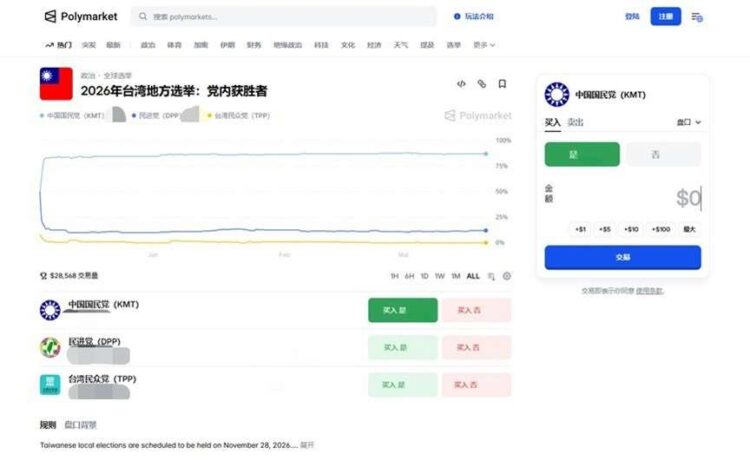
Court records compiled by Lien News further reveal a widespread legal offensive, with similar cases and judgments recorded in district courts across Yunlin, Shilin, Hsinchu, Miaoli, Taoyuan, and Taichung, underscoring the nationwide scope of the investigation.
- Related Report: 2026 Taiwan Election Prediction Market Betting Case “Formally Indicted”: Man Arrested for Betting 23,000 on Polymarket
Police Possess Advanced Crypto Tracing Capabilities: A Warning Against Testing the Law
A common misconception among participants in decentralized markets is the belief that using VPNs or transacting on blockchain platforms guarantees anonymity. However, Taiwanese law enforcement agencies have demonstrated sophisticated capabilities in tracing cryptocurrency flows to identify real individuals.
0xFunky, from his personal experience, highlighted a critical point: regardless of VPN usage, if an individual has completed Know Your Customer (KYC) verification on a cryptocurrency exchange, police can subpoena those records to trace the wallet holder’s true identity. This effectively negates any perceived anonymity.
The Yunlin County Government Police Bureau has also publicly affirmed its commitment to these investigations, stating its intent to continuously deploy technological resources and smart policing strategies to rigorously detect and prosecute election betting. They issued a stern warning to the public, urging citizens to refrain from placing bets to avoid infringing upon the law.
(The above content is an authorized excerpt and reproduction from our partner CryptoCity. Original Article Link)
Disclaimer: This article is for market information purposes only. All content and views are for reference only and do not constitute investment advice. They do not represent the views and positions of BlockTempo. Investors should make their own decisions and trades. The author and BlockTempo will not bear any responsibility for direct or indirect losses resulting from investor transactions.