Author: Fenrir, Crypto City
Bitcoin’s $66,000 Return: A Fragile Recovery or a New Ascent?
Bitcoin recently surged past the $66,000 mark, a level not seen since early June, sparking renewed optimism across the crypto market. This rally is underpinned by a confluence of positive factors: a resurgence of capital into US spot Bitcoin ETFs, a slight easing of broader macroeconomic pressures, and a notable contraction in the supply held by long-term investors. These developments have naturally led traders and analysts to question whether the market is finally transitioning into a sustained recovery phase.
However, a deeper dive into on-chain and derivatives data reveals a more nuanced and, at times, contradictory picture. While the price action is encouraging, underlying metrics suggest that the market’s repair is far from complete, and significant challenges remain from the preceding downturn. VanEck data indicates that investors who sold Bitcoin in the last month realized substantially more losses than profits, with the total network’s unrealized loss still hovering around 16% of Bitcoin’s market capitalization. Furthermore, only about 53% of the circulating supply is currently in profit, significantly below the four-year average of 76%. This suggests that despite the price rebound, a substantial portion of the market remains under pressure, holding positions acquired at higher price points.
Spot Market’s Hesitation: A Foundation of Sand?
The first red flag emerges from the spot market. Bitcoin’s average daily spot trading volume over the past 30 days stood at approximately $5.1 billion, a notable 29% decrease from the $7.2 billion average recorded since 2019. This disparity is crucial: while Bitcoin’s price briefly breached $66,000, the absence of a corresponding surge in general spot buying activity casts doubt on the rally’s underlying strength and sustainability. A robust price movement typically requires strong conviction from spot buyers, which appears to be lacking.
Adding to this concern, trading sentiment continues to lean towards selling. Over the past month, daily market sell orders have outpaced buy orders by an average of $70 million. Although this gap narrowed slightly to $59 million in the most recent week, it remains significantly higher than the historical average of $21 million. This suggests that Bitcoin’s ascent has occurred without a full return of buying enthusiasm. Should demand fail to pick up, the price remains vulnerable to minor selling pressure or adverse macroeconomic news, potentially unwinding recent gains.
Derivatives Traders Remain Wary: Hedging Over HODLing
The derivatives market presents another layer of caution. Over the last month, the premium for put options (bets on price decline) was nearly 50% higher than for call options (bets on price increase), pushing the Put-to-Call premium ratio to approximately 1.49. This elevated ratio, observed only about 10% of the time since 2021, signals that even as prices rebound, traders are willing to pay a premium for downside protection, indicating lingering apprehension about a potential reversal.
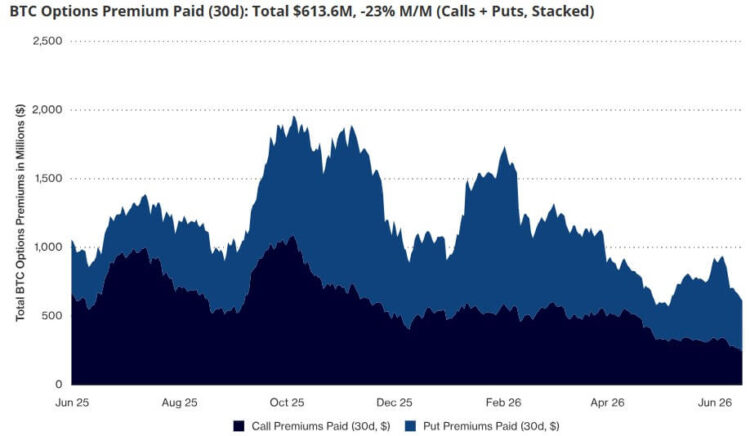
Perpetual futures positions also reflect a cautious stance. Average open interest has declined from roughly $35.7 billion two months ago to about $29.4 billion. While funding rates remain positive, they are still below historical averages. This data suggests that the market is not aggressively chasing higher prices, keeping leverage pressure relatively contained and mitigating the immediate risk of cascading liquidations. However, this also implies that without substantial spot demand, the derivatives market alone is unlikely to drive a sustained, powerful rally.
The Supply Side Story: HODLers & Renewed ETF Interest
A more encouraging signal comes from the supply side: the continued contraction of long-term holder supply. Approximately 12.2 million Bitcoins, representing 60.8% of the circulating supply, have remained unmoved for over a year—an increase from 59.1% six months prior. An additional 3.55 million Bitcoins have been dormant for 6 to 12 months, meaning a remarkable 78.5% of the total supply has not changed hands for at least half a year. This “HODLing” behavior by long-term investors keeps the tradable supply tight, creating a fertile ground for price appreciation if demand increases.
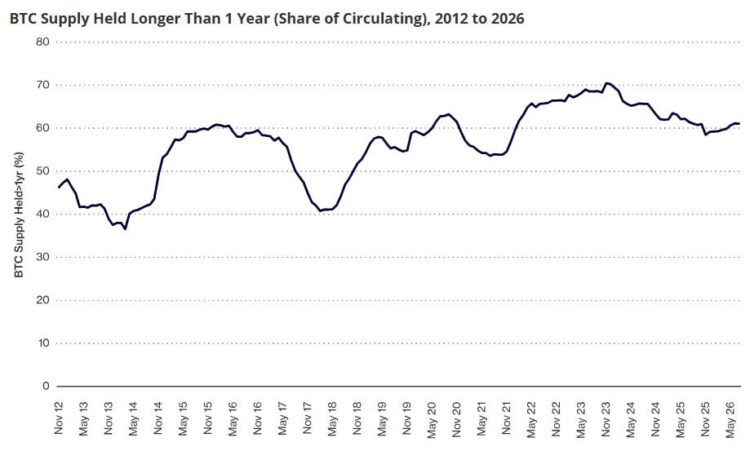
Yet, the supply landscape isn’t entirely static. Exchange balances have seen an increase of approximately 26,674 Bitcoins over the past month, indicating that some dormant supply is re-entering the market. Additionally, a portion of Bitcoins held for 3 to 10 years has begun to move. Crucially, the fourth significant signal is the renewed demand from US spot Bitcoin ETFs. These products have recorded six consecutive days of net inflows, totaling over $930 million, including a single-day inflow of approximately $226 million on July 20. This influx is a vital step towards recovery, especially considering the preceding 30 days saw outflows of about 40,010 Bitcoins (valued at approximately $2.4 billion) from these very products. Thus, the current inflows represent an early, rather than complete, phase of market repair.
Navigating Critical Price Levels: What’s Next for Bitcoin?
According to Glassnode analysis, Bitcoin is now approaching the short-term holder cost basis around $69,000. This represents the average acquisition price for investors who bought in the last five months. As the price nears this zone, previously “underwater” investors may opt to sell at break-even, making $69,000 a critical short-term decision point. A decisive breakthrough above this level would open the door for Bitcoin to challenge the formidable resistance band near $70,920.
Conversely, strong support is concentrated around the $63,000 level. For Bitcoin’s rebound to sustain, several conditions must align: continued ETF inflows, a recovery in spot trading volume, and the absence of large-scale profit-taking from long-term holders. Should buying demand remain subdued and the options market continue to favor hedging, the current price breakthrough could remain within a high-volatility structure, susceptible to pullbacks.
In essence, these four key signals collectively paint a consistent picture: Bitcoin is undeniably in a phase of market repair. However, it has not yet entered a full-blown “chase higher” state, demanding careful observation from investors and traders alike.
(The above content is an authorized excerpt and reprint from our partner “Crypto City”, original link)
Disclaimer: This article is for market information purposes only. All content and views are for reference only and do not constitute investment advice, nor do they represent the views and positions of BlockTempo. Investors should make their own decisions and trades. The author and BlockTempo will not bear any responsibility for direct or indirect losses incurred by investors’ transactions.