Grayscale Challenges Bitcoin’s 4-Year Cycle: Macro Factors Signal a Potential Bear Market End
A new research report from digital asset management giant Grayscale has sent ripples through the market, positing a provocative idea: the Bitcoin bear market may already be behind us, provided the U.S. Federal Reserve halts its interest rate hikes.
Zach Pandl, Grayscale’s Head of Research, delves into two competing narratives currently shaping Bitcoin’s trajectory. The first is the long-revered “4-year cycle” theory, while the second is a novel pricing logic predominantly influenced by macroeconomic forces. Pandl leans heavily towards the latter, asserting that Bitcoin’s price movements are increasingly tied to interest rates and the broader economic environment, suggesting that traditional market cycle patterns may be losing their predictive power.
The Contradictory Forecasts: Cycles vs. Fundamentals
According to the conventional 4-year cycle theory, Pandl notes that Bitcoin’s price still has room for further decline. This model predicts a bottoming out around September or October of this year, which, from the current approximate price of $65,000, would imply an additional dip of about 15%.
However, real-world capital flows paint a different picture. Bitcoin has already staged a robust rebound, climbing over 10% from its early July low of $57,717. Furthermore, spot Bitcoin ETFs have seen seven consecutive days of inflows, accumulating nearly $1 billion in net capital. Despite this short-term strength, a glance at the monthly charts reveals that the market technically remains in a weak bearish configuration, with the potential for further downward drift over several months.
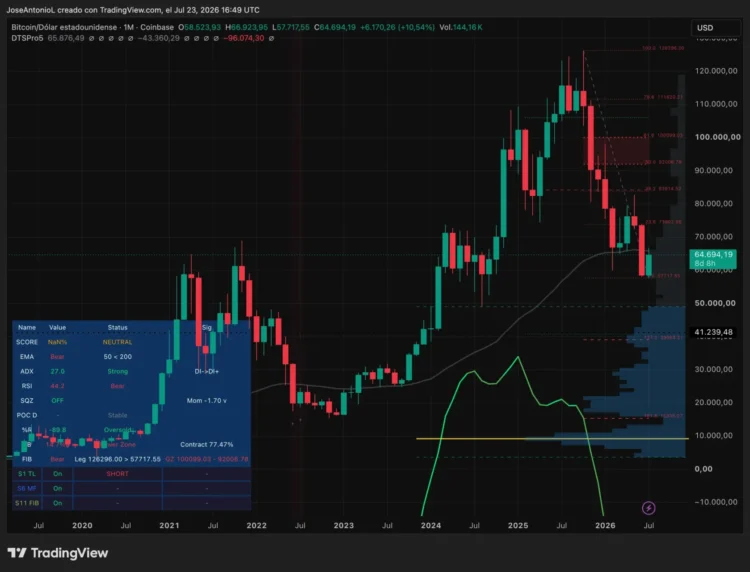
Pandl elaborates on the traditional 4-year cycle, explaining that Bitcoin typically bottoms out roughly a year after a bull market peak, or about two and a half years post-halving. Historically, these downturns have seen average pullbacks of up to 80%. Should this historical pattern repeat, Bitcoin could plummet below $50,000 in the coming months before embarking on its next major upward phase.
Bitcoin’s Evolution: A Macro-Sensitive Asset
Yet, Zach Pandl expresses skepticism about this “old script,” advocating for a perspective that he believes better reflects Bitcoin’s current reality. He argues that Bitcoin has matured beyond a speculative retail asset, increasingly resembling gold or even highly interest-rate-sensitive technology stocks.
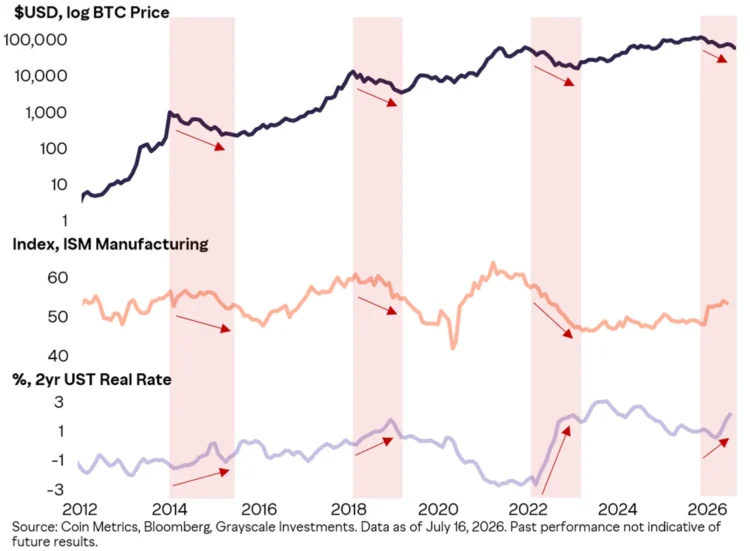
The Grayscale report highlights that past bear markets have consistently coincided with slowing economic growth and escalating real interest rates (the actual yield on bonds after accounting for inflation). Pandl articulates this crucial insight:
“This bear market similarly reflects a significant shift in Fed monetary policy expectations and rising real interest rates. Given that macroeconomic factors now dominate the market, Bitcoin will find its true bottom once these macroeconomic headwinds reverse.”
Reflecting on a previous high of $126,000 (at one point), Bitcoin is currently down approximately 49% from that peak. A significant prior downturn was largely attributed to the nomination of a hawkish figure like Kevin Warsh for Fed Chairman, which dampened market expectations for monetary easing and a weaker dollar. This event effectively ended a key narrative that had propelled Bitcoin’s earlier ascent, causing it to briefly dip below $58,000 in early July before a precarious rebound.
Conversely, an improving macroeconomic landscape could trigger an astonishingly swift market recovery. Pandl emphasizes:
“As long as the Fed ceases raising interest rates and economic growth remains robust, Bitcoin may have already found its floor.”
Grayscale thus concludes that while the “4-year cycle” theory forecasts a deeper trough, the “macroeconomic perspective” suggests that the worst of the market downturn may already be behind us.
Regulatory Clarity: Another Catalyst for Confidence
Beyond macroeconomic shifts, the market is also closely monitoring the progress of the U.S. “Digital Asset Market Clarity Act (CLARITY Act).” There is a widespread belief that the successful passage of this bill through the Senate and its enactment into law would significantly enhance regulatory transparency. Such clarity is expected to further bolster investor confidence in Bitcoin and the broader cryptocurrency market, potentially sparking a powerful rally.
Disclaimer: This article is intended solely for market information purposes. All content and views are for reference only and do not constitute investment advice, nor do they represent the views or positions of the publisher. Investors should make their own decisions and conduct their own due diligence. The author and publisher will not be held responsible for any direct or indirect losses resulting from investor transactions.