
Crypto’s Crystal Ball? SK Hynix Flash Crash on Hyperliquid Foreshadows Major Stock Market Plunge
A startling incident unfolded on the Hyperliquid decentralized exchange today, raising intriguing questions about the predictive power of cryptocurrency derivatives over traditional financial markets. Just hours before Asian markets opened, a perpetual contract tracking South Korean chip giant SK Hynix experienced a dramatic ‘flash crash,’ plummeting 20% in a single minute. This digital tremor remarkably preceded a significant downturn in SK Hynix’s actual stock price and the broader Korean market.
According to Hyperliquid data, between 07:00 and 07:01 AM (Asia time), the SK Hynix perpetual contract saw its value nosedive to $900, a 20% drop. Remarkably, it rebounded almost as quickly, recovering above the $1,000 mark in the subsequent minute. 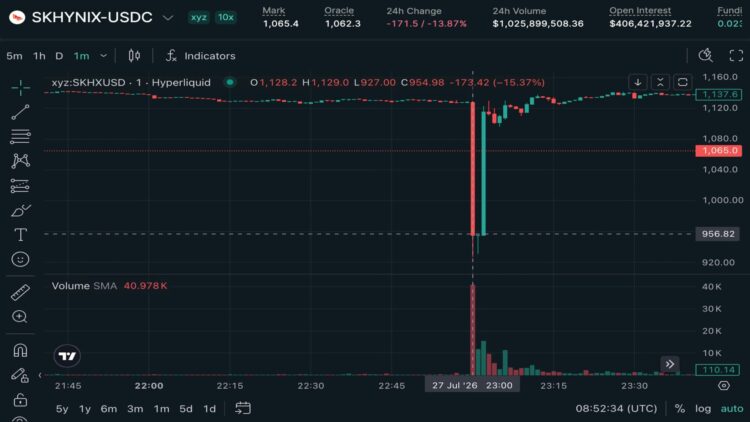 Such rapid, extreme price movements are not uncommon in the cryptocurrency derivatives space, particularly during the ‘interim window’ when major US markets have closed and Asian markets are yet to open. This period often sees thinner liquidity, making assets highly susceptible to volatility.
The digital market’s tremor soon manifested in the physical world. Just an hour after the Hyperliquid flash crash, the South Korean stock market opened with a significant downturn, led by the semiconductor sector. By market close, SK Hynix’s shares had plunged a substantial 15%, settling at 1,550,000 Korean Won (approximately $1,762 USD). The ripple effect spared no major players, with benchmark stocks like Samsung Electronics and Hyundai Motor also experiencing declines, collectively dragging the KOSPI Composite Index down by 11%. Furthermore, SK Hynix’s American Depositary Receipts (ADRs), recently issued on Nasdaq (where 10 ADRs represent 1 ordinary share), saw a 4.5% dip in pre-market trading, reaching $136.51.
This sequence of events has ignited debate: did the cryptocurrency derivatives market, known for its 24/7 trading and high leverage, act as an early barometer for the sentiment brewing in traditional financial circles? The precise correlation in timing is difficult to ignore, prompting market watchers to consider the evolving interplay between these distinct, yet increasingly connected, financial ecosystems.
The recent market woes are particularly sharp for SK Hynix, a critical supplier of High Bandwidth Memory (HBM) for NVIDIA’s cutting-edge AI processors. Despite its pivotal role in the booming AI sector, the company’s stock has endured a brutal ‘bloodbath,’ having plummeted nearly 48% from its June 26th peak of 1.947 million Korean Won. This downturn isn’t isolated; a broader cooling of Wall Street’s enthusiasm for AI-related stocks is evident. Earlier this week, even NVIDIA, the titan of AI, saw its shares dip 5% following reports in The Wall Street Journal suggesting it might provide up to $250 billion in financial guarantees for OpenAI’s data center initiatives.
In this dynamic landscape, platforms like Hyperliquid are carving out a significant niche. It has emerged as the world’s largest decentralized perpetual contract trading platform, expanding beyond its crypto-native roots. Since the escalation of geopolitical tensions in the Middle East earlier this year, a growing number of traders have turned to Hyperliquid to gain exposure to traditional financial assets – including stocks and indices – through perpetual contracts, rather than confining their activities solely to cryptocurrencies. This trend underscores a fascinating convergence, where decentralized finance (DeFi) tools are increasingly being leveraged to speculate on conventional market movements.
Disclaimer: This article is for market information purposes only. All content and views are for reference only and do not constitute investment advice. They do not represent the views or positions of the author or BlockBeats. Investors should make their own decisions and trades. The author and BlockBeats will not bear any responsibility for direct or indirect losses incurred by investors’ trading activities.
