
Author: Kurumi, CryptoCity
Michael Saylor: Bitcoin’s Core Rules Are Its ‘Constitution,’ Resist Protocol Changes
Michael Saylor, the influential founder of MicroStrategy, has once again issued a stark warning regarding the future governance of Bitcoin ($BTC). Saylor emphatically states that **Bitcoin’s consensus rules should be treated as its “constitution,” cautioning that any attempt to modify the underlying protocol could severely undermine holders’ fundamental trust in its scarcity, settlement finality, and property rights.** This powerful declaration comes amid swirling debates within the Bitcoin community concerning proposals like Bitcoin Improvement Proposal (BIP) 110, Covenants, and block size, reigniting the critical discussion: how conservative should Bitcoin’s base layer truly remain?
Bitcoin has won. Now it must survive victory.
Its gravest threat is not an enemy at the gates, but corruption from within: factions that invent pretexts, rewrite the rules, and seize economic rights until freedom becomes permission and law becomes loot.
— Michael Saylor (@saylor) July 28, 2026
At the heart of Saylor’s argument is the belief that Bitcoin’s enduring value is derived from its immutable rules, not from a continuous stream of new features. He contends that if the community permits certain factions to alter the base layer’s operational logic or exclude specific transactions through protocol modifications, it would effectively redefine the economic rights of every Bitcoin holder. For Saylor, the most profound threat to Bitcoin isn’t external forces like regulation, competing blockchains, or cyberattacks, but rather internal pressures to tamper with its foundational consensus rules.
BIP 110 Ignites Governance Divide: Ordinals and Inscriptions at the Core
A primary catalyst for this intensified debate is Bitcoin Improvement Proposal (BIP-110). **This controversial proposal seeks to restrict the embedding of non-monetary data on Bitcoin’s base layer, directly targeting protocols like Ordinals, BRC-20, and Runes, which facilitate inscriptions.** Proponents of BIP-110 argue that such data consumes valuable block space, drives up transaction fees, and diverts Bitcoin from its original purpose as peer-to-peer electronic cash and a robust store of value.
Saylor has previously voiced strong opposition, publishing “110 Reasons Against BIP 110.” He criticized the proposal for potentially leading to the exclusion of legitimate, fee-paying transactions and setting a dangerous precedent for base-layer censorship. Saylor maintains that as long as a transaction adheres to existing consensus rules and pays the requisite fee, nodes and miners should not arbitrarily judge its legitimacy based on its subjective use.
Adding significant weight to the conservative stance, Blockstream CEO Adam Back has also publicly supported the opposition to BIP 110, elevating this technical disagreement into a fundamental debate about Bitcoin’s core philosophy and values.
- Related News: Should Bitcoin’s “Junk Data” Be Cleared? MicroStrategy Founder Lists 110 Reasons Against BIP-110
Covenants and Big Blocks: Expanding the Base-Layer Conservative Front
Saylor’s opposition isn’t confined solely to BIP 110. He extends his concerns to Covenants, large blocks, and other proposed base-layer modifications, viewing them all as potential risks. Covenants, for instance, would enable more complex spending conditions for Bitcoin transactions:
- While supporters argue they could enhance self-custody scaling, facilitate advanced vault designs, and bolster asset security,
- Opponents, including Saylor, express apprehension that Covenants would introduce unnecessary protocol complexity, create new attack vectors, and ultimately undermine Bitcoin’s cherished simplicity, stability, and predictability.
The “big block” controversy, too, harks back to the contentious block size wars of 2015-2017, which famously culminated in the Bitcoin Cash fork. By grouping Covenants, big blocks, and BIP 110 under the same defensive umbrella, Saylor not only expresses opposition to specific technical proposals but also endeavors to establish clearer political boundaries for Bitcoin’s base layer. This conservative philosophy suggests that innovation should primarily occur on higher layers—such as the Lightning Network, sidechains, or application layers—rather than directly rewriting the main chain’s fundamental rules, which would incur substantial governance costs and risks.
MicroStrategy’s Stance: The Largest Corporate Holder Defines Governance Red Lines
Michael Saylor’s pronouncements carry immense weight, largely due to MicroStrategy’s unparalleled Bitcoin holdings. According to data from Bitcoin Treasuries, the company currently possesses an astonishing 843,775 Bitcoins, acquired at an average cost of approximately $75,476, solidifying its position as the world’s largest corporate holder of BTC.
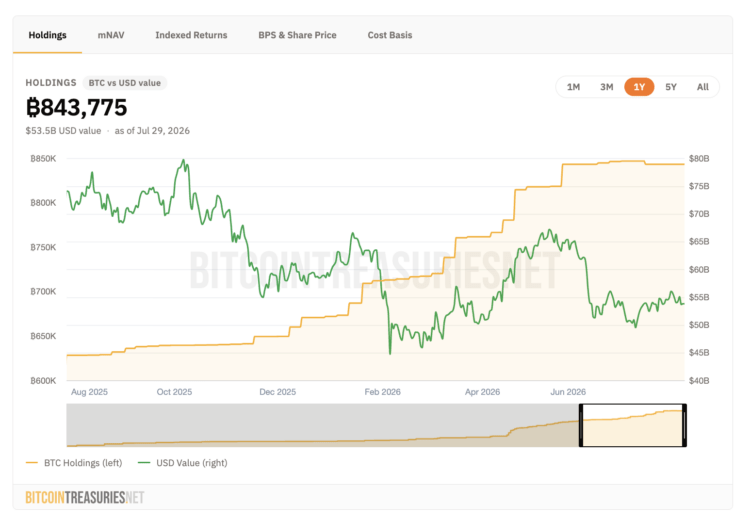
When an economic participant of this magnitude publicly labels protocol modifications as an “attack on economic rights,” its impact transcends typical community commentary. Such statements can significantly sway institutional investors’ perceptions of Bitcoin’s governance stability and long-term viability.
Bitcoin’s decentralized governance model, lacking a formal foundation, board, or single manager, means protocol changes rely on a rough consensus among developers, miners, node operators, and users. While this structure prevents single-point control, it also makes significant upgrades notoriously difficult. Saylor’s high-profile intervention serves as a powerful reminder to the market: Bitcoin’s investment thesis is fundamentally built upon its scarcity, immutability, and the stability of its rules. Should the community embark on frequent modifications to the base layer, the very predictability that institutional capital values most could be severely challenged.
(The above content is excerpted and reproduced with authorization from our partner “CryptoCity”, original link)
Disclaimer: This article is for market information purposes only. All content and views are for reference only and do not constitute investment advice, nor do they represent the views and positions of BlockTempo. Investors should make their own decisions and trades. The author and BlockTempo will not be liable for any direct or indirect losses incurred by investors’ transactions.