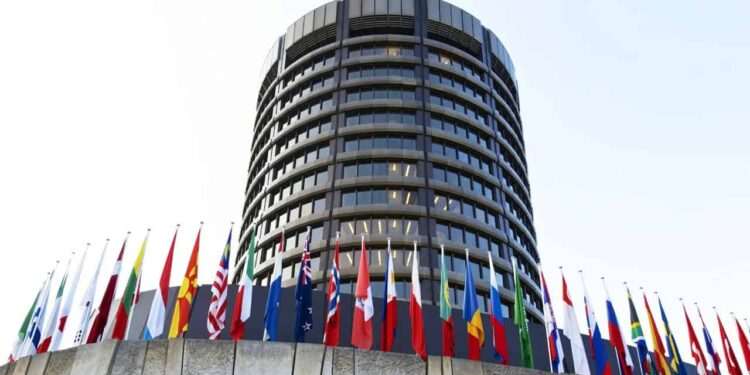
Project Agorá: BIS-Led Initiative Accelerates Global Tokenized Finance with 80-Second Cross-Border Settlements
The global financial landscape is rapidly evolving, with tokenization technology transitioning from theoretical concepts to integral components of the world’s financial infrastructure. At the forefront of this transformation is “Project Agorá,” a groundbreaking initiative spearheaded by the Bank for International Settlements (BIS) and involving a consortium of leading global banks. This project has successfully completed a pioneering pilot test for cross-border payments using “tokenized money,” processing approximately $1 million in real funds with an astonishing average settlement time of just 80 seconds.
Unpacking Project Agorá’s Pilot Success
This landmark trial brought together an impressive coalition of 5 central banks and 28 major commercial banks worldwide. Giants like JPMorgan Chase, Citi, UBS, Deutsche Bank, and Standard Chartered collaborated to rigorously test the practical application of tokenized money across critical financial operations: cross-border payments, interbank clearing, and foreign exchange (FX) transactions.
The BIS report highlights that the Project Agorá test encompassed six major global currencies: the US Dollar (USD), Euro (EUR), British Pound (GBP), Japanese Yen (JPY), Swiss Franc (CHF), and Korean Won (KRW). Utilizing “tokenized central bank reserves” and “tokenized commercial bank deposits” as settlement assets, the pilot successfully simulated diverse cross-border payment scenarios, including corporate disbursements, interbank fund transfers, and complex FX trades.
Despite the prototype platform not yet being fully integrated with existing banking payment systems, the consistent 80-second average settlement time vividly demonstrates the immense potential of a tokenized payment architecture to dramatically enhance efficiency and speed in global finance.
The Core Innovation: Tokenized Traditional Currencies
The launch of Project Agorá underscores the global financial market’s accelerating embrace of tokenization. While the past few years have seen a surge in stablecoins and Real World Asset (RWA) tokenization – with asset managers launching tokenized money market and private credit funds, and enterprises using stablecoins for cross-border payments – Project Agorá delves deeper. It explores whether tokenization can fundamentally upgrade the existing cross-border payment infrastructure of traditional banks.
Crucially, BIS emphasizes a fundamental distinction between Project Agorá and mainstream stablecoins. While popular stablecoins like those from Circle and Tether are issued by private entities, Project Agorá tokenizes two bedrock forms of currency within the traditional banking system:
- Central Bank Reserves: The ultimate settlement funds used by commercial banks for interbank transactions.
- Commercial Bank Deposits: The funds held by businesses and individual customers in their bank accounts.
Essentially, Project Agorá isn’t creating new forms of digital currency. Instead, it’s leveraging blockchain technology to bring existing, established bank currencies onto a distributed ledger, thereby enhancing the efficiency and security of cross-border financial flows.
Revolutionizing Cross-Border Transactions with Shared Ledgers
Current cross-border payments are often mired in complexity, relying on a chain of correspondent banks, each maintaining separate ledgers. This multi-layered process is inherently time-consuming and costly. Project Agorá introduces a transformative “Shared Ledger” architecture. By recording tokenized money on a single, distributed ledger, all participating banks gain simultaneous, real-time visibility into asset ownership and payment status, drastically streamlining the entire cross-border payment journey.
Mitigating FX Settlement Risk with Atomic Settlement
The pilot also validated an innovative approach to foreign exchange settlement. Traditional cross-border FX transactions often involve sequential settlement, where one currency is exchanged before the other. This creates a significant settlement risk – the possibility that one party fulfills its obligation while the other defaults. Project Agorá addresses this by enabling banks to exchange two currencies simultaneously, achieving near-atomic settlement and effectively neutralizing counterparty risk.
Furthermore, participating banks lauded the new platform’s enhanced transparency and traceability, offering a complete audit trail from payment initiation to completion. Critically, the system is designed to operate in parallel with existing payment infrastructures rather than completely replacing them, facilitating a smoother, phased adoption of tokenized solutions by financial institutions.
The Dawn of a Tokenized Financial Era
Project Agorá stands as a testament to the global financial industry’s pivot towards tokenization. It is one of several wholesale tokenization initiatives worldwide, reflecting a concerted effort by central banks and major commercial banks to explore how digital currencies can fundamentally reshape financial market architecture.
As tokenized currencies, tokenized deposits, and tokenized Real World Assets continue to mature, there is a widespread belief that blockchain technology will increasingly drive the future of cross-border payments, interbank clearing, and foreign exchange transactions. Tokenized finance is no longer just an experiment; it is rapidly moving towards practical, widespread commercial application, heralding a new era for global financial infrastructure.
Disclaimer: This article provides market information only. All content and views are for reference and informational purposes only, do not constitute investment advice, and do not represent the views or positions of the author or publisher. Investors should conduct their own due diligence and make independent investment decisions. The author and publisher will not be liable for any direct or indirect losses arising from investor transactions.