Author: Jae, PANews
Uniswap’s Resurgence: The Fee Switch, Robinhood Chain, and Lingering Concerns
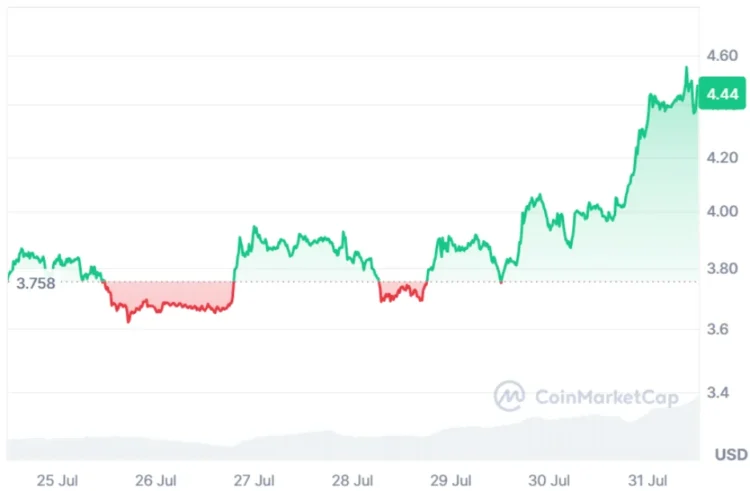
The decentralized exchange (DEX) giant, Uniswap, witnessed a significant rally on the evening of July 30th, mirroring the broader AI stock surge. UNI’s price soared past the $4 mark, registering an impressive daily gain of over 10% and extending its weekly increase to more than 17%, effectively dispelling the consolidation gloom of the past three months.
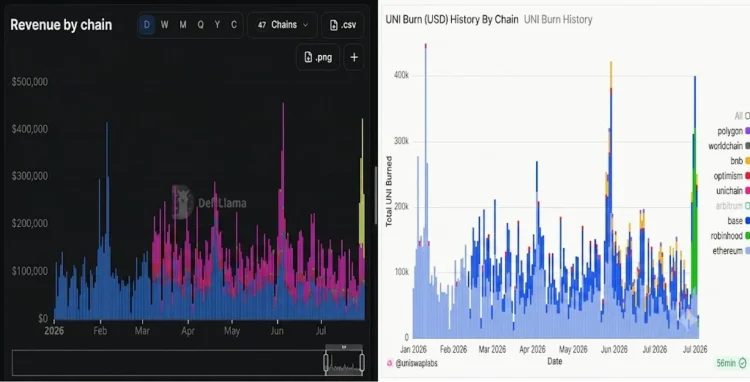
The primary catalyst for this rebound was the activation of the Fee Switch. On July 27th, the Fee Switch was officially enabled on Uniswap V4, triggering an explosive growth in the protocol’s network-wide revenue. Daily average income skyrocketed from $118,000 in early July to an astounding $318,000—a remarkable 2.7-fold increase. Notably, the Robinhood Chain alone contributed an average of $168,000 daily, accounting for over half of the protocol’s total network revenue.
This revenue surge was accompanied by a powerful wave of UNI token burns, with daily destruction volumes reaching 106,000 tokens, and even hitting a historical record of 186,000 tokens previously. However, beneath this celebratory surface, underlying concerns and strategic tensions regarding traffic sustainability, perpetual growth, and the interests of Liquidity Providers (LPs) are simultaneously coming to a head.
The Flywheel Ignites: Robinhood Chain Emerges as Uniswap’s Premier “Money Printer”
In conventional DEX fee mechanisms, transaction fees typically flow entirely to LPs or are captured by front-end operators, leaving the protocol layer with minimal value capture. To address this, Uniswap introduced a comprehensive governance proposal, UNIfication, which, through the integration of a TokenJar liquidity pool and a Firepit burn contract, established a programmatic fee distribution pathway.
Simply put, TokenJar acts as a transparent, one-way vault where protocol-allocated transaction fees continuously accumulate. While no one can directly withdraw funds, the sole method to “unlock” these fees is to provide on-chain proof of burning an equivalent amount of UNI tokens.
This ingenious design creates an arbitrage opportunity: when the value of the fees within the TokenJar surpasses the cost of acquiring and burning UNI, arbitragers (such as MEV bots) are incentivized to autonomously purchase UNI from the market, burn it, unlock the accumulated fees, and profit from the spread. This entire process operates without manual intervention, driven purely by on-chain economic incentives, forming a virtuous cycle: “Transactions generate fees → Arbitragers repurchase and burn UNI → Circulating supply decreases → Token value increases.”
Following the activation of the Fee Switch, the highly popular Robinhood Chain has supplanted the Ethereum mainnet as Uniswap’s central hub for protocol fee capture, becoming the most critical catalyst for UNI’s deflationary trend.
As a Layer 2 network built on Arbitrum Orbit, Robinhood Chain launched its mainnet on July 1st, immediately benefiting from the halo effect of its fintech giant backing. Features like gas-free subsidies and deeply integrated Web2 user access have attracted a massive influx of capital. DeFiLlama data reveals that within just one week of deploying Uniswap V2, V3, and V4 protocols, the chain’s cumulative transaction volume rapidly surpassed the $6 billion mark.
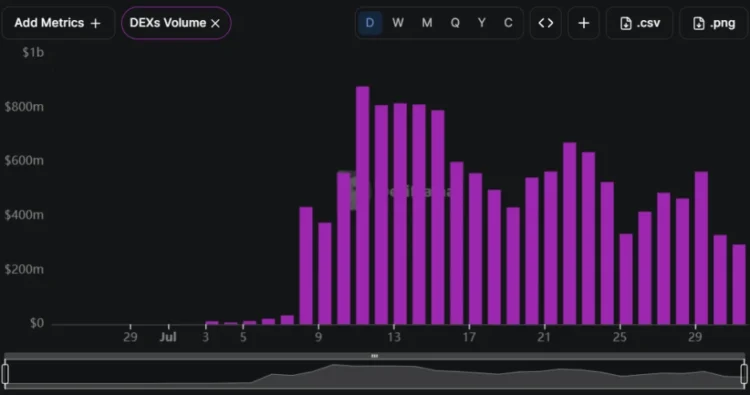
With the Fee Switch enabled on Robinhood Chain, this enormous transaction volume translates into tangible protocol revenue, contributing over 52% of Uniswap’s daily average protocol income network-wide. It has swiftly become Uniswap’s largest revenue source and a robust buying force for UNI.
Beneath the Frenzy: Unpacking Multiple Hidden Concerns
Despite the recent success, Uniswap’s highly concentrated revenue structure implies that UNI’s burn rate is now tightly coupled with the traffic fluctuations of a single chain.
The “traffic core” of Robinhood Chain, however, appears far more fragile than its surface suggests.
According to Oak Research, over 99% of the transaction volume generated on Robinhood Chain since its launch has been driven by the speculative trading of Meme coins like CASHCAT.
A significant test looms in late September.
Currently, Robinhood Chain’s high transaction volume relies heavily on official gas fee subsidies. Once these subsidies expire in late September, and on-chain interactions revert to their true costs, Meme coin speculation—which is heavily dependent on automated scripts and high-frequency trading—is likely to cool down substantially.
In essence, half of Uniswap’s current revenue is sustained by highly speculative and volatile Meme coin transactions, rather than by real asset transactions that offer long-term stability. While Uniswap announced the beta launch of “Launches” on Robinhood Chain yesterday (July 30th), aiming to aggregate popular token issuances and provide distribution channels, this initiative does not fundamentally alter the protocol’s current fragile traffic structure.
Furthermore, the market has already priced in exceptionally high growth expectations for UNI. From a valuation perspective, Uniswap’s Fully Diluted Valuation (FDV) stands at approximately $4 billion, corresponding to an annualized revenue of around $41 million. This implies a high Price-to-Earnings (P/E) ratio nearing 100x. Should revenue growth fall short of these lofty expectations, the high valuation could face significant correction pressure.
The most intense debate, however, centers on whether the “protocol tax” comes at the expense of Liquidity Providers (LPs).
Alexander Cutler, co-founder of direct competitor Aerodrome, argues that the Fee Switch fundamentally represents the protocol forcibly carving out a share from the existing pie. He suggests that after the Fee Switch was activated for Uniswap V2 and V3 concentrated liquidity pools, it effectively siphoned off up to 25% of LPs’ original earnings. Under the V4 architecture, it amounts to an indirect “tax rate” of up to 33% on liquidity interactions.
In response to market skepticism, Uniswap founder Hayden Adams clarified that the Uniswap V4 protocol fee is “additive,” not “deductive.” He emphasized that LPs’ existing pooled fee rates remain untouched, and the protocol fee is an additional, incremental charge levied on traders. Therefore, LPs’ earnings are not diminished.
Mathematically, Adams’ statement holds true. However, from an economic standpoint, the question remains unresolved: Will an increase in the total transaction fee rate elevate trader costs, subsequently suppressing trading volume, and ultimately indirectly reduce LPs’ actual realized earnings? This complex issue still requires longer-term market data for definitive validation.
Nevertheless, Uniswap has undeniably executed a commendable “commercialization” debut. Whether this debut can evolve into a sustainable, ongoing success will depend on its ability to expand into more long-term valuable application scenarios on-chain.
(The above content is excerpted and reproduced with permission from partner PANews, original link)
Disclaimer: This article is for market information purposes only. All content and views are for reference only, do not constitute investment advice, and do not represent the views and positions of the publisher. Investors should make their own decisions and trades. The author and the publisher will not bear any responsibility for direct or indirect losses incurred by investors’ transactions.