Author: Jae, PANews
Coldcard Breach: The $110 Million Wake-Up Call for Bitcoin Self-Custody and the Rise of AI in Crypto Security
The world of Bitcoin self-custody has been shaken to its core. For years, hardware wallets stood as the undisputed bastion of Bitcoin security, promising an impenetrable fortress where private keys remained offline, shielded from digital threats. However, the recent security crisis involving Coldcard, a prominent Bitcoin hardware wallet, has ripped a gaping hole in this long-held belief.
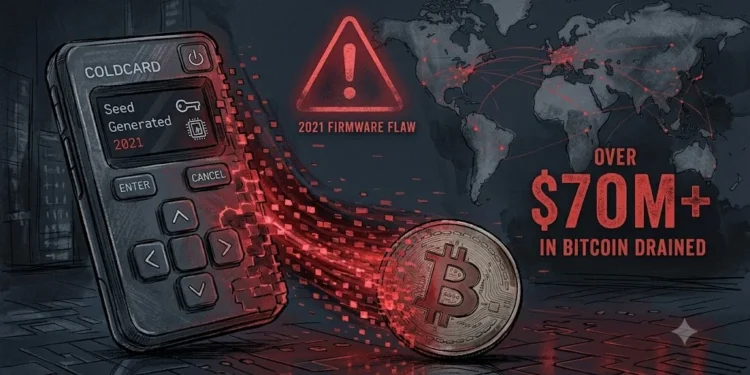
On July 30th, a staggering 1,755.95 Bitcoins—worth over $110 million at current market prices—were silently siphoned from thousands of addresses. What makes this incident particularly alarming is that the attackers managed to transfer the bulk of the funds a full 30 hours before Coldcard issued its official warning. The breach wasn’t an external assault; rather, a fatal flaw lay dormant within the wallet’s foundational code for five years.
This revelation sent shockwaves across the cryptocurrency market. On-chain Bitcoin transfer volumes, particularly for smaller amounts, surged to levels not seen since the FTX collapse. Faced with unprecedented uncertainty, many self-custody users opted to move their assets to centralized exchanges or Bitcoin ETFs, signaling a profound crisis of public trust in the self-custody ecosystem.
AI Uncovers 5-Year-Old Vulnerability in Minutes, Shattering the Cold Wallet “Security Myth”
The genesis of this crisis dates back to March 2021. Coldcard’s v4.0.1 firmware update contained a critical oversight: the development team erroneously invoked a software Pseudo-Random Number Generator (PRNG) instead of the more secure True Random Number Generator (TRNG) derived from physical hardware for cryptographic private key generation.
The distinction between PRNG and TRNG is monumental in cryptography. Entropy, the measure of randomness, is the bedrock of security. TRNGs leverage unpredictable physical noise, ensuring genuine randomness. In contrast, PRNGs operate within a finite “entropy pool,” making their underlying patterns potentially deducible. This critical flaw provided attackers with a programmatic pathway to exhaust and reconstruct the private keys of affected addresses, completely compromising the product’s security chain.
A single logical error in the code left all private keys generated with that specific firmware over five years vulnerable to brute-force attacks. This incident unequivocally demonstrates that relying solely on a single hardware device cannot fully mitigate supply chain risks or internal code defects, rendering the concept of “absolute security” a dangerous fallacy.
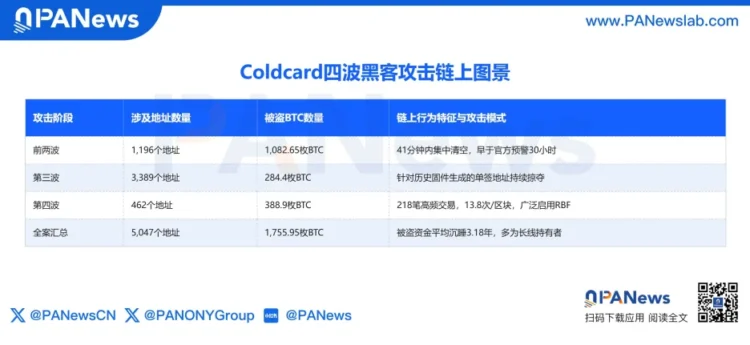
On-chain analysis reveals the attackers’ operations were highly automated and ruthlessly efficient. According to Galaxy Research, the first two waves of attacks saw 1,196 victim addresses emptied in just 41 minutes. Over $70 million was moved approximately 30 hours before Coldcard’s official alert, allowing the hackers to complete their initial harvest before most users were even aware of the impending danger.
The attack then evolved into sustained, multi-wave plundering. During the fourth observed attack wave, hackers aggressively cleared victim accounts at a rate of up to 13.8 transactions per block. They leveraged the Replace-by-Fee (RBF) mechanism to prioritize their transactions, effectively shutting down any window for users to intervene or recover funds.
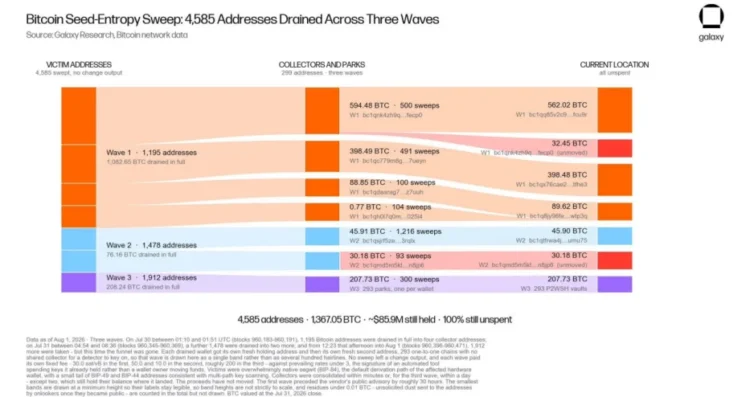
The profile of the victims is particularly poignant. Data indicates that the stolen Bitcoins had an average dormancy period of 3.18 years, with a median of 3.55 years. These were predominantly long-term HODLers, early adopters who had unwavering faith in cold storage security for years, only to fall prey to a five-year-old, hidden code vulnerability.
Adding another layer of concern, the “weaponization of AI” is significantly expanding the arsenal available to attackers. The successful use of AI to batch crack private keys lowers the barrier to entry for automated cybercrime. Moving forward, AI-driven attacks targeting legacy codebases are likely to become a normalized and persistent threat.
While AI is being weaponized on the offensive front, it’s also revolutionizing efficiency in defense. Following the full-scale attack, developers in the Reddit community leveraged Claude Code to scan Coldcard’s open-source firmware. In a mere 8 minutes, Claude precisely pinpointed the pseudo-random number logic flaw that had remained hidden for half a decade.
Further cross-verification using offline environments with Zhipu GLM 5.2 and the open-source model Kimi K3 independently reproduced the vulnerability scan results. Impressively, the Galaxy Research security team also utilized Chinese open-source AI to conduct a complex clustering analysis of 218 RBF transactions from the hacker’s fourth attack wave, successfully identifying the “second-hop” destination addresses for the stolen funds.
These AI-powered reverse engineering efforts by the community underscore a critical point: AI-driven automated code auditing can drastically shrink the exposure window for zero-day vulnerabilities. In the future, integrating real-time AI auditing into the development pipelines of hardware manufacturers and smart contracts will transition from an optional luxury to an absolute necessity.
On-Chain Flight to Safety Nears FTX Collapse Levels, Diversified Custody Emerges as Mainstream Solution
The ongoing repercussions of the Coldcard vulnerability have fundamentally shaken the crypto market’s collective confidence in self-custody security, rapidly triggering a massive on-chain flight to safety.
According to CryptoQuant, the number of daily active Bitcoin addresses surged from 645,000 on July 30th to nearly 1 million on July 31st, marking the highest single-day level since December 10th, 2022. On that same day, the volume of on-chain Bitcoin transfers under 1 BTC reached its highest point since November 2022, with approximately 39,600 BTC moved—just 300 BTC shy of the record set days after FTX filed for bankruptcy.
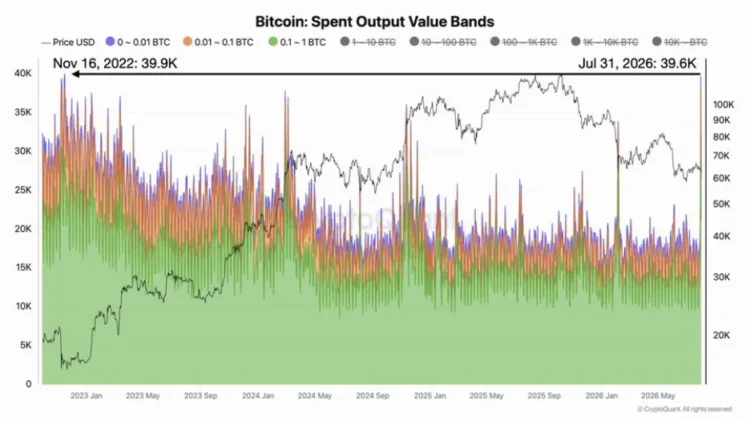
Julio Moreno, Head of Research at CryptoQuant, emphasized that the Bitcoin community has not witnessed such an intense “self-rescue migration” since the dramatic collapse of FTX.
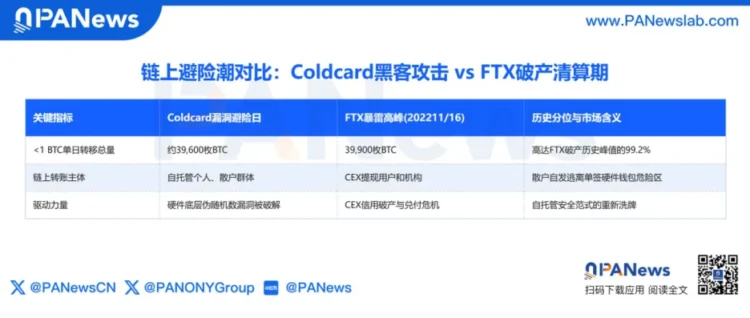
When “cold wallets” are no longer deemed secure, the entire on-chain ecosystem becomes acutely aware. A loss of trust in even offline hardware wallets signifies a foundational restructuring of the crypto security paradigm.
Binance founder CZ weighed in, asserting that as long as code is human-written, vulnerabilities are inevitable. He recalled that Trust Wallet also suffered a $12 million loss years ago due to a PRNG vulnerability. His advice: avoid blind faith in a single hardware device or long-dormant old wallets. Instead, diversified allocation and multi-signature collaboration offer a superior approach to mitigating single-point failure risks.
Bloomberg Senior ETF Analyst Eric Balchunas highlighted the inherent risk of a small, approximately five-person company being entrusted with such critical Bitcoin storage responsibilities. He argued that while users might incur higher transaction costs, larger institutions like Coinbase and Ledger offer superior security investments and operational capabilities. Bitcoin ETFs, he noted, present another viable option, providing investors with the security assurances of large, professional, and regulated financial institutions, often coupled with competitive management fees.
Joe Burnett, VP of Bitcoin DAT (Treasury Enterprise) Strive, believes that self-custody will persist, but the Coldcard theft will permanently alter user confidence. He contends that protecting significant Bitcoin holdings with a single key from a single hardware wallet represents an unacceptably high concentration risk. Burnett posits that as long as Bitcoin itself remains secure, the failure of one custody method does not invalidate the underlying monetary system but rather compels the market to develop superior tools, elevated standards, and more resilient custody architectures.
Muneeb Ali, co-founder of Bitcoin L2 Stacks, strongly advocates for the “don’t put all your eggs in one basket” philosophy:
- Allocate 20%-30% of BTC to ETFs, such as BlackRock’s IBIT, benefiting from professional custody and regulatory protection.
- Employ a multi-signature solution for 40%-50% of BTC, similar to Casa’s three-key model, distributing keys across a security company, a mobile device, and a hardware wallet.
- Reserve 20%-30% of BTC for more advanced self-management strategies, integrating various hardware wallets and diverse entropy sources.
As Ali suggests, users must move beyond implicit trust in single hardware wallets. The shift must be towards architectural solutions that eliminate single points of failure, embracing cross-vendor multi-signature schemes, Threshold Signatures (MPC), smart contract-based social recovery wallets, or even ETFs. This systemic approach is crucial to prevent catastrophic losses from isolated vulnerabilities.
The Coldcard incident is undeniably a landmark event in the annals of crypto security. The illusion of “absolute cold storage security” has been decisively shattered by the harsh reality of latent code defects.
True security isn’t about an impenetrable single fortress; it’s about systemic redundancy and resilience. While the 1,755 Bitcoin “tuition fee” is steep, it serves as a crucial lesson. Only when the industry sheds the dangerous notions of “offline equals safe” and “hardware equals safe” can the crypto asset security ecosystem truly achieve robust, long-term development amidst the ever-escalating arms race between attackers and defenders.
(The above content is excerpted and reproduced with authorization from our partner PANews. Original Link)
Disclaimer: This article is for market information purposes only. All content and opinions are for reference only, do not constitute investment advice, and do not represent the views and positions of BlockTempo. Investors should make their own decisions and transactions. The author and BlockTempo will not bear any responsibility for direct or indirect losses resulting from investor transactions.