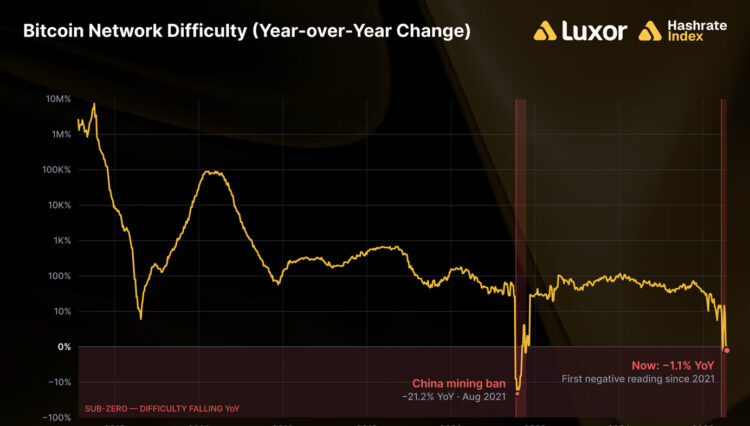
The Bitcoin network is currently experiencing a rare and significant “hash rate retreat.” A confluence of factors—including a weakening Bitcoin price, diminished mining profitability, and a substantial redirection of capital and power resources towards artificial intelligence (AI) computing demands—has led to a notable decline. Bitcoin mining difficulty has fallen by approximately 14% from its peak earlier this year, marking only the second time in history that it has dropped below the level of the previous year’s corresponding period, signaling a clear global contraction in mining capacity.
Bitcoin Mining: Easing Competition Pressure
On-chain data reveals that after a recent minor adjustment of a 0.74% reduction, Bitcoin’s current mining difficulty stands at 126.23 terahashes (T). This represents a 1.1% decrease compared to 127.62 T recorded during the same period last year. When measured against its historical peak of 155.97 T (recorded in November 2023), the current difficulty shows a substantial decline of 19.1%.

The Bitcoin blockchain is designed to adjust its mining difficulty approximately every two weeks (or precisely every 2,016 blocks). This mechanism ensures that, regardless of the number of miners operating, the network consistently maintains its target block production rate of roughly one block every 10 minutes.
Fundamentally, mining difficulty serves as a direct indicator of the competition among miners. Higher difficulty implies a more intense competitive landscape. Conversely, if the network’s total computational power (hash rate) increases over a two-week period, the difficulty will rise, making it harder to mine Bitcoin. Should the hash rate decline, the difficulty level will decrease, making it comparatively easier for miners to solve blocks.
Data indicates that following reductions of 10% in June and 5% in early July, Bitcoin’s mining difficulty has now significantly decreased by approximately 14% from its high point in January of this year.
Remarkably, this is only the second instance in Bitcoin’s history where the mining difficulty has fallen below its level from the previous year’s corresponding period.
The first such occurrence was in 2021, following China’s comprehensive ban on Bitcoin mining. This policy abruptly forced nearly half of the global hash rate offline, leading to a drastic drop in mining difficulty. However, as miners relocated to regions like the United States and Kazakhstan, the network’s hash rate quickly rebounded and resumed its growth trajectory.
This time, however, the decline in mining difficulty is not a consequence of regulatory crackdowns but rather a symptom of a deteriorating overall mining economy.
Profit Squeeze: Bitcoin Miners Pivot to AI and HPC
Analysis from Hashrate Index, a platform by mining data provider Luxor, highlights that the sustained weakness in Bitcoin prices and severe compression of mining revenues are compelling mining companies to reallocate significant capital, power resources, and operational focus towards artificial intelligence (AI) and high-performance computing (HPC) infrastructure.
Furthermore, seasonal power restrictions, such as curtailments in Texas during the summer, alongside power outages in other key mining regions, have further contributed to the overall weakening of the network’s hash rate.
Profitability Indicators Bottom Out: A Lingering Crypto Winter for Miners?
Regrettably, the recent downward adjustments in mining difficulty have offered minimal respite to miners.
Hashprice, a crucial metric measuring the expected revenue for a unit of hash rate, plunged to a low of $27.66 per petahash per second (PH/s) per day in late June. This figure was just a single cent shy of the all-time low recorded in February of this year. While it has since recovered slightly to approximately $31.7, it remains significantly below levels seen during previous bull markets, indicating persistent and heavy operational pressure on miners.
Looking ahead, pricing data from Luxor’s forward market suggests that the average hashprice is projected to hover around $31.85 per PH/s per day by the end of December this year, only marginally above current levels.
This forecast implies a widespread market expectation that Bitcoin miners’ profitability is unlikely to see significant improvement for the remainder of the year and into the near future. Against a backdrop of ongoing pressure on mining revenues and the rapid expansion of AI infrastructure, the global Bitcoin mining industry is poised for a new phase of transformation and consolidation.
Disclaimer: This article provides market information only. All content and views are for reference only and do not constitute investment advice. They do not represent the views and positions of BlockBeats. Investors should make their own decisions and trades. The author and BlockBeats will not bear any responsibility for direct or indirect losses incurred by investors’ transactions.