The unfolding security vulnerability affecting Coldcard cold wallets is sending ripples far beyond its immediate victims, prompting the awakening of long-dormant “ancient Bitcoin wallets.” On-chain data reveals a recent instance where a wallet, inactive for nearly 13 years, suddenly transferred a staggering 500 Bitcoins, valued at approximately $31.3 million.
Since the revelation of the significant Coldcard hacking incident on July 30th, the crypto landscape has witnessed a surge in “ancient” Bitcoin transfers to exchanges. This trend underscores a palpable shift among long-term holders, who are rapidly reallocating their assets to mitigate escalating security risks.
According to the blockchain tracking platform Whale Alert, the wallet address “18TExP” recently moved its entire balance of 500 Bitcoins. Tracing back to its last activity in 2013, these Bitcoins were then worth only about $500,000. Today, their value has soared to roughly $31.3 million, marking a dormancy period of 12.7 years.
Lookonchain highlighted on social media: “The 18TExP wallet, dormant for over 12 years, transferred all 500 Bitcoins to a new address within an hour. It is highly probable that the owner, driven by security concerns stemming from the Coldcard hack, hastily moved the funds.”
Wallet 18TExP, holding 500 $BTC($31.27M), transferred all 500 $BTC to a new wallet 1 hour ago after over 12 years of inactivity.
The owner may have moved the funds to a new wallet due to security concerns following the #Coldcard hack.https://t.co/1gQtI6XbwG pic.twitter.com/pVyPVBYaW0
— Lookonchain (@lookonchain) August 3, 2026
Ancient Wallets Stirring: The Aftermath of the Coldcard Security Crisis
These significant transfers coincide precisely with the escalating Coldcard security crisis. Since July 30th, attackers have been exploiting a firmware vulnerability present in Coldcard devices since March 2021, siphoning thousands of Bitcoins from numerous affected wallets.
The attackers have relentlessly leveraged a “random number vulnerability” within Coldcard’s March 2021 firmware to compromise the private keys of impacted wallets on a large scale. Galaxy Research’s latest estimates indicate that the total value of stolen Bitcoin has now reached approximately $130 million.
Concurrently, several analysts have observed a notable increase in Bitcoin inflows to cryptocurrency exchanges. This trend suggests that the Coldcard incident has significantly eroded market confidence in self-custody solutions, pushing users towards centralized platforms.
The recent transfer of 500 Bitcoins is far from an isolated event. Blockchain data analytics platform CryptoQuant, by tracking the “spent output age distribution” metric, has identified a clear uptick in transfers from ancient Bitcoin wallets.
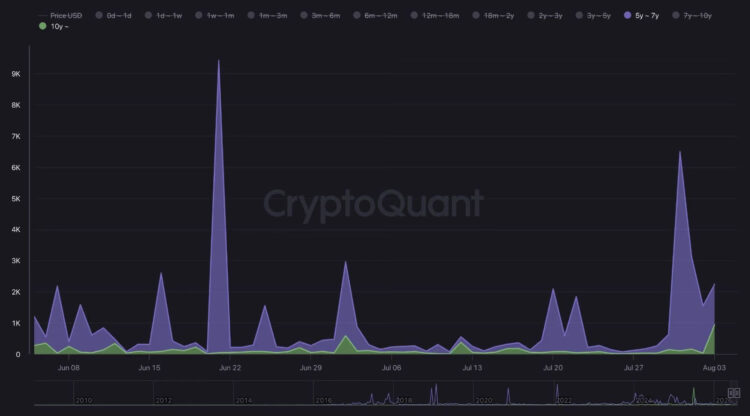
This crucial metric categorizes Bitcoin based on how long it remained dormant before being transferred, offering insights into the movement of funds across different holding periods. Data for August 3rd revealed that approximately 935 Bitcoins, dormant for over 10 years, were moved—the highest single-day volume since March 20th of this year. Furthermore, Bitcoins dormant for 5 to 7 years saw a massive surge, with 6,388 coins transacted on July 31st alone.
While a sudden movement of long-dormant Bitcoin can stem from various reasons—such as inheritance, exchange wallet consolidation, or custodian migration—not all are necessarily linked to hacking incidents.
However, the intense cluster of multi-year dormant Bitcoin transfers occurring within days of the Coldcard security crisis makes it difficult for the market to ignore the strong implication: these “ancient whales” are actively seeking safer havens for their assets, driven by an urgent need for self-preservation.
Disclaimer: This article is provided for market information purposes only. All content and opinions are for reference only and do not constitute investment advice, nor do they represent the views and positions of BlockBeats. Investors should make their own decisions and transactions. The author and BlockBeats shall not be held responsible for any direct or indirect losses incurred by investors’ transactions.