By: Nancy, PANews
Hyperliquid Thrives on RWA Surge Amidst HYPE Token Correction: A Deep Dive into Ecosystem Expansion and Market Dynamics
Despite a recent pullback in the HYPE token price from its two-month high, the Hyperliquid ecosystem continues its relentless expansion. Fueled by the growing demand for Real World Asset (RWA) trading through its HIP-3 initiative, the platform is rapidly increasing its footprint in the global perpetual futures market. This surge in RWA activity has ignited fierce competition for entry points into the HIP-3 ecosystem, with Trade.xyz leveraging its first-mover advantage while new contenders strategically carve out their niches.
RWA Dominates Growth, Redefining Hyperliquid’s Trajectory
The prevailing bear market has done little to impede Hyperliquid’s impressive growth. What’s particularly noteworthy is the shift in its primary growth driver: no longer solely reliant on traditional crypto assets like Bitcoin and Ethereum, Hyperliquid is now propelled by the burgeoning RWA sector.
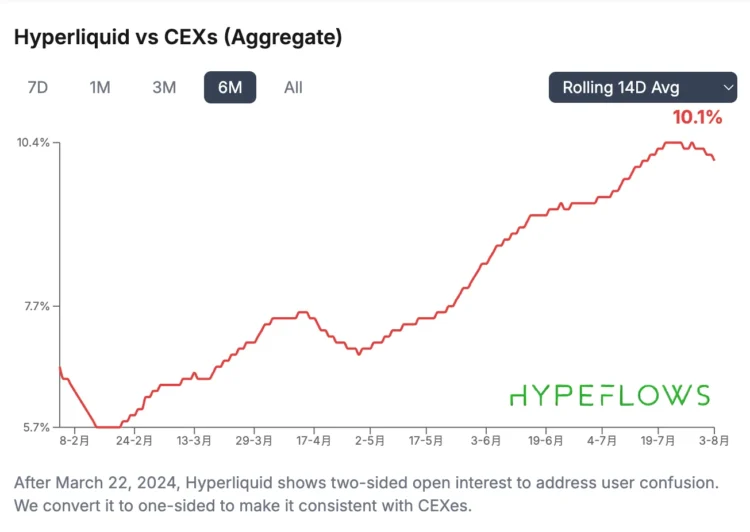
Hyperliquid is aggressively strengthening its position in the global perpetual futures landscape. Data from Hypeflow reveals a significant leap in its market share, measured by the 14-day rolling average of Open Interest (OI). As of August 3rd, Hyperliquid commanded 10.1% of the global perpetual futures market, a substantial increase from just 7.1% six months prior.
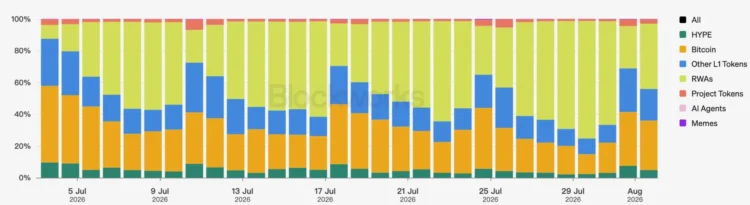
This remarkable growth is intrinsically linked to the RWA trading demand catalyzed by HIP-3. Blockworks data from August 1st indicates that HIP-3 related RWA assets now constitute a staggering 41% of Hyperliquid’s perpetual contract trading volume, having peaked at 74% recently. This trend underscores a fundamental evolution in Hyperliquid’s growth strategy, moving beyond crypto-native assets to embrace an on-chain perpetual trading market that encompasses equities, commodities, and a broader spectrum of real-world assets.
As the HIP-3 ecosystem matures and expands, a new wave of deployers is entering the fray, intensifying the competitive landscape.
Currently, Trade.xyz maintains a formidable lead, bolstered by its early market entry and consistently breaking trading records. Official disclosures highlight Trade.xyz’s cumulative trading volume, which has soared to an impressive $408.4 billion. Over a single weekend, its cumulative turnover surpassed $26 billion, with daily unique traders peaking at over 60,000.
However, this dominance is now being challenged. Competitors are rapidly penetrating the HIP-3 market by deploying differentiated strategies and lowering participation barriers.
Battle for the HIP-3 Frontier: Trade.xyz Faces Emerging Challengers
One notable challenger, Paragon, is strategically expanding its presence within the HIP-3 ecosystem through aggressive Ticker acquisition. hl.eco data shows that since July 15th, Paragon has secured 13 Tickers, investing approximately 6,328 HYPE, valued at around $333,000. This marks a significant shift, as Trade.xyz previously held an almost exclusive grip on HIP-3 Ticker auctions.
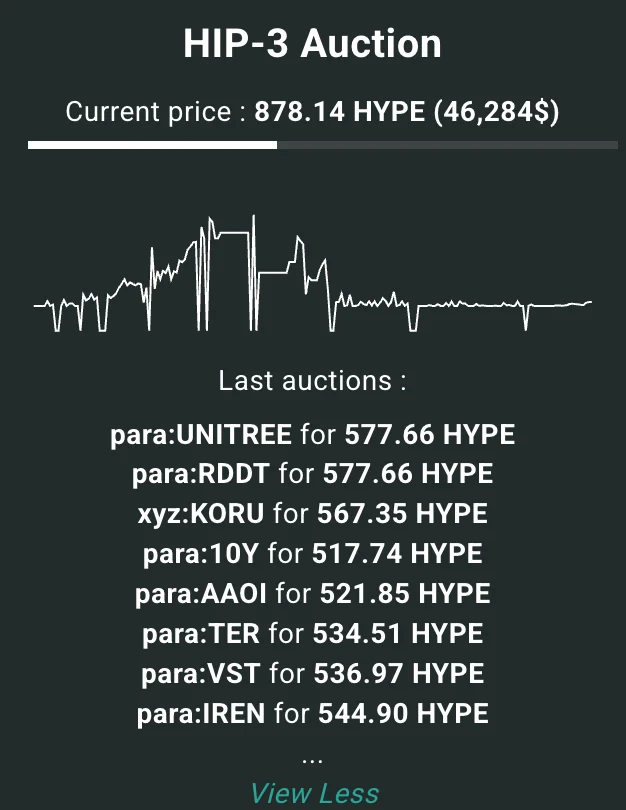
Paragon’s asset selection strategy is distinctly differentiated. Its recent Ticker acquisitions span various segments of the Artificial Intelligence (AI) industry chain, including fiber optics and optical modules (GLW, CRDO, AAOI, CIEN), semiconductor equipment (LRCX, TER), storage solutions (STX), computing power and energy infrastructure (IREN, VST, NET), and even emerging sectors like humanoid robots (UNITREE) and social platforms (DTDT). In contrast to Trade.xyz’s focus on mainstream large-cap stocks, Paragon targets assets with relatively lower liquidity in traditional markets but strong narrative potential, making them ideal for on-chain perpetual trading. This strategy is widely seen by the community as a cost-effective way to secure early positions in high-growth sectors.
Despite this strategic maneuvering, Paragon’s current scale remains significantly smaller than Trade.xyz’s. ASXN data indicates Paragon’s latest weekly trading volume at approximately $15.55 million, a remarkable 12.8x increase since early July. However, this still represents less than 0.01% of Trade.xyz’s trading volume over the same period. Similarly, Paragon’s weekly traders grew from 1,260 to 12,760, while Trade.xyz boasted 18.7 million traders.
Democratizing Access: Lowering HIP-3 Participation Barriers
Concurrently, the entry barriers for the HIP-3 ecosystem are becoming more accessible. Historically, HIP-3 deployers were required to stake 500,000 HYPE, a substantial threshold that limited participation. However, as the ecosystem evolves, more deployers are leveraging capital and resource collaborations to reduce entry costs.
For instance, Hyperion, the second-largest HYPE DAT company, is providing 500,000 HYPE in staking support and collaborating with Skew Technologies to launch institutional-grade perpetual futures products. Through equity participation in Skew and revenue sharing from listing services, Hyperion empowers Skew to concentrate on product development and user distribution without needing to lock up significant HYPE. This collaboration may also pave the way for expansion into HIP-4 related markets. Another example is Multicoin Capital’s $1.75 million seed round investment in Trasia, making it the sole seed investor, with the project reportedly securing over $35 million in additional commitments.
HYPE Token Dynamics: Navigating Price Correction and Institutional Moves
Despite the ecosystem’s robust expansion, the HYPE token price has not been immune to market pressures, failing to sustain its previous upward trajectory.
In mid-June, HYPE surged to an all-time high near $77 before entering a sustained correction phase. CoinGecko data reveals a cumulative decline of 26.8% for HYPE over the past 30 days.
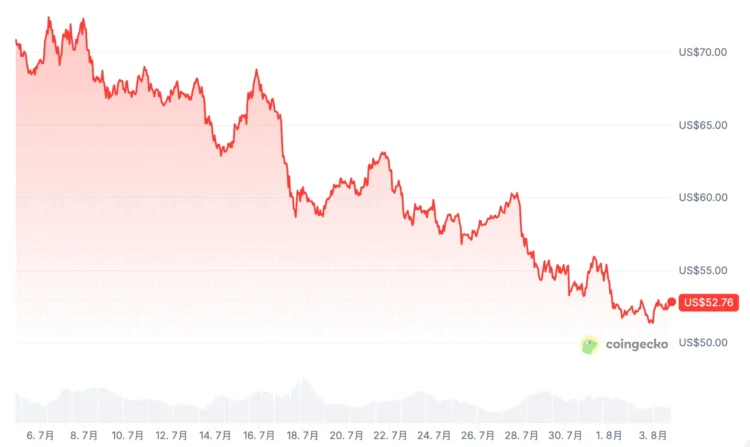
This recent pullback can be attributed primarily to a cooling in ETF fund inflows and strategic profit-taking by large institutional investors (whales).
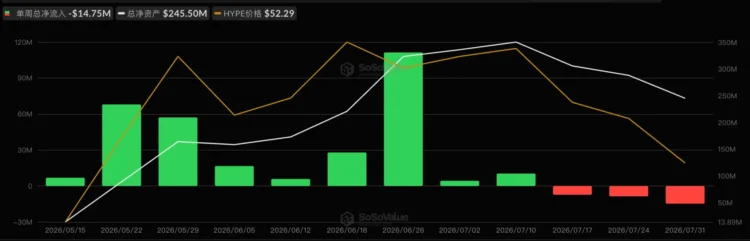
HYPE spot ETF inflows have notably decelerated. SoSoValue data illustrates a gradual cooling and subsequent net outflow from HYPE spot ETFs since late June. The week of June 26th saw HYPE spot ETF net inflows exceed $110 million, but this momentum has since waned, transitioning to continuous outflows throughout July, accumulating to over $15.16 million in net outflows for the month.
Simultaneously, several institutional whales have executed significant on-chain operations. On July 22nd, Multicoin Capital unstaked 1.96 million HYPE, valued at approximately $120 million, transferring a portion to exchanges. Two days later, Paradigm-affiliated wallets unstaked around 2.92 million HYPE, worth about $171 million. A16z-affiliated addresses also made several large transfers to various trading platforms in mid-July. Similar transfers of HYPE to exchanges, ranging from millions to tens of millions of dollars, were observed from addresses associated with Selini Capital, Bitwise, and market maker Cumberland.
However, it’s crucial to note that these on-chain movements do not necessarily equate to outright selling. Tushar Jain, co-founder of Multicoin Capital, clarified that their unstaking was primarily for wallet rotation and privacy management, not liquidation. The founder of Selini Capital similarly denied any “dumping” behavior, stating that HYPE remains integral to multiple business operations. Intriguingly, a16z-affiliated entities are suspected of engaging in a “sell high, buy low” strategy, having reportedly repurchased approximately $7.335 million worth of HYPE.
Beyond the FUD: Understanding HYPE’s Supply-Demand Balance
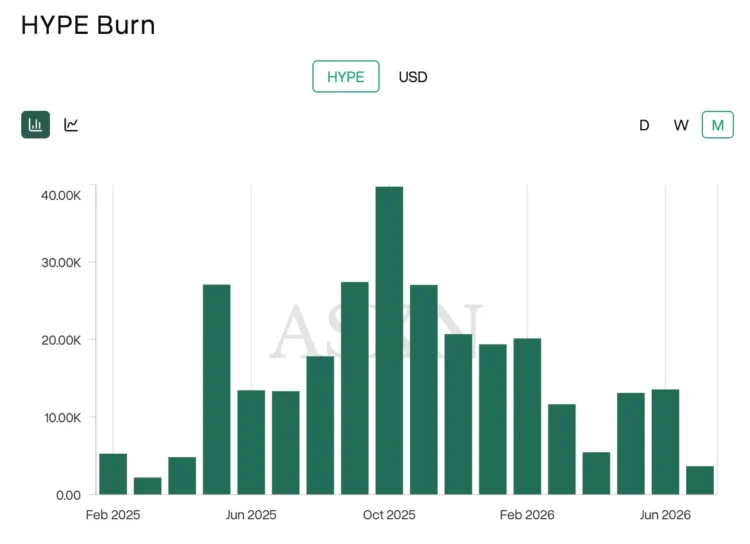
Beyond capital flow shifts, a decrease in Hyperliquid’s revenue has also tempered HYPE’s buyback efforts, impacting short-term market support. ASXN data shows that HYPE buybacks in July amounted to approximately $244,000, a significant 72.4% reduction from $886,000 in June.
Importantly, concerns surrounding team token unlocks have not materialized into the massive selling pressure initially feared by the market. According to recent reports from MLM, since HYPE team tokens began unlocking in December 2025, approximately 4.93 million HYPE (valued at about $270 million at current prices, representing 0.493% of total supply) have been allocated to team members. Of this, about 1.19 million tokens were sold on the secondary market for roughly $32.5 million, and another 3.14 million were transferred to OTC platforms, valued at about $132 million at the time of transfer. In total, approximately 4.33 million HYPE, amounting to about $165 million, were sold by team members.
During the same period, the aid fund cumulatively repurchased approximately 9.8 million HYPE, investing around $364 million. This translates to an average monthly repurchase of about 1.23 million HYPE, valued at $46 million – a buyback rate more than double the selling pace of current and former team members.
This data suggests that the primary pressure on HYPE currently stems from shifts in market demand rather than team unlocks. Furthermore, the Hyperliquid team is proactively utilizing OTC channels to mitigate the impact of unlocks on secondary market liquidity, while the aid fund’s consistent buybacks provide a crucial buffer against circulating supply pressure.
Hyperliquid’s Trajectory: Short-Term Challenges, Long-Term Potential
In the short term, Trade.xyz, with its superior liquidity, vast user base, and first-mover advantage, remains the undisputed leader in the HIP-3 ecosystem. Other deployers face an uphill battle to mount a direct challenge.
However, the long-term outlook for the HIP-3 ecosystem points towards significant expansion. As asset types continue to diversify, participation thresholds become more accessible, and additional infrastructure and capital flow in, Hyperliquid is poised for sustained growth. For the platform, the ongoing enrichment of its ecosystem and asset offerings will not only amplify trading demand but also strengthen its network effects, creating new avenues for HYPE token value capture.