Author: Jae, PANews
In the peak of summer, July witnessed Real World Assets (RWA) emerge as the hottest narrative in the crypto market. On-chain RWA volume soared to an all-time high of $32 billion, marking an approximately 22% increase from the beginning of the month and surpassing the previous peak set in April this year.
While the industry celebrates RWA tokenization breaching the $30 billion mark, a closer look at DeFi utilization data reveals a structural dilemma beneath this apparent boom. Currently, nearly 90% of on-chain RWA remains unutilized, failing to engage in any DeFi activities such as lending or collateralization.
This stark inversion between impressive scale and actual activity presents an unavoidable question for the RWA sector: After assets are brought on-chain, what then?
The Utilization Paradox: A Widening Gap Between Scale and Activity
According to “The State of Tokenized Real World Assets 2026” report, co-published by BeInCrypto Intelligence and RWA.xyz, among 1,289 tokenized assets valued over $100,000, 910 showed no on-chain transfers within a week. This means over 70% of tokenized assets are effectively “dormant” on any given day.
Further statistics from Edgy, a partner at Bitcoin L2 protocol Stacks, indicate that out of the RWA market’s total volume exceeding $30 billion, 87% of assets are in an “on-chain dormant” state. They neither serve as collateral in lending markets nor facilitate effective circulation in trading venues. For most, merely “recording assets on-chain” is the first and only step completed. A DWF Labs report corroborates this, stating that only about 10% of tokenized RWA is genuinely active within DeFi protocols, with the remaining 90% “parked” as static capital in institutional wallets.
This significant divergence between scale and utilization is even more pronounced among leading platforms:
- Securitize: The Volume King with Low Utilization
As BlackRock’s BUIDL fund issuance partner, Securitize is undoubtedly the “volume leader” in RWA tokenization. Its tokenized asset volume has surpassed $4.9 billion, with Q1 revenue reaching $19.5 million, and it recently listed on the NYSE with a valuation of approximately $1.25 billion. However, its DeFi utilization rate stands at a mere 0.7%, a staggering contrast between its vast asset base and minimal DeFi engagement. - Ondo Finance: Multi-Chain Expansion, Yet Utilization Remains Modest
Ondo Finance manages nearly $3.5 billion in tokenized assets, deployed across more than 10 chains with 168 integration projects, and commands over 70% market share in tokenized equities. Despite these achievements, its DeFi utilization rate is around 2.7%. While better than Securitize, it remains a significant distance from true “activity.” - Maple Finance: High Efficiency from a Smaller Footprint
Maple’s scale is considerably smaller than Securitize and Ondo, with assets under management (AUM) of only $2.3 billion. Yet, it boasts active loans exceeding $1.6 billion and has facilitated over $22 billion in cumulative loans, achieving an impressive DeFi utilization rate of 62%.
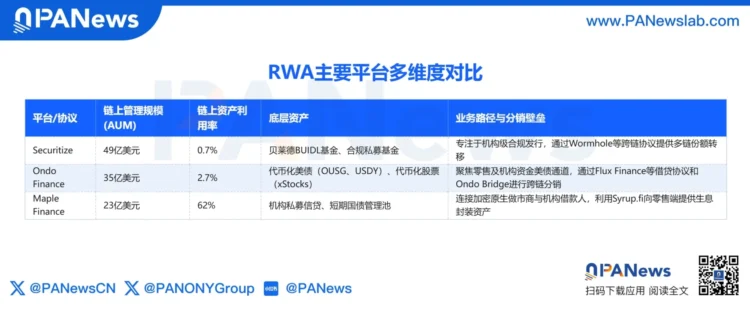
These platforms exhibit fundamental differences in their business models.
Securitize and Ondo primarily act as “asset issuers.” Their strengths lie in regulatory frameworks and institutional relationships: acquiring licenses, securing major clients, and bringing assets on-chain. Their revenue is derived from issuance and management fees, akin to a “picks and shovels” business model, where circulation and utilization post-tokenization are not their core operations.
Maple, on the other hand, represents the “asset application” approach. As an on-chain credit protocol, its assets are designed from inception to be embedded within lending activities. Consequently, Maple can leverage a smaller asset base to achieve significantly higher DeFi utilization, ensuring assets are actively “in motion” and generating on-chain economic value through lending interest and transaction fees.
Why “On-Chain” Doesn’t Necessarily Mean “Circulation”
The phenomenon of RWA being “on-chain yet dormant” is a transitional state resulting from a confluence of asset characteristics, regulatory constraints, and infrastructure deficiencies.
1. Asset Attributes: Income Generation vs. Active Trading
Currently, the on-chain RWA sector is largely divided into two main categories: “active income-generating pools” primarily focused on private credit, and “income-generating safe havens” dominated by tokenized government bonds. These two segments exhibit polarized DeFi utilization rates.
- Private Credit: The inherent nature of private credit business is “fund lending.” In Maple’s credit pools, stablecoins deposited by investors are rapidly lent out by the protocol to qualified institutional borrowers, pushing DeFi utilization rates above 60%. This “deposit-to-lend” model means that most of private credit’s Total Value Locked (TVL) is equivalent to “outstanding loan balances.”
- Tokenized Government Bonds: In stark contrast, tokenized government bonds have a DeFi utilization rate of only about 5%. Their value proposition is “on-chain risk-free yield,” not active trading. Products like BlackRock’s BUIDL and Franklin Templeton’s BENJI are predominantly held by institutions and stablecoin issuers, whose primary objective is to hold for yield, not frequent trading or leveraging. Many tokenized treasuries serve as underlying assets for stablecoins: approximately 90% of Ethena’s USDtb reserves hold BUIDL, and Frax’s frxUSD also uses BUIDL as one of its reserve assets. In this sense, tokenized government bonds are indeed fulfilling a financial role, even if it’s not reflected in DeFi utilization metrics.
2. Compliance Constraints: Whitelisting Limits Free Flow
The vast majority of tokenized assets are legally classified as securities and must adhere to stringent investor suitability rules. Products such as Securitize’s BUIDL and Ondo’s OUSG implement KYC whitelisting mechanisms, allowing tokens to be transferred only between verified, qualified investor wallets.
This implies a fundamental contradiction between traditional assets, from the moment they are tokenized, and the logic of “permissionless DeFi.” While they can be tokenized, they cannot freely enter public lending pools like Aave or Compound as collateral. Even permissioned markets like Aave Horizon can only cater to a small segment of institutional users.
However, high volume and low utilization are arguably a necessary stage for RWA to go mainstream. First, bringing assets onto the chain compliantly, establishing a full lifecycle of custody, auditing, and transfer agency, and *then* discussing composability is the inevitable sequence for institutional capital entry. From this perspective, “dormant RWA” is not a waste but rather a buildup of momentum for the next phase of development.
3. Infrastructure Gaps: Immature Market Making and Liquidation Mechanisms
Andrei Grachev, Managing Partner at DWF Labs, points out that liquidity is a limiting factor for scaling RWA on-chain. The missing piece is the infrastructure that enables tokenized assets to be traded at scale: real-time pricing, instant redemption, and secondary markets with sufficient depth to provide reliable quotes.
As he rightly states, the lack of liquidity infrastructure is the third major bottleneck for RWA. Market makers are generally adopting a wait-and-see approach to tokenized assets: thin trading volumes cannot cover market-making costs, opaque underlying asset valuations exacerbate holding risks, and compliant transfer restrictions further narrow the scope of potential counterparties.
Most RWA, due to low turnover rates, exhibit bid-ask spreads significantly wider than traditional financial markets. In the absence of deep secondary markets, even investors wishing to participate in DeFi trading and lending face practical challenges in asset pricing and liquidation.
From “Issuance Race” to “Application Battle”: Channels Are Consuming Everything
The industry has recognized the issue of low DeFi utilization for tokenized assets. The focus of competition in the latter half of the RWA race is shifting from “who issues the most” to “who can make them useful.”
On one hand, native credit protocols inherently possess the advantage of high DeFi utilization. Protocols like Maple and Centrifuge are designed from the outset to deeply integrate assets with lending scenarios, with their business models intrinsically driving asset circulation. While these projects may be smaller in scale, they represent a direction for deep integration between RWA and DeFi.
On the other hand, distribution layer integration is emerging as a new growth area. Securitize’s integration with UniswapX enables compliant on-chain trading, while Centrifuge’s collaboration with Morpho opens up lending distribution channels. The gradual maturation of infrastructure is bridging the “last mile” from asset issuance to utilization.
Even more noteworthy are entry-point players like Robinhood Crypto. For most DeFi protocols, the toughest challenge after product launch is finding users and incentivizing action. Robinhood Crypto possesses an existing application ecosystem (App), a proprietary wallet (Wallet), and established customer relationships. Assets issued can be directly connected to its existing user base, addressing the pain point many platforms face: “who will use it after issuance?”
After Maple’s income-generating token, SyrupUSDG, launched on Robinhood Crypto, its circulating market cap soared to $100 million within a month. In contrast, a similar product, SyrupUSDT, promoted independently by the protocol, took a full nine months to reach the same level. This demonstrates that as RWA enters a phase of mass adoption, the dominance of channels, distribution networks, and user habits far outweighs mere asset attributes.
The RWA utilization paradox is essentially a microcosm of the collision between traditional financial frameworks and crypto-native logic. The former emphasizes compliance, risk control, and holding for yield, while the latter pursues composability, high turnover, and “Lego-like” innovation. The chasm between the two cannot be bridged by a single platform or technology in the short term.
The $32 billion scale proves the feasibility of “bringing traditional assets on-chain,” but low utilization serves as a crucial reminder to the industry: this is merely the first step in a long journey. The next challenge will not be how many assets can be recorded on the blockchain, but how many assets can circulate, be used, and create new application scenarios on-chain.
For builders and investors, the next stage of evaluation criteria needs to be more diverse: not just looking at issuance scale, but also liquidity depth; not just the length of the asset list, but also actual utilization rates. Tokenization is never the endpoint; making assets truly alive on-chain is the real starting point of the RWA narrative.
(The above content is an authorized excerpt and reprint from our partner PANews. Original Link)
Disclaimer: This article is for market information purposes only. All content and opinions are for reference only and do not constitute investment advice, nor do they represent the views and positions of BlockTempo. Investors should make their own decisions and trades. The author and BlockTempo will not bear any responsibility for direct or indirect losses incurred by investors’ transactions.