Author: Nancy, PANews
The narrative of Bitcoin miners pivoting towards Artificial Intelligence (AI) is rapidly evolving from a novel concept to an industry benchmark. However, as an increasing number of mining firms venture into this burgeoning sector, Wall Street’s enthusiasm for the AI transformation story is notably diminishing, leading to a reduction in valuation premiums.
Recent analysis by Blocksbridge Consulting highlights a distinct cooling in market reaction to AI/High-Performance Computing (HPC) infrastructure initiatives by mining companies. Even substantial AI hosting contracts are struggling to replicate the early market excitement they once generated. Historically, initial AI business announcements often triggered dramatic stock price volatility, with an average absolute fluctuation of 24.1% post-announcement. In contrast, recent similar disclosures have seen this figure drop to approximately 10.2%.
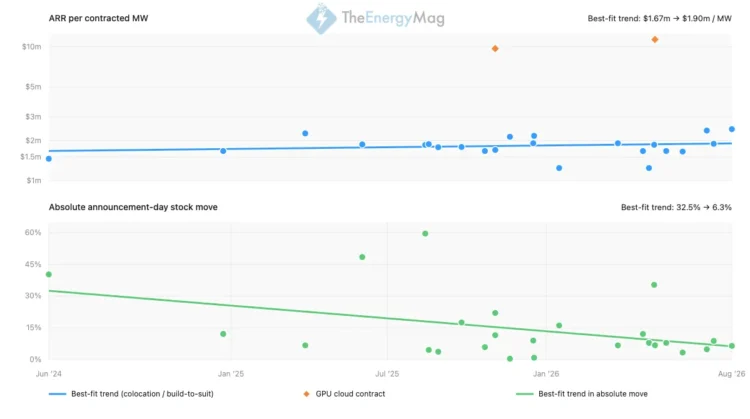
Paradoxically, the inherent commercial value of AI/HPC hosting services continues to rise. Data indicates that the annualized revenue per megawatt (MW) from such leases has climbed from an early average of $1.67 million to roughly $1.9 million.
This shift signifies a market no longer swayed by mere AI transformation rhetoric. Instead, investors are now scrutinizing concrete factors: tenant quality, project execution capabilities, capital deployment, and the tangible realization of future cash flows. For Bitcoin miners, the AI pivot has moved beyond “storytelling” to a critical phase of “proving the business model.”
With the release of Q2 earnings reports, Bitcoin miners’ AI strategies are undergoing a rigorous new assessment. PANews has delved into the latest financial disclosures of five leading Bitcoin mining companies. While some firms remain in the infrastructure development phase with their AI ventures yet to generate revenue, others have successfully leveraged AI/HPC hosting to secure new income streams, even beginning to redefine their core business structures. Overall, many miners still contend with declining revenues, expanding losses, and substantial capital expenditure demands, indicating that the AI transformation narrative is still some distance from consistently delivering robust cash flow.
The secondary market’s response to miners’ AI transitions has also become increasingly rational. Over the past month, most Bitcoin mining stocks have experienced varying degrees of correction, partly influenced by a broader pullback in the global AI sector. Even significant AI/HPC lease announcements or operational advancements from some miners have met with a relatively muted market reception.
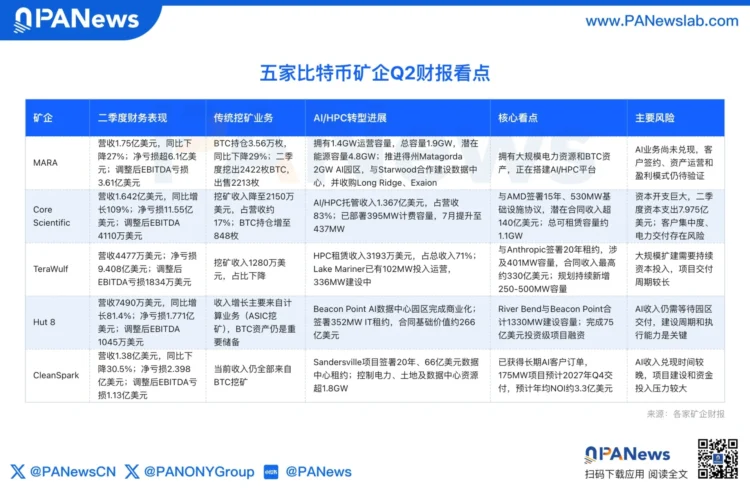
MARA: Widening Losses, AI Revenue Yet to Materialize
Over the last month, MARA’s stock price declined by approximately 11.6%, with a further drop of about 5.25% on the day its Q2 earnings were announced.
MARA’s latest quarterly report reveals that its traditional Bitcoin mining operations continue to face pressure from industry cycles, leading to shrinking profit margins. The company’s significant investment in AI/HPC infrastructure remains largely in the foundational build-out phase, with commercialization and revenue generation still pending.
In Q2, MARA reported revenues of approximately $175 million, a 27% year-over-year decrease from $238.5 million in the prior year. The company posted a net loss exceeding $610 million, a stark contrast to the $810 million profit recorded in the same period last year. Adjusted EBITDA swung to a loss of $361 million, down significantly from a $1.245 billion profit, primarily due to a $343 million digital asset impairment driven by Bitcoin price depreciation.
MARA’s financial report outlined a “three major infrastructure” strategy encompassing Bitcoin mining, power resources, and AI computing infrastructure.
- Mining Operations: As of Q2 end, MARA held 35,577 BTC, a 29% decrease from 49,951 BTC a year ago. The company mined 2,422 Bitcoins and sold 2,213 at an average price of $73,000. Total cash and BTC assets stand at approximately $2.5 billion.
- AI/HPC Transformation: MARA boasts 1.4 GW of operational capacity as of June 2026, with a total current capacity of 1.9 GW and a potential energy capacity of 4.8 GW. A key future project is the Matagorda County, Texas, site, planned for up to 2 GW of power capacity and intended as an AI/HPC computing campus, with construction projected to begin in 2027. MARA is also collaborating with Starwood on data centers and has acquired Long Ridge energy assets and French HPC operator Exaion (expected full-year revenue in the low millions).
- Strategic Financing: To fuel energy infrastructure expansion, MARA established a new $100 million credit facility, collateralized by 18,750 BTC. This move aims to enhance the liquidity and capital efficiency of its Bitcoin holdings to support future investments.
Despite these initiatives, AI/HPC currently contributes almost no revenue to MARA. During the earnings call, management acknowledged this, stating that H1 focused on scaling and platform transformation, with H2 shifting to execution, including securing client agreements, bringing new assets online, and validating profitability.
Core Scientific: AI Dominates Revenue, Resumes BTC Accumulation
Core Scientific’s stock price saw a modest increase of approximately 0.05% on its Q2 earnings release day, despite a 3.04% decline over the past month.
The latest quarterly report confirms a significant restructuring for Core Scientific, with its traditional mining business substantially reduced. The company’s strategic pivot to AI/HPC infrastructure has successfully translated into dominant revenue streams, largely validating its commercialization strategy.
In Q2, Core Scientific reported revenues of approximately $164.2 million, marking a substantial 109% year-over-year increase. While the company still recorded a net loss of about $1.155 billion, adjusted EBITDA reached approximately $41.1 million, with a gross profit of $70 million and a gross margin of 43%.
Core Scientific is rapidly reducing its reliance on mining revenue:
- Mining Operations: Q2 mining revenue decreased to approximately $21.5 million, representing only about 17% of total revenue. Interestingly, after previously selling BTC to fund its AI transition, Core Scientific increased its Bitcoin holdings from 547 BTC at the end of Q1 to 848 BTC in Q2.
- AI/HPC Dominance: The primary driver of revenue growth was the AI/HPC infrastructure business, with hosting revenue reaching approximately $136.7 million in Q2, a dramatic increase from $10.6 million in the prior year, now accounting for about 83% of total revenue.
- Capacity & Contracts: The company has deployed approximately 395 MW of billing capacity, which further increased to 437 MW by mid-July, corresponding to an annualized hosting revenue of roughly $635 million. A significant highlight is the 15-year infrastructure agreement with AMD, covering 530 MW across five data center campuses, with potential base contract revenue exceeding $14 billion. Core Scientific’s total leasable customer power capacity now stands at approximately 1.1 GW, with potential contract revenue surpassing $24 billion.
This transformation, however, comes with substantial capital investment. Q2 capital expenditures reached $797.5 million for data center construction and land acquisition, contributing to a net cash outflow from investment activities exceeding $1.18 billion in the first half of the year. The company bolstered its finances through a $3.3 billion senior secured notes issuance, which has, in turn, increased interest burdens and balance sheet leverage. Shareholder equity remains negative, and equity debt volatility persists. Furthermore, hosting revenue is highly concentrated among a few clients, making project progress, power acquisition, and supply chain stability critical for timely delivery and revenue realization.
During the Q2 earnings call, Core Scientific management asserted that the transformation inflection point has passed. The company is now focused on efficient computing capacity delivery, stringent project oversight, and responsible capital allocation to continuously create value for stakeholders.
TeraWulf: HPC Business Fuels Revenue Growth, Long-Term Contracts Secure Future
TeraWulf’s stock price declined by approximately 12.97% over the past month, with a 4.29% drop on its Q2 earnings announcement day.
In Q2, TeraWulf’s traditional mining operations also experienced reduced contributions due to industry dynamics. However, its AI/HPC transformation has begun to yield significant revenue, marking early success.
Q2 financial results show TeraWulf’s total quarterly revenue at approximately $44.77 million. Notably, Bitcoin mining revenue accounted for only $12.8 million, while HPC leasing revenue surged to $31.93 million, representing about 71% of total revenue. The net loss expanded to approximately $940.8 million, primarily driven by a $755.7 million loss from changes in the fair value of warrants. Adjusted EBITDA was a loss of $18.34 million. As of June 30, the company maintained strong liquidity with approximately $3 billion in cash and restricted cash.
Operationally, TeraWulf made significant strides:
- Lake Mariner Campus: The Lake Mariner data center campus is progressing well, with 102 MW of critical IT capacity operational by early July and an additional 336 MW under construction. Construction costs per MW remain within the $8 million to $10 million guidance. Google’s $600 million credit support for Fluidstack’s lease obligations activated post-CB-3 delivery. TeraWulf is also pursuing an extra 250 MW of power capacity.
- Lake Hawkeye Campus: This 183-acre campus has a potential capacity of approximately 320 MW of critical IT load, with operations not expected before 2029.
- Post-Quarter Milestones: TeraWulf signed a landmark 20-year data center lease with Anthropic for approximately 401 MW of critical IT capacity at its Justified campus in Kentucky. This contract is valued at approximately $19 billion over the term, potentially reaching $33 billion if Anthropic exercises two five-year renewal options. Initial deliveries are anticipated in H2 2027.
- Strategic Acquisitions & Divestitures: The company sold a 50.1% interest in the Abernathy joint venture for $530 million and acquired the Muskie Data Campus in Kentucky, securing a power service agreement for up to 1 GW. FERC’s approval of the Morgantown power plant acquisition cleared regulatory hurdles for its Chesapeake Data Campus subsidiary, which can expand to 1 GW, with data center operations expected around 2030.
TeraWulf reiterated its annual target of signing 250 to 500 MW of new critical IT capacity, emphasizing a preference for opportunities with stable power, clear customer demand, and scalable infrastructure. CEO Paul Prager highlighted the company’s transition from platform construction to scalable execution, focusing on controlling power-advantaged infrastructure, securing long-term credit-backed clients, and phased capacity delivery.
Hut 8: Revenue Soars Amidst Losses, First AI Campus Commercialized
Hut 8’s stock price fell by approximately 6.3% over the past month, experiencing a 9.74% decline on the day its Q2 earnings were released.
In Q2, Hut 8 reported impressive revenues of approximately $74.9 million, an 81.4% year-over-year increase. The surge was primarily driven by its computing business, particularly ASIC mining, which contributed $72.5 million. Digital infrastructure added $1.3 million, and power revenue was $1.2 million. Despite robust revenue growth, the company recorded a net loss of approximately $177.1 million, largely due to $138.6 million in unrealized losses on digital assets. Adjusted EBITDA, however, saw a strong 149% year-over-year increase to $10.45 million.
Hut 8 achieved significant commercialization milestones:
- Beacon Point Commercialization: The company successfully commercialized its first gigawatt-scale AI data center campus, Beacon Point. Post-quarter, it secured a second 352 MW IT lease, with a total value of approximately $26.6 billion over the base contract period. This contract is projected to generate over $1.75 billion in average annual net operating income (NOI) and covers 949 MW of already contracted IT capacity with signed parties.
- Construction Pipeline: The River Bend and Beacon Point campuses collectively have 1,330 MW of power capacity under construction, with initial data hall deliveries targeted for Q2 and Q3 2027, respectively. As of Q2 end, Hut 8’s total development pipeline stood at approximately 8,660 MW.
Financially, Hut 8 secured $7.5 billion in investment-grade project financing during the quarter, including $3.3 billion for the River Bend campus and $4.25 billion for Beacon Point Phase 1. These non-recourse and non-dilutive arrangements set a precedent for single-sponsor data center project financing, providing a solid foundation for large-scale construction.
Hut 8 CEO Asher Genoot emphasized that the company’s core focus has shifted from securing orders to project delivery. The priority is to rapidly convert contracted capacity into operational assets and stable cash flow, thereby solidifying its transformation from a mining company to an AI infrastructure provider.
CleanSpark: Mining Revenue Declines, $6.6 Billion Lease is a Game Changer
CleanSpark’s stock price saw a rise of approximately 2.16% over the past month, though it experienced a 5.56% dip on the day its Q2 earnings were released.
In its most recent reported quarter (Q2), CleanSpark’s revenue was $138 million, a 30.5% year-over-year decrease. The company posted a net loss of $239.8 million, a significant reversal from the $257.4 million net profit in the same period last year. Adjusted EBITDA also sharply declined from $377.7 million to a loss of $113 million.
As of June 30, CleanSpark held $202.6 million in cash and Bitcoin assets valued at approximately $814.9 million. Net long-term debt stood at $1.78 billion, with working capital of $761 million. While CleanSpark maintains strong asset reserves and financing capabilities, its continuous expansion of data centers and computing infrastructure necessitates substantial capital investment.
Notably, in this quarter, CleanSpark’s revenue was entirely derived from Bitcoin mining operations, with AI/HPC-related businesses yet to contribute substantial revenue.
However, the quarter’s most significant highlight was the signing of a 20-year, $6.6 billion data center lease agreement for CleanSpark’s Sandersville project with an undisclosed global technology company. CleanSpark disclosed that this project involves a high-specification data center build-out, with construction costs estimated at $10 million to $12 million per MW. The 175 MW capacity corresponds to a total investment of $1.75 billion to $2.1 billion, with an expected average annual net operating income (NOI) of approximately $330 million. This revenue, however, is contingent on construction completion, with deliveries projected to commence as early as Q4 2027. CleanSpark has confirmed that the necessary equity funding is secured, and procurement and advance payment for critical long-lead equipment are complete, ensuring the project’s planned operational timeline.
Unlike some miners still primarily articulating their AI ambitions, CleanSpark benefits from its established large-scale power resources, land reserves, and proven data center operational expertise. Currently, the company controls over 1.8 GW of power, land, and data center resources across the United States.
The Q2 performance of these mining companies underscores that the AI transformation is reaching a critical juncture. For investors, the focus has unequivocally shifted from the grandiosity of the AI story to tangible operational metrics. For Bitcoin miners, merely possessing power, land, and computing resources serves as an entry ticket; the ultimate re-rating of their valuation will hinge on their project delivery capabilities, the quality of their clientele, and their proven ability to generate future cash flows.
(The above content is an excerpt and reproduction authorized by our partner PANews. Original link)
Disclaimer: This article is for market information purposes only. All content and views are for reference only and do not constitute investment advice. They do not represent the views and positions of BlockTempo. Investors should make their own decisions and transactions. The author and BlockTempo will not bear any responsibility for direct or indirect losses caused by investor transactions.