Bitcoin’s Persistent Plateau: Awaiting a Catalyst Amidst Conflicting Currents
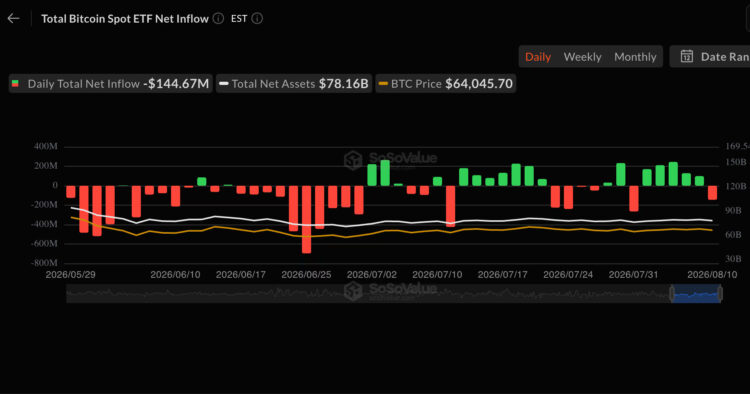
Despite a steady stream of capital flowing into Bitcoin spot Exchange Traded Funds (ETFs), the cryptocurrency market’s flagship asset, Bitcoin (BTC), has found itself in a prolonged holding pattern. For approximately five weeks, BTC has been locked in a tight trading range, caught between robust institutional demand and persistent profit-taking from miners and large corporate holders. The market now keenly awaits a new catalyst to shatter this enduring stalemate.
In the last 24 hours, Bitcoin registered a modest dip of 0.6%, hovering around the $63,500 mark. This minor fluctuation is indicative of a broader trend: throughout the summer, the world’s largest cryptocurrency by market capitalization has largely remained confined within a narrow $62,000 to $66,000 band, demonstrating a notable lack of directional momentum.
Paul Howard, a senior executive at Wincent, attributes Bitcoin’s recent price behavior to a delicate equilibrium. He explains that the consistent buying pressure from ETFs is effectively being neutralized by selling activity originating from miners and significant over-the-counter (OTC) transactions. This push-and-pull dynamic has prevented any decisive breakout.
Howard further highlights a critical observation: overall cryptocurrency trading volume has plummeted to a nearly three-year low. This scarcity of capital momentum, he argues, is a primary factor preventing Bitcoin from achieving a significant breakthrough in either direction.
Echoing these sentiments, analysts at Bitfinex have also identified similar capital flow trends. Their team notes that while spot ETFs and dedicated Bitcoin-focused corporate entities represent two key “price-insensitive” buying forces—consistently accumulating assets regardless of price movements—the recent surge in selling from mining operations and long-term holding companies has partially counteracted these ETF inflows. This intricate interplay, they contend, fully explains why Bitcoin mustered a mere 2% gain last week, even against a backdrop of substantial ETF absorption and a broader rally in global risk assets.
CPI: The Potential Game-Changer
All eyes are now fixed on the upcoming U.S. inflation data. The release of the latest Consumer Price Index (CPI) on Wednesday is widely anticipated to be the pivotal event that could finally disrupt Bitcoin’s entrenched consolidation pattern.
Jeff Anderson, Managing Partner at STS Digital, observes a prevailing lack of conviction among both bullish and bearish camps. This sentiment is further exacerbated by the characteristic low liquidity of the summer months, fostering a strong “wait-and-see” approach among investors. He points out that implied volatility in the options market has significantly receded to low levels, as traders cautiously await clearer signals regarding monetary policy and the progression of the U.S. “Digital Asset Market Clarity Act” (CLARITY Act).
This suppressed volatility carries a crucial implication: should Bitcoin eventually breach its current trading range, whether upward or downward, it has the potential to ignite a swift and dramatic one-sided price movement. Anderson emphasizes that Wednesday’s CPI report will serve as the market’s next critical litmus test, marking the first major inflation data point since Federal Reserve Chairman Kevin Warsh addressed inflation concerns following the July Fed meeting.
Looking ahead, Paul Howard projects that in the absence of significant positive fundamental catalysts, the current phase of consolidation could persist until mid-September. However, any substantial progress on the CLARITY Act is identified as a potential powerful driver capable of propelling the market out of its current inertia.
Furthermore, an analysis of derivatives positions reveals that investors are currently maintaining relatively robust hedging strategies. This suggests a cautious stance, with the market not heavily betting on an immediate Bitcoin breakthrough. Traders, by and large, appear to be patiently awaiting definitive confirmation signals before committing to a strong directional bias.
Should Bitcoin continue its struggle to break free from its current range, upcoming seasonal factors could present additional headwinds.
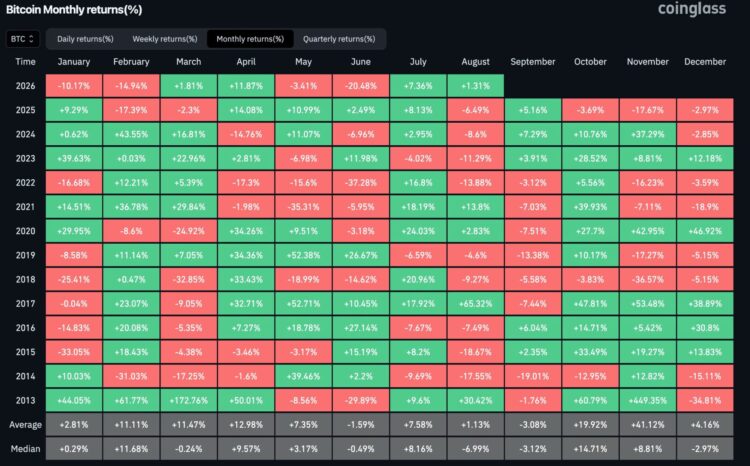
Jeff Anderson underscores that September has historically been Bitcoin’s most challenging month. Data from CoinGlass, dating back to 2013, indicates an average decline of 4% for Bitcoin during September.
Disclaimer: This article is intended solely for market information purposes. All content and views expressed herein are for reference only and do not constitute investment advice. They do not represent the opinions or positions of the publisher. Investors are encouraged to make their own independent investment decisions and transactions. The author and publisher shall not bear any responsibility for direct or indirect losses incurred by investors as a result of their transactions.