Crypto.com Bridges DeFi and TradFi with Launch of Tokenized US Stocks and ETFs
The convergence of cryptocurrency exchanges and traditional financial markets is accelerating, and Crypto.com is at the forefront of this evolution. The global exchange announced a significant expansion this week, introducing tokenized derivatives that track approximately 1,500 US stocks and Exchange Traded Funds (ETFs). This innovative offering empowers eligible users to seamlessly trade popular assets like Apple, Nvidia, and Tesla stocks, alongside prominent ETFs such as SPDR Gold ETF (GLD) and iShares Silver ETF (SLV), directly on its platform.
According to Crypto.com’s statement, qualified users within the European Economic Area (EEA) and other approved markets can now gain exposure to traditional equity markets with unprecedented ease. The platform boasts a low entry barrier, allowing positions to be opened for as little as $1, coupled with the convenience of 24/7 trading capabilities.
Unpacking Synthetic Exposure: Flexible Trading, Secure Custody
These newly launched products are derivatives issued by Foris Capital CY Limited, meticulously designed to mirror the price performance of their underlying stocks or ETFs. This mechanism provides “synthetic exposure”—a sophisticated investment approach where users benefit from the price movements of an asset without directly owning the asset itself. For instance, if Apple’s stock price appreciates, the corresponding tokenized product will reflect this gain, but the holder does not acquire shareholder status in Apple Inc.
Consequently, investors purchasing these tokenized derivatives will not possess legal ownership or beneficial rights to the underlying securities, nor will they have access to shareholder privileges such like voting rights. However, Crypto.com emphasizes that investors are still eligible for price adjustment compensation equivalent to cash dividends. Crucially, the underlying assets that back these derivatives are securely held in custody by Alpaca, a qualified US broker, ensuring a robust and regulated framework.
This strategic expansion was made possible by Crypto.com’s successful acquisition of Foris Capital in May 2025. This acquisition was pivotal, enabling the exchange to secure its Markets in Financial Instruments Directive (MiFID) license, thereby authorizing it to issue regulated financial products across Europe. Currently, Crypto.com stands as the 11th largest cryptocurrency exchange globally, as reported by data platform CoinGecko.
The Tokenization Tsunami: A Multi-Trillion Dollar Future
Crypto.com’s latest product rollout is perfectly timed amidst an explosive growth phase in the tokenized asset market. Data from RWA.xyz reveals that the total market capitalization of tokenized stocks has already reached approximately $2.49 billion, experiencing a staggering surge of nearly 600% over the past year. Citi Group offers an even more optimistic forecast, projecting that the tokenized securities market will balloon to an astounding $5.5 trillion by 2030, with tokenized stocks alone accounting for $2.6 trillion of this colossal figure.
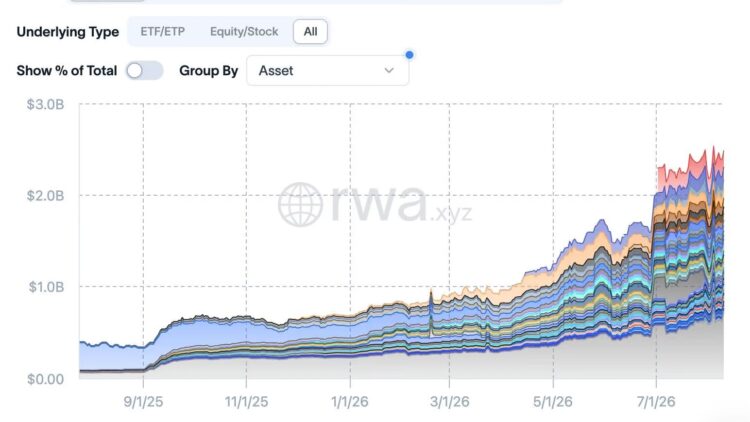
This isn’t an isolated trend. Numerous other trading platforms, including Kraken, Bybit, Bitget, and even the prominent US online broker Robinhood, have already introduced tokenized stock products to investors outside the United States. Furthermore, traditional finance behemoths are actively exploring this frontier: the Depository Trust & Clearing Corporation (DTCC) is rigorously testing underlying infrastructure for tokenized securities, while both Nasdaq and the New York Stock Exchange (NYSE) have unveiled their ambitious asset tokenization roadmaps.
Different Shades of Tokenization: Synthetic vs. Issuer-Sponsored
It’s important to note that not all tokenized stock products are created equal. Crypto.com’s offering falls under the synthetic or derivative model, providing investors with price exposure without conferring direct shareholder rights. In contrast, an “issuer-sponsored” model involves placing actual common shares on-chain, thereby retaining original stock ownership and all associated shareholder rights upon tokenization.
As tokenized securities steadily integrate into the financial mainstream, the distinctions, advantages, disadvantages, and regulatory compliance of these differing models are drawing significant attention from regulators and financial market infrastructure providers alike. For exchanges, the initial challenge of bringing traditional stock liquidity onto the blockchain is just the beginning. The true determinant of tokenization technology’s widespread adoption will lie in its ability to simultaneously address complex issues surrounding securities ownership, investor rights, robust custody solutions, and comprehensive regulatory oversight.
Disclaimer: This article is intended solely for market information purposes. All content and views are provided for reference only, do not constitute investment advice, and do not represent the opinions or positions of the author or the publishing entity. Investors should exercise their own judgment and make independent trading decisions. The author and publisher shall not be held liable for any direct or indirect losses incurred by investors’ transactions.