By Jae, PANews
Bitcoin Miners Pivot to AI: Riot Platforms Secures $9.1 Billion Deal with Anthropic, Reshaping the Digital Infrastructure Landscape
In the scorching heat of Rockdale, Texas, a sprawling campus once reverberating with the hum of tens of thousands of Bitcoin mining machines is undergoing a profound and strategic asset transformation. This shift is not just an upgrade; it’s a complete re-evaluation of purpose, driven by the insatiable demand for artificial intelligence compute.
According to Bloomberg, AI powerhouse Anthropic has signed a monumental 20-year supercomputing hosting agreement with Bitcoin miner Riot Platforms, valued at an astonishing $9.1 billion. The news sent shockwaves through the market, with Riot’s stock price surging over 25% in after-hours trading. This landmark deal underscores a burgeoning trend: the AI compute arms race is pulling erstwhile crypto miners directly into the global technological spotlight.
The Deepening Compute Race: Anthropic’s Strategic Move to Secure Future AI Power
On August 11, Anthropic finalized its $9.1 billion AI Data Center (AIDC) compute agreement with Riot Platforms. This partnership aims to meet the escalating compute demands of Claude users by leveraging Riot’s infrastructure. Riot has committed to providing 191 megawatts (MW) of compute capacity, equivalent to powering approximately 143,000 homes, over the two-decade contract term.
However, as revealed in SEC filings, the collaboration between Anthropic and Riot is not an immediate activation. The initial 96 MW is slated for delivery by December of next year, with the full capacity deployment projected to conclude by June 2028.
In the high-stakes arms race among leading AI laboratories, guaranteed compute supply has become the lifeline for large model developers. The computational demands for model training and inference are rising exponentially, often exceeding the capacity and scheduling capabilities of single cloud providers.
To mitigate supply chain bottlenecks and control long-term costs, Anthropic is meticulously building a global “asset-light, long-cycle” infrastructure network. Instead of constructing data centers themselves, they are securing power, land, and compute through customized “build-to-suit” long-term lease agreements, typically spanning 15 to 20 years.
Beyond its partnerships with public cloud giants like AWS and Google Cloud, Anthropic’s infrastructure strategy is multi-faceted:
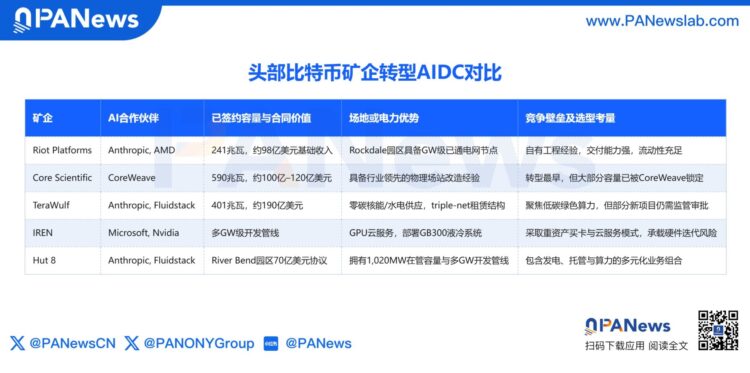
- A 20-year lease agreement with TeraWulf for 401 MW, valued at $19 billion.
- A $10 billion supply agreement with infrastructure startup Volta Infra Holdings.
- A near $45 billion compute procurement intent with xAI.
- Established AI data center partnerships with Hut 8 and Fluidstack.
Anthropic’s overarching strategic objective is singular: to secure physical compute resources for decades to come, ensuring uninterrupted innovation and growth.
Compared to the multi-year construction timelines, massive capital expenditures, and operational risks associated with building proprietary AIDCs, this “long-lease” model offers Anthropic a dual advantage. It guarantees future compute supply for decades while maintaining maximum financial flexibility, effectively transferring the burden of heavy asset construction to specialized infrastructure providers. This allows Anthropic to remain focused on its core mission of model research, development, and commercialization. This approach exemplifies the evolving competitive landscape in the AI arms race, where success is increasingly defined not just by the ability to acquire chips, but by the speed and certainty of locking in power and land.
Riot’s $9.1 Billion Coup: Strategic Power, Proven Delivery, and Robust Financials
Driven by the dual forces of the Bitcoin halving and the AI boom, nearly all US-listed Bitcoin miners have embarked on a strategic pivot towards AI Data Centers (AIDC). Companies like Core Scientific, TeraWulf, IREN, Hut 8, and Cipher Mining are actively promoting their “compute hosting” narratives. PANews identifies three primary reasons why Anthropic ultimately entrusted Riot with this colossal $9.1 billion order:
1. Strategic Power: The Scarcity of “Energized” Nodes
The most significant bottleneck in global AIDC construction currently is securing substation and high-voltage grid connection permits. Traditional data center developers often face a 2-4 year waiting period from grid application to formal power activation.
Riot’s Rockdale campus stands as one of North America’s largest single-site digital infrastructure parks. Crucially, it has already secured approval from the Electric Reliability Council of Texas (ERCOT) and boasts high-voltage power connectivity. This makes it one of the few ready-to-convert nodes in the entire U.S. that can be directly repurposed into an AI compute center.
In contrast, many competitors face limitations: Core Scientific’s capacity is largely pre-booked by CoreWeave, while TeraWulf’s existing capacity is significantly allocated to clients like Fluidstack. For Anthropic, which urgently needs to scale its capacity, Riot’s “plug-and-play” power allocation is a rare and invaluable commodity in the market.
While Texas is an attractive location for AIDCs due to its low electricity prices, a critical consideration emerges: the impact of large-scale, high-load facilities on the power grid is drawing increasing regulatory scrutiny. Bitcoin mining offers high flexibility, capable of shutting down to balance grid loads. However, AI model training and inference demand 24/7 uninterrupted power, imposing fundamentally different stability requirements on the grid. Sustained high loads could lead to tighter local regulations.
2. Delivery Certainty: Engineering Prowess Validated by AMD
Leading AI laboratories are highly sensitive to compute delivery timelines. Project delays can translate into setbacks in model training, product launch postponements, and disrupted funding cycles, with potential costs far exceeding initial construction expenses.
Riot’s engineering execution capabilities have already been market-validated. In January of this year, Riot signed its first 50 MW data center lease agreement with AMD. By the second quarter, it successfully completed and delivered the initial 25 MW IT capacity on time and within budget.
Furthermore, Riot is not merely a “sub-landlord.” It possesses proprietary engineering, manufacturing, and assembly facilities in Denver and Houston. This grants Riot end-to-end control over the engineering process, from transformer design and customized cooling systems to site construction, significantly mitigating risks of supply chain disruptions and construction delays.
However, the rapidly evolving AI landscape means a two-year engineering window is fraught with uncertainties. Chip architectures may iterate rapidly, compute demand structures could shift, and construction costs might exceed projections.
3. Financial Resilience: A Strong Balance Sheet for Heavy Asset Transformation
Upgrading a Bitcoin mining facility into an AIDC represents a colossal investment, with industry average capital expenditures for conversion reaching up to $7.5 million per megawatt. Many small to medium-sized mining companies, burdened by fragile balance sheets, have faltered due to liquidity crises.
As of the end of the second quarter this year, Riot boasted over $1.2 billion in liquid assets on its books, including approximately $549 million in cash and reserves of 11,380 Bitcoin. To support the ongoing construction at its Rockdale campus, Riot also secured a $573 million transitional financing agreement with Morgan Stanley.
With ample cash, substantial reserves, and established bank credit lines, Anthropic can proceed with confidence, assured that Riot possesses the financial fortitude to complete the project without interruption.
Nevertheless, for Riot and other transitioning Bitcoin miners, current large-scale orders are heavily reliant on a limited number of AI laboratories and cloud providers. Should these clients face challenges in commercialization, monetization, or funding, the long-term hosting agreements could face market scrutiny regarding their fulfillment capabilities.
Beyond Volatility: Bitcoin Miners Rewrite Their Valuation Formula
This $9.1 billion transaction is more than just a business upgrade for Riot; it signifies a fundamental restructuring of the capital logic underpinning Bitcoin miners.
Enhanced Revenue: 1-3x Improvement in Efficiency
The most immediate impact is a qualitative leap in revenue efficiency per megawatt of power. Previously, Bitcoin mining revenue was highly correlated with cryptocurrency price fluctuations and network difficulty, with profit margins consistently narrowing post-halving and exhibiting strong cyclicality. By redirecting power to compute hosting, annual revenue per megawatt approaches $2.4 million, representing a 1 to 3 times increase in efficiency compared to mining. Crucially, this revenue stems from long-term agreements, providing highly predictable cash flow and decoupling the business from the inherent volatility of the crypto market.
Valuation Reshaping: From High-Beta Crypto to Infrastructure Operator
Even more profound than the revenue enhancement is the shift in valuation methodology. Capital markets have historically applied a discounted valuation to Bitcoin miners, with EBITDA multiples typically ranging between 6-12x. In stark contrast, data center infrastructure operators, characterized by stable, long-term cash flows, commonly command EBITDA valuation multiples of 20-25x.
With the accumulation of 241 MW and approximately $9.8 billion in long-term contracts from AMD and Anthropic, Riot is poised to complete its identity metamorphosis. It is transitioning from a high-volatility cryptocurrency concept stock to an infrastructure company with utility-like characteristics, offering greater stability and predictability to investors.
Capital Reallocation: Selling Bitcoin, Investing in Hard Assets
Beneath this transformation lies a significant internal capital reallocation within the crypto industry. To fund the substantial capital expenditures required for its AIDC conversion, Riot sold 9,665 Bitcoin in the second quarter of this year, realizing approximately $733 million. This strategic move may well become a consensus among miners: converting non-cash-generating Bitcoin reserves into tangible, hard assets capable of generating long-term, stable income.
Miners are no longer merely “miners” of Bitcoin; they are evolving into “landlords” of compute resources. Leveraging their existing engineering expertise and physical assets, they are becoming indispensable infrastructure providers in the age of AI.
Naturally, transformation is rarely instantaneous. Delivery capabilities, technological evolution, and regulatory risks all present significant challenges. However, those players who have proactively secured resources are ultimately poised to realize a substantial revaluation of their worth amidst the surging wave of AI innovation.
(The above content is an authorized excerpt and reprint from our partner PANews. Original Link)
Disclaimer: This article provides market information only. All content and views are for reference only and do not constitute investment advice. They do not represent the views and positions of BlockTempo. Investors should make their own decisions and trades. The author and BlockTempo will not bear any responsibility for direct or indirect losses incurred by investors’ transactions.