

Cryptocurrency Market Faces Liquidity Crunch as Binance Dominates Amid Shifting Capital Flows
The cryptocurrency market is currently navigating a significant contraction in liquidity. According to recent data from CryptoQuant, stablecoin reserves held on centralized exchanges (CEXs) have plummeted to approximately $64 billion. This marks a substantial $16 billion reduction from their peak of nearly $80 billion at the close of 2025, representing a sharp 20% decline.
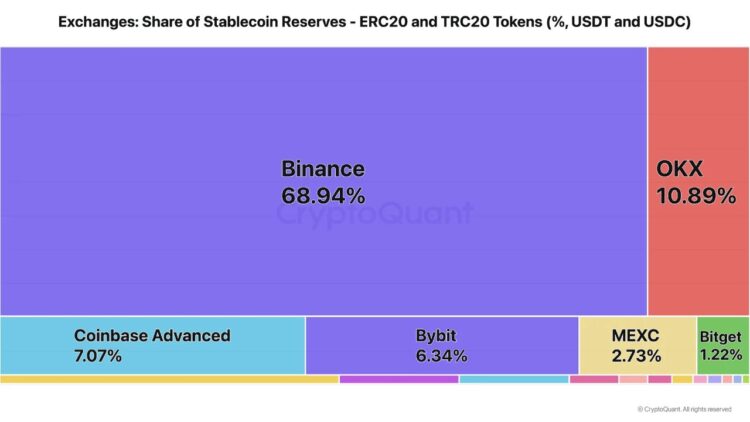
This trend signals a decrease in readily available capital on exchanges, funds typically poised to absorb buying pressure and fuel market activity. Furthermore, the remaining liquidity is rapidly consolidating, with a disproportionate share now held by a select few platforms. Notably, Binance alone commands an astonishing 68.5% of the total stablecoin liquidity across all exchanges.
CryptoQuant’s research team highlights Binance’s remarkable “resilience” in liquidity performance, especially when contrasted with its peers. While major platforms like Coinbase, Bybit, and OKX have experienced dramatic outflows of stablecoin balances, Binance has largely bucked the trend. This divergence has allowed Binance to expand its market share from an estimated 62-63% at the end of 2025 to its current 68.5%, effectively capturing a larger piece of a shrinking pie.
“This phenomenon of divergence illustrates one thing: the current downturn is not only draining overall market liquidity but also highly concentrating the remaining capital.”
Indeed, capital naturally gravitates towards deeper trading environments. CoinGecko data from the second quarter of this year reinforces Binance’s market leadership, showing the exchange facilitating 38.7% of all spot trading volume on centralized exchanges. In stark contrast, Bybit, the second-ranked exchange, secured only about 10% of the market share.
Market Pessimism Surges: A Potential Signal for “Smart Money”?
Parallel to the dwindling stablecoin liquidity, retail investor sentiment has visibly weakened. Blockchain analytics firm Santiment reports a pervasive wave of bearish commentary across major social media platforms.
Santiment observes a resurgence of “crypto is dead” narratives, which typically coincide with widespread market fear, exhausted retail patience, and a tendency for investors to interpret temporary pullbacks as permanent crashes, especially after prolonged periods of price stagnation. However, Santiment also points out that such moments of collective despair frequently precede significant market reversals.
If this pessimistic sentiment persists, yet Bitcoin manages to hold crucial price levels, long-term investors continue to accumulate, and forced selling pressure subsides, it could create an exceptionally attractive entry point for patient buyers. Objectively, market fear appears to be gradually easing; the “Crypto Fear & Greed Index” registered 46 on Wednesday. While still within the “fear” zone, this marks a notable recovery from 27 a week prior and 29 a month ago.
Beneath the Surface: Is Capital Simply Shifting On-Chain?
Stablecoins serve as the primary quoting assets in the cryptocurrency market, and their total supply can be seen as the most readily deployable on-chain purchasing power. A decline in stablecoin supply therefore suggests a reduction in funds available to absorb selling pressure or catalyze the next market rally.
According to DeFiLlama, the overall stablecoin market capitalization has receded from its May high of nearly $316 billion to $300.89 billion. Tether (USDT) remains dominant with a market cap of $182.95 billion, followed by USDC at $71.97 billion.
Crucially, the overall stablecoin market’s 4.8% contraction is significantly less severe than the 20% fund outflow observed from centralized exchanges. This disparity suggests that a substantial portion of the capital exiting CEXs may not be leaving the crypto ecosystem entirely. Instead, it is likely being redeployed on-chain, for instance, into DeFi protocols to generate yield.
Historical Context and Future Outlook
From a historical perspective, the current liquidity contraction, while notable, has not yet reached extreme levels. Between April 2022 and August 2023, the total stablecoin supply plummeted by 34%, coinciding with a prolonged and severe liquidity crunch and a 43% drop in Bitcoin’s price.
In contrast, the current decline in stablecoin supply is relatively moderate, indicating that the market has not yet plunged into the depths of liquidity depletion witnessed in 2022. However, analysts caution that a sustained decline in stablecoin supply, especially if it approaches past extreme levels, would signal a further erosion of usable purchasing power within the cryptocurrency market, potentially exerting greater pressure on Bitcoin and the broader digital asset space.
Disclaimer: This article is provided for market information purposes only. All content and views are for reference only and do not constitute investment advice. They do not represent the views or positions of the author or publisher. Investors should conduct their own research and make independent investment decisions. The author and publisher will not be held responsible for any direct or indirect losses incurred from investor transactions.




