Author: Nancy, PANews
Arthur Hayes Unveils Flop Labs: A Bold Bet on the AI Agent Economy Amidst Skepticism
On August 18th, the cryptocurrency community was set abuzz by the sudden emergence of “Flop,” a new project that quickly became a hot topic across social media, drawing a flurry of applications from eager participants.
The mastermind behind this new venture is none other than crypto veteran Arthur Hayes. That evening, Hayes dramatically announced on X (formerly Twitter) that he was “ending his retirement” to assume the role of CEO at the nascent Flop Labs. After stepping down from his operational role at the helm of crypto derivatives giant BitMEX, Hayes had primarily operated as an investor and crypto commentator, consistently sharing his insights on macroeconomic trends and industry shifts. Now, donning his executive hat once more, Hayes has bypassed the familiar trading arena to instead focus on the burgeoning AI Agent economy.
From pioneering crypto derivatives during the BitMEX era to now championing the AI Agent space, Hayes’ return imbues Flop Labs with immediate relevance and significant buzz. This raises a crucial question: How does Flop Labs differentiate itself from existing AI Agent projects in the market?
Flop Labs: Fueling the AI Agent Economy with “Useful Inference Proof”
The day began with Hayes posting a selfie showing him on nasal oxygen, playfully captioned, “Physically preparing for the bull run.”

Mere hours later, the seasoned crypto entrepreneur declared his “un-retirement” and revealed his new role as CEO of Flop Labs, announcing plans for a token, $FLOP, positioned as “AI Agent fuel.” The project’s promotional slogans—”no presale, no VC, 100% fair launch, Q4 airdrop”—combined with Hayes’ direct involvement, swiftly captured market attention during a bear market, igniting widespread community enthusiasm.
According to official descriptions, Flop Network is a protocol built on “useful inference proof,” specifically engineered for the AI Agent economy. The project envisions a future where AI agents autonomously execute tasks, conduct transactions, and collaborate on a massive scale, forming an agent economy that could potentially dwarf human economic activity. However, for these AI agents to truly participate economically, a native currency is essential for settling computations, storing and retrieving memories, and facilitating transactions between agents. $FLOP is designed precisely for this purpose.
Unlike traditional blockchains that rely on computational hashing for mining, Flop Network aims for miners to provide genuine AI inference computing power. Participants contribute to network operations by executing AI inference tasks with practical utility, earning token rewards in return. In essence, the project seeks to transform mining from a pure consumption of computing power into the production of computational resources directly serving the AI economy.
Based on the currently available information, Flop Network outlines four primary participant categories:
- Miners: Provide computing resources, run AI inference tasks, and receive $FLOP block rewards and inference task payments. Prospective miners can apply by submitting personal details, preferred mining equipment types, and planned operational scale.
- Validators: Act as the network’s trust layer, responsible for verifying inference results submitted by miners. They also undertake decentralized storage and management of AI agent memories, earning $FLOP rewards for validation work, inference payments, and memory services. Applicants must provide personal information, validator configuration preferences, and planned node quantities.
- AI Agents: The demand side of the network, utilizing $FLOP to acquire computing resources, store and retrieve memories, and conduct inter-agent commercial activities on the network.
- KOLs & Creators: Primarily tasked with project promotion and community engagement. Participants can submit personal details, audience reach, content distribution channels, and past community project experience, receiving $FLOP rewards based on their contribution to community activity.
However, Flop Labs has disclosed relatively limited project specifics thus far. Public information currently comprises a landing page, three application forms, and a project overview diagram. A whitepaper, tokenomics, contract addresses, underlying chain type, or specific technical implementation details have yet to be released. Consequently, the project’s technical architecture, token economic model, and ultimate viability remain subjects for further observation.
According to Flop Network’s published roadmap, a large-scale airdrop is anticipated in Q4 2026, with the genesis block scheduled for Q1 2027. It’s noteworthy that this implies the $FLOP token airdrop will occur approximately one quarter before the network’s first block is generated, meaning participants will initially receive an “expected token entitlement.”
Arthur Hayes’ AI Stance: A Controversial Pivot?
Beyond the project itself, Hayes’ direct involvement undoubtedly generates more discussion and has sparked skepticism within the market.
Notably, the crypto veteran has repeatedly warned against the AI sector. In fact, he publicly cautioned multiple times in 2026 (Note: The original article states “2026” as the year of these past warnings, which appears to be a typo given the article’s publication date in August 2024. We preserve the original detail while acknowledging the discrepancy.) that the frenzied expansion of current AI infrastructure is fundamentally a debt-driven credit bubble. He argued its logic differs from the dot-com valuation bubble of 2000, instead drawing parallels to the 2008 real estate bubble.
Hayes’ analysis suggested that data center construction largely relies on massive borrowing, with GPU loan terms often stretched to five or six years, while the chips’ effective lifespan might only be two or three. Should demand growth slow or cheap Chinese models drive down inference prices, the cash flow assumptions underpinning these debts could collapse. From late 2022 to mid-2026, AI-related debt was estimated to reach approximately $1.5 trillion, nearly absorbing the entire M2 growth in the U.S. during the same period. This not only siphoned liquidity away from the crypto market but also laid the groundwork for future compute oversupply. Hayes predicted that capital expenditure growth might begin to decelerate in late 2027, with credit pressures becoming more apparent around 2028, potentially forcing governments and central banks into large-scale money printing to bail out markets, ultimately benefiting Bitcoin.
Therefore, Hayes’ sudden pivot into the AI sector, after consistently warning about an impending AI bubble, naturally invited scrutiny. His explanation is that his skepticism wasn’t directed at AI itself, but rather at the financial bubble forming around AI infrastructure. He contends that the bubble primarily exists in the vast amount of debt issued for data center construction, and in the high valuations of some unprofitable hyperscale tech companies and frontier AI labs, not in the agent economy itself. He asserts his “100% belief” in the agent economy and argues that the excess computing power built with borrowed money precisely supports his thesis for Flop Labs.
Furthermore, Hayes’ personal trading activities have also drawn criticism. In June of this year, on-chain detective ZachXBT publicly questioned Hayes’ trading behavior, detailing instances where Hayes had previously publicly endorsed tokens like NEAR, HYPE, ZEC, and WLD, only to reportedly sell his holdings shortly thereafter. ZachXBT raised concerns about whether Hayes’ followers might have inadvertently provided exit liquidity for these trades.
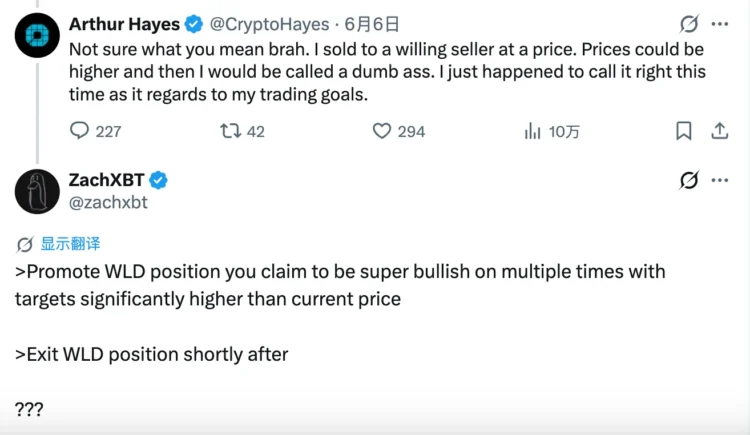
In response to these accusations, Hayes stated that he simply made correct trading decisions based on predefined targets, never instructed anyone to buy or sell specific crypto assets, and does not offer investment advisory services. However, ZachXBT vehemently countered, labeling Hayes’ actions as contradictory and perplexing given his pattern of publicly endorsing tokens before rapidly liquidating his positions.
Despite these controversies, Hayes’ influence in the cryptocurrency industry remains Flop Labs’ most significant asset. Even though BitMEX, the pioneering perpetual futures exchange he co-founded, has evolved beyond his direct operational leadership, Hayes’ personal brand and market appeal show no signs of diminishing.
For Flop Labs, the ultimate challenge will be converting the considerable traffic and attention generated by Hayes into genuine network demand. The project’s long-term success will ultimately hinge on its ability to deliver on its ambitious vision for the AI Agent economy.
(The above content is an excerpt and reproduction authorized by partner PANews, original link)
Disclaimer: This article is for market information purposes only. All content and opinions are for reference only and do not constitute investment advice. They do not represent the views and positions of BlockTempo. Investors should make their own decisions and transactions. The author and BlockTempo will not bear any responsibility for direct or indirect losses resulting from investor transactions.