
Source: “Milk Road Show”
Compiled by: Felix, PANews
Navigating the Crypto Waters: Rob’s Strategies for Bitcoin, Altcoins, and Self-Custody Security
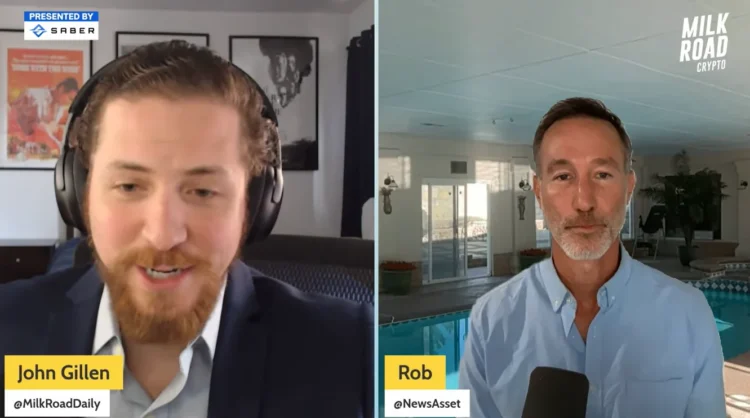
In a recent episode, the popular podcast “Milk Road Show” featured an insightful interview with renowned crypto analyst Rob. As the host of the YouTube channel Digital Asset News, Rob is a prominent content creator and market analyst, closely tracking cryptocurrency trends, macroeconomic shifts, and market dynamics.
The discussion delved into Bitcoin’s price movements around the critical 200-week moving average, exploring whether this signals a definitive bear market bottom. Rob unveiled his unique, risk-tiered dollar-cost averaging (DCA) strategy for accumulating assets. He also candidly shared his growing concerns regarding asset security and potential vulnerabilities in cold storage solutions. In light of these challenges, Rob advocated for a diversified custody approach to mitigate risks for investors.
PANews has distilled the essence of this compelling conversation below.
Is Bitcoin’s Bear Market Bottom In? An Analyst’s Perspective
Host: Bitcoin has finally reclaimed the 200-week moving average, a level historically associated with bear market bottoms. However, prices can often linger and consolidate around this point for extended periods during a bear market. Do you believe we’ve hit the bottom, or are more turbulent bear market oscillations still ahead?
Rob: That’s an excellent question. Honestly, I hope the market hasn’t bottomed out yet. Historically, the vicinity of the 200-week moving average has always presented an exceptional buying opportunity. If we rewind to 2015, when Bitcoin was still incredibly cheap and investing in it seemed almost irrational, the price only briefly dipped below the 200-week MA before a swift recovery. Fast forward to 2018, after the all-time highs of 2017 (which is when I first entered the space), we saw a more significant breach of the 200-week MA. Many were lamenting, “It’s all over, it’s never coming back!” Yet, the astute investors simply continued their dollar-cost averaging (DCA) strategy. Then came 2020, with the global panic of the COVID-19 pandemic, and Bitcoin once again fell below the 200-week MA – another incredibly opportune “golden buying point.”
Zooming to 2022, Bitcoin plummeted, breaking not just the 200-week MA but even the 250-week and 300-week averages. Now, Bitcoin is testing this range repeatedly, currently hovering slightly above the 200-week MA. For me, this remains a prime DCA period.
I don’t want to repeat the mistake I made in 2022. I foolishly practiced what I call “micro-DCA,” reducing my weekly investment amounts due to fears of further crashes, intending to make a large lump-sum purchase at a lower point. Had I stuck to my original plan (regular DCA and increasing buys during dips), my portfolio would be in a much stronger position today. While I’ve performed reasonably well, everyone would agree that buying Bitcoin at $15k, $16k, or $17k in 2022, or even at $3,000 in 2018, proved to be incredibly shrewd decisions.
So, to answer your question: I hope this isn’t the bottom. Let’s see if the four-year cycle plays out perfectly as it has in the past, or if this current period merely represents a very attractive buying window.
Rob’s Risk-Tiered DCA Strategy: Doubling Down on Dips
Host: Dollar-cost averaging and long-term holding are certainly easier said than done. You’re well-known for your unwavering commitment to DCA Bitcoin every Monday. Could you walk us through how you developed this strategy and how it operates in practice?
Rob: My approach integrates a risk model. Simply put, as Bitcoin’s price declines, the perceived risk level also drops. When the risk level falls between 0.5 and 0.6, I initiate my regular weekly purchases. Once it dips below 0.49, I double the amount I bought the previous Monday. If, by the next Monday, the risk level drops to 0.39, I quadruple my purchase. Should it continue to plummet, falling below 0.29, I octuple my buying amount.
I must admit, initially, within these risk bands, I felt quite comfortable. But as the price kept falling, I had to manually increase my buy orders. The process is straightforward because I use Cash App, and my DCA automatically triggers at 6:30 AM every Monday. Many ask why Cash App? Because for automated recurring purchases, their fees are negligible, and the spread is excellent, likely facilitated through OTC (Over-The-Counter) trading.
So, to summarize: the lower the price, the more I buy – doubling, quadrupling, even octupling. I don’t overthink it; I simply believe that, in the long run, buying now is highly likely to be a profitable decision.
Host: So, at this very moment, within that doubling, quadrupling, octupling range, where do you find yourself?
Rob: I’m not tracking the exact real-time data, but the current risk level is roughly around 0.3, so I’m currently in the quadrupling buying phase. Should it drop further below this level, I’ll activate my octuple DCA. Frankly, every time I trigger these larger purchases, my bank used to call me, asking, “Hey, is this transaction really you?” I’d confirm, “Yes, it is.” They’ve grown accustomed to it now and no longer call, as these are indeed substantial sums.
Host: It’s good that your bank is looking out for your security. Given your aggressive DCA in a bear market, do you employ a similar “DCA selling” strategy in a bull market, or do you simply hold?
Rob: I was more effective at profit-taking during the 2021 bull market. Back then, I simply set clear price targets and sold in batches. My method involved using “fractals.” I’d compare the percentage gains from previous cycles (e.g., 2x, 3x, or 4x) and tell myself: once Bitcoin’s price has risen 2x from its cycle bottom, I’d cash out a small portion of profits. When it hit 4x, I’d take out another portion, and so on.
But by 2025, I thought I’d become smarter, so I started relying on various technical indicators like the MVRV score, the Puell Multiple, and others. I believed these indicators would never fail me, but unfortunately, they did.
In fact, the wisest course of action at the time would have been to listen to a Reddit user who posted three years prior. Based solely on the four-year cycle timeframe, he predicted October 6, 2025, would be the absolute peak of that cycle. I thought, “How could that be?” And what happened? October 6 genuinely marked the highest point of that cycle.
So, while I didn’t perfectly time the absolute top, I still managed to cash out some profits in batches as the price declined. I believe no one can truly buy the bottom and sell the top. In the next four-year cycle, I’ll continue to adhere to a phased profit-taking strategy.
I know some will say, “Rob, you should never sell your Bitcoin.” But everyone has their own life goals, and my goals differ from yours. The feeling of being debt-free and no longer burdened by financial pressure is truly wonderful. Bitcoin is indeed magnificent; it’s the best monetary issuance mechanism. But for me, cashing out a portion of Bitcoin profits and moving them into assets I consider more stable (like the S&P 500, bonds, or real estate) allows me to sleep better at night. Of course, the vast majority of my assets remain in Bitcoin, not altcoins.
Market Catalysts and the Regulatory Landscape
Host: Bitcoin’s volatility has recently hit historic lows, even quieter than gold and the US stock market, having traded sideways in a narrow range for two to three months. In this subdued market, do you foresee any short-term catalysts that could break the monotony and reignite Bitcoin’s volatility?
Rob: It’s tough to predict because whenever there’s potential good news, it’s often accompanied by various FUD and negative developments. For example, the AI bubble might burst, or there could be a widespread hacking incident involving certain cold wallet devices – these are all possibilities.
On the positive side, I had hoped the “Clarity Act” would pass, which could have provided positive momentum and market impetus. Unfortunately, it didn’t. Given that it’s a midterm election year, Democrats were clearly unwilling to hand President Trump a legislative victory that he could parade around and use to mock them, so they essentially vetoed it.
What other positive factors are there? We’re seeing Wall Street institutions accelerate their entry. For instance, Citi, the world’s third-largest bank, plans to launch Custody+, a custody solution designed for 24/7 needs, later this year, starting with Bitcoin. Other major institutions are also rushing in. We even have a “pro-crypto presidential candidate.” While this might primarily be for promoting his World Liberty Financial project, there are indeed candidates campaigning on this platform and making many promises, though they often struggle to deliver.
In the short term, I don’t anticipate any significant breakthroughs. I believe the SEC and CFTC will step in to regulate where Congress fails. Congress consistently disappoints us, but the rules and adjustments made by regulatory bodies might offer some short-term assistance. I don’t think we’ll see a super bull run before the end of this year because people used to think the market was entirely driven by fundamentals and institutional entry. But ultimately, everything still adheres to the four-year cycle. Once we move out of this year’s consolidation range and investor sentiment shifts, we’ll truly see price explosions.
Host: You touched on many interesting points, especially regarding hacking incidents, but I want to continue discussing regulation first. While the “Clarity Act” is stalled, it’s not entirely dead, merely postponed until September. Today, as we record this podcast, President Trump is meeting with several crypto industry leaders at the White House. Do you think this meeting could signal anything genuinely impactful for the market or worth investors’ attention, or is it just another “show”?
Rob: I certainly hope it leads to substantive progress. However, I note that Trump’s World Liberty Financial project recently received a conditional bank charter from the OCC, and they are attempting to enter the stablecoin arena. Their current stablecoin is roughly ranked fifth globally, which could help strengthen the US dollar’s global position.
I believe President Trump will strongly push for this because it greatly benefits his family’s initiatives. This endeavor has both supporters and detractors. But if we return to the “circle of control” – what can ordinary investors truly control? We cannot control a current or incoming US president creating his own crypto business ventures. If he can communicate with everyone in the White House and genuinely push for congressional legislation, that would be ideal. But in my view, this is largely still a political gesture.
Host: There’s another major development: the SEC has voted to approve and launch what they call “crypto regulatory ordinances.” This framework clarifies how digital assets will operate in the US, covering Initial Coin Offerings (ICOs), fundraising, and providing “innovation exemptions” for projects still in their network development phase. What’s your response to this SEC move? Do you see it as a positive development?
Rob: Regarding the ICO regulations, the government’s actions have been ongoing for five to six years. If these rules had been introduced in 2017, when I first entered the industry and ICOs were rampant, with the market growing wildly and unregulated, I would have been incredibly grateful. At that time, if you invested in the right projects, you could indeed make a fortune.
I believe the intervention of the SEC and CFTC is beneficial for capital allocation. I’ve reviewed the new rules; for financing under $5 million within four years, there are minimal restrictions, with the cap potentially reaching $75 million. If these policies are implemented, a continuous flow of capital will enter the crypto space.
However, my real concern is: do we genuinely need to cram more new crypto projects, altcoins, and DeFi startups into this already chaotic “melting pot”? Everyone comes along saying, “I have a brand-new token, a new feature, or the next greatest DeFi invention.” While free market competition is good, how many altcoins are there on the market now?
Host: That depends on how you define and count them, but at least several million.
Rob: Exactly, millions. My personal view is that we should focus on building upon mainstream altcoins that have already been tested by the market and proven their resilience. If people wish, they could even use Bitcoin as the ultimate settlement layer, as was envisioned in the early days. So, while I’m happy to see the SEC and CFTC providing positive regulatory intervention, I don’t view it as a super catalyst that will fundamentally turn the market around.
The Shaken Trust in Self-Custody: A Call for Diversification
Host: We’ve seen a string of security breaches recently. From Coldcard to Trezor, and last week, SafePal – these vulnerabilities and hacks have severely shaken ordinary investors’ confidence in “self-custody.” I’d like to know your thoughts: Will the core philosophy of self-custody suffer a major blow due to these consecutive incidents? And what should ordinary people do in the face of these concerns?
Rob: Some might argue this is pure coincidence, given that traditional giants like Citigroup just announced their entry into Bitcoin custody, and numerous third-party custody services are emerging – the timing perfectly overlaps. But you must realize that devices like Coldcard have operated securely for many years. Regardless of any conspiracy theories, the undeniable fact is that many people have lost their life savings in these incidents.
If we continue to promote “self-custody as the only way forward for future finance,” I believe it’s simply not suitable for everyone. A few years ago, renowned quantitative analyst PlanB stated on X: “I’m moving all my assets into ETFs.” This is someone who has been deeply involved in the crypto industry for years, fully aware of all the risks and technical intricacies of self-custody, yet he explicitly said: “I don’t want to bother anymore. ‘Not your keys, not your coins’ is true, but now ‘no keys, no worries’ applies better to me.”
Another industry titan, Simon Dixon, holds a different view. He believes this series of wallet security crises is a meticulously orchestrated propaganda campaign designed to scare away general users, forcing them to abandon self-custody and return to the embrace of traditional custodians.
For me, every one to two weeks, I receive desperate emails from fans. They write, “Rob, I’ve just lost all my life savings.” In the past, this was mostly due to users’ own ignorance and negligence (e.g., falling for phishing scams). But now, the situation has changed. Brands like Ledger, SafePal, and several other cold wallet companies have had their own security defenses or corporate databases hacked, leading to the leakage of users’ sensitive personal information (like home addresses, emails, phone numbers). This allows hackers to directly pinpoint and target you, creating immense offline personal and asset security risks.
Even worse, we can no longer fully trust the technology and underlying algorithms of hardware wallets themselves. This reminds me of the saying: “It’s not what I know that’s scary, nor what I know I don’t know, but what I don’t know that I don’t know.”
In the realm of self-custody, I am not omniscient. If I had delved deeper into certain cold wallet vulnerabilities earlier, perhaps I could have warned everyone. My biggest fear is that one day, a mainstream cold wallet company will suddenly announce: “We apologize, an underlying code vulnerability, dormant for years, was discovered by AI, and we regret that it has led to thousands of users losing their Bitcoin.”
Some might accuse me of spreading FUD. But I believe those who suffered losses due to the Coldcard vulnerability would certainly have wished for more such warnings at the time.
To address this risk, I’ve adopted a diversified strategy. I keep a portion of funds on Ledger, a significant portion on Tangem, and I also utilize iTrust Capital’s custody services. Simultaneously, I allocate a part to ETFs.
Host: This approach embodies immense wisdom, and my own strategy is very similar to yours. On one hand, we desire autonomy and control over our assets, but on the other, we cannot bear the enormous cost of a single point of failure. Diversifying risk and using a combination of custody solutions is indeed best practice. How did you gradually arrive at this blended custody solution?
Rob: It stems from an episode where I invited former LA Raiders star player Steve Wisniewski onto my show. He’s a future Hall of Famer who had invested over $3.2 million into Bitcoin. However, he ultimately lost it all due to a sophisticated phishing scam.
On the show, he meticulously recounted the entire process. That interview deeply impacted me; I realized that if someone as intelligent as Steve could fall victim, then countless ordinary people are even more vulnerable. Sometimes, you might have printed your seed phrase on paper five years ago and tucked it away somewhere, forgotten about it, and somehow that information gets leaked.
I’ve received too many desperate emails, with people asking, “Rob, who do I contact? How do I explain this to my wife? How will I pay for my children’s college tuition?” I can only helplessly tell them: “In the world of self-custody, once your assets are lost, no one can help you. You can report it to the police, contact the FBI, and I can recommend on-chain investigators like ZachXBT, but you will never get it back.”
Losing 25% of your assets is painful, but the most tragic outcome is losing 100% of your entire life savings. I hope to protect more people rather than watch them blindly pursue self-custody without any safety net.
Altcoin Strategy: The ‘BEST’ Approach and Market Realities
Host: Given that you focus the vast majority of your energy on Bitcoin, do altcoins still have a place in your investment portfolio? In this bear market, are you also DCAing or holding any altcoins? What’s your overall outlook for the altcoin market?
Rob: For altcoins, I approach it from a practical application perspective. We know stablecoins will flourish in the future and further strengthen the US dollar’s global dominance. I’ve researched Visa’s on-chain analytics platform, which tracks on-chain data for major public blockchains carrying mainstream stablecoins like Tether and Circle. The data is very honest; the top four chains are consistently the same. I’ve coined the token combination of these four chains as the “BEST” portfolio: Binance Coin (BNB), Ethereum (ETH), Solana (SOL), and Tron (TRX).
These are my “four kings” of altcoins. Of course, there are other good projects on the market, such as Polygon. But my personal funds are limited, and I can’t spread my money across every project. Some might argue: “While stablecoin transaction volume is in the trillions of dollars, this is only a tiny fraction of what determines a token’s price appreciation.” They are right; payments are only part of the fundamentals. The biggest driver of token prices, frankly, is speculation.
Host: In future markets, would you consider expanding your horizons beyond this “BEST” combination to allocate to some smaller-cap dark horse projects?
Rob: If market conditions change, my strategy will adapt accordingly; I always maintain an open mind. For example, I’m monitoring the progress of the Canton chain in RWA tokenization. If you visit rwa.xyz and break down the data by chain, you’ll find that the Canton chain holds a significant market share. Additionally, I’ve been observing the activity and trading volume on Hyperliquid, which is quite astonishing.
However, whenever I examine these emerging projects, I torment myself: Is it truly worth disrupting my existing stable positions to risk diversifying? The current answer is: no, it’s not worth it. My altcoin allocation remains very tight.
Because historical patterns tell us: if traditional financial markets (like US stocks) sneeze, Bitcoin catches a cold; and once Bitcoin catches a cold, altcoins are directly “sent to the ICU and put on a ventilator.” This is the undeniable trajectory of the crypto market.
(The above content is an authorized excerpt and reprint from our partner PANews, original link.)
Disclaimer: This article is for market information purposes only. All content and opinions are for reference only, do not constitute investment advice, and do not represent the views and positions of BlockTempo. Investors should make their own decisions and trades. The author and BlockTempo will not bear any responsibility for direct or indirect losses resulting from investor transactions.