
Arthur Hayes Deciphers US Long-Term Bond Buybacks: A New Era for Bitcoin?
The recent announcement by the U.S. Treasury Department to expand its long-term bond buyback program has sent ripples through financial markets, propelling hard assets like Bitcoin and gold upwards. Bitcoin, in particular, has seen a remarkable surge of over 20% in a single week, breaching the $80,000 mark and sparking widespread speculation about the dawn of a new bull market.
In response to this market fervor, Arthur Hayes, co-founder of BitMEX and head of the Maelstrom family office, released his latest essay on August 25th, titled “Same Same But Different.” Hayes’ incisive analysis centers on the distinct yet strikingly similar approaches of current U.S. Treasury Secretary Scott Bessent and his predecessor, Janet Yellen. He argues that both officials, when confronted with escalating government bond yields, have resorted to comparable liquidity-injecting maneuvers, which he identifies as the primary catalyst behind Bitcoin’s recent ascent.
A Shared Playbook: Treasury Secretaries’ Response to Fiscal Pressure
Hayes opens his essay with a vivid, fictional nightclub analogy, illustrating how Bessent and Yellen, despite belonging to different administrations and having previously criticized each other’s philosophies, ultimately converged on similar policy paths once in office.
His core argument is that both Secretaries have been compelled to contend with relentless political pressure for increased government spending. In response, they have consistently leveraged the Treasury Department’s operational tools, employing various forms of “money printing” to suppress government bond yields. This strategy effectively injects substantial U.S. dollar liquidity into the financial system, a significant portion of which, Hayes contends, inevitably finds its way into Bitcoin and other digital assets.
The 5% Policy Red Line: Why 10-Year Treasury Yields Matter
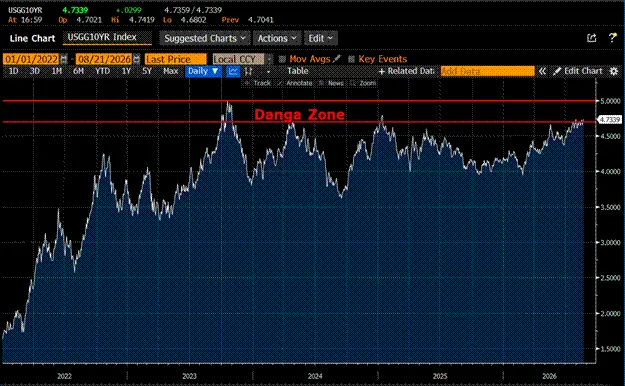
The yield on the 10-year U.S. Treasury note stands as the single most critical pricing benchmark across the entire American financial system. It serves as the foundational rate for calculating a vast array of borrowing costs, from mortgage rates for consumers to corporate bond rates for businesses, directly influencing both consumer spending and business investment.
Should this benchmark yield approach the 5% threshold, financing costs would surge dramatically, inevitably leading to a significant slowdown in economic activity. Consequently, both Janet Yellen and Scott Bessent have demonstrated extreme sensitivity to this critical level. Historical patterns show that as soon as yields near this mark, the Treasury Department has consistently intervened aggressively to mitigate the impact.
From Yellen’s Short-Term Maneuvers to Bessent’s Long-Term Buybacks
Hayes meticulously differentiates between government debt instruments: short-term Treasury bills (T-bills), maturing in under a year, and long-term Treasury bonds, typically maturing in 20 years or more. T-bills, characterized by their high liquidity, are favored assets for money market funds (MMFs).
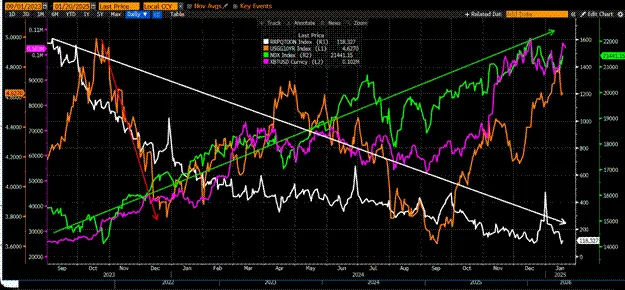
In late 2023, Janet Yellen significantly ramped up the issuance of short-term T-bills. This strategic move diverted funds that were previously parked in the Federal Reserve’s Overnight Reverse Repurchase Agreement (RRP) facility—funds that were effectively dormant within the banking system—into these highly liquid and re-lendable T-bills. Academics later dubbed this operation “Activist Treasury Issuance” (ATI).
The impact was profound: the RRP facility’s balance plummeted from $2.5 trillion to a mere $100 billion, effectively unleashing $2.4 trillion in fresh liquidity into the market. This massive injection coincided with a synchronized rally in the Nasdaq index and Bitcoin.
Scott Bessent now finds himself in a similar predicament. Recognizing that an over-reliance on short-term T-bill issuance could accelerate the national debt’s accumulation, Bessent has opted for a different strategy. He is leveraging the Federal Reserve’s Reserve Management Program (RMP) to ensure the Fed continues purchasing T-bills, while simultaneously employing the Treasury’s long-term bond buyback mechanism. This involves using proceeds from new debt issuance to repurchase longer-dated Treasury bonds, thereby aiming to suppress long-end yields.
On August 19th, Bessent announced an additional $20 billion increase in long-term bond buybacks for the upcoming fiscal quarter. This news initially caused a brief dip in the 10-year Treasury yield, triggering a corresponding rebound in Bitcoin.
However, Hayes cautions that given the staggering $40 trillion total U.S. national debt, this $20 billion increase is a relatively modest sum. Consequently, the yield quickly reverted to its pre-announcement levels, indicating the limited immediate impact of this particular intervention.
Bitcoin’s Trajectory: What Lies Ahead?
Looking forward, Hayes outlines several potential strategies Bessent might employ to manage bond yields and liquidity:
- Adopting a Yield Curve Control (YCC) model, akin to the Bank of Japan, by declaring unlimited buybacks whenever the 10-year Treasury yield surpasses 5%.
- Continuing with incremental increases in buybacks, while also deploying other Treasury tools to generate additional market liquidity.
- Utilizing the substantial funds within the Treasury General Account (TGA), currently holding approximately $1 trillion, to finance these buyback operations.
Regardless of the specific path taken, Hayes unequivocally predicts that these liquidity injections will ultimately gravitate towards risk assets.
He stresses that this cycle of liquidity easing has only just begun. While the overall trend may be upward, Hayes cautions that price movements will likely not be linear, and increased volatility should be expected. Consequently, he advises against the use of leveraged trading, particularly for those who are not professional traders.
Hayes further discloses that his fund, Maelstrom, has already positioned its risk exposure at maximum capacity. Their primary holdings include Bitcoin ($BTC), Ethereum ($ETH), Ethena ($ENA), and Ether.fi ($ETHFI), signaling their readiness to capitalize on the anticipated next bull market cycle.
(The above content is an authorized excerpt and reproduction from our partner, CryptoCity. Original Article Link)
Disclaimer: This article is for market information purposes only. All content and views are for reference only and do not constitute investment advice. They do not represent the views or positions of the BlockBeats. Investors should make their own decisions and trades. The author and BlockBeats will not be liable for any direct or indirect losses incurred by investors’ transactions.