
Tokenized US Stocks: Wall Street Questions Demand Despite SEC’s Regulatory Nod
The U.S. Securities and Exchange Commission (SEC) recently unveiled a regulatory pathway for tokenized U.S. equities, yet a wave of skepticism is already rippling through Wall Street. Institutions are pondering a fundamental question: Do American investors truly need another method to acquire stocks?
On September 17th, the SEC formally introduced its “Innovation Exemption,” a provisional framework designed to facilitate the trading of tokenized National Market System (NMS) stocks. This exemption permits qualified Tokenized Securities Venues (TSVs) to operate using Automated Market Maker (AMM) liquidity pools for a period of five years, without needing to register as conventional securities exchanges. Additionally, certain liquidity providers may receive temporary relief from dealer registration mandates.
However, a recent report from TD Cowen casts doubt on the immediate impact of these regulatory easements. The firm suggests that even with reduced barriers, the short-term appetite for tokenized stocks among both retail and institutional investors in the U.S. is likely to be constrained.
Reid Noch, VP of U.S. Equity Market Structure at TD Cowen, highlights a critical point: U.S. investors already benefit from a traditional stock market characterized by low costs, robust liquidity, and highly efficient execution. For tokenized platforms to gain traction, they must offer distinct advantages compelling enough to outweigh the perceived downsides of “thinner liquidity and more complex operations.”
SEC’s Move: A Pilot Program, Not a Full Endorsement
The SEC’s new regulatory regime comes with notable limitations. Tokenized stocks must directly correspond to U.S. NMS stocks, retaining identical economic rights such as dividends, voting privileges, and liquidation entitlements. Furthermore, any third party intending to tokenize publicly traded shares must first inform the issuer, providing an opportunity for objection. The SEC also imposes restrictions on the volume and quantity of tradable stocks, and crucially, smart contracts must be public, auditable, and deployed on a public, permissionless Distributed Ledger Technology (DLT).
This approach distinguishes it from certain overseas “synthetic” stock products that merely track U.S. stock prices. SEC Chairman Paul Atkins himself has characterized this mechanism as a temporary bridging arrangement, designed to foster market experimentation before permanent rules are considered.
The Figure Case Study: A Stark Reality Check
TD Cowen’s most compelling evidence stems from Figure, a company that simultaneously offers its Nasdaq-listed FIGR shares and native on-chain FGRS shares, both providing identical economic exposure and voting rights. A 24-hour trading analysis by TD Cowen revealed a striking disparity: 99.9% of the nominal trading volume occurred on the traditional Nasdaq exchange, with on-chain shares accounting for a mere 0.1%.
This data precisely underscores the primary challenge facing tokenized stocks today: the technical capability for 24/7 trading does not automatically translate into deep liquidity.
TD Cowen further noted that after engaging with dozens of public companies, most issuers, apart from those with direct ties to the crypto industry like Figure, expressed very limited interest in tokenizing their own equities.
Despite Skepticism, Tokenized Stock Market Sees Significant Growth
However, dismissing the potential of tokenized stocks entirely would be premature. A recent study by Binance Research indicates substantial growth in the active tokenized stock market. Its size has surged by 314% this year, reaching approximately $4 billion. Monthly trading volume has also escalated dramatically, from around $237 million in January to an impressive $7.9 billion by August.
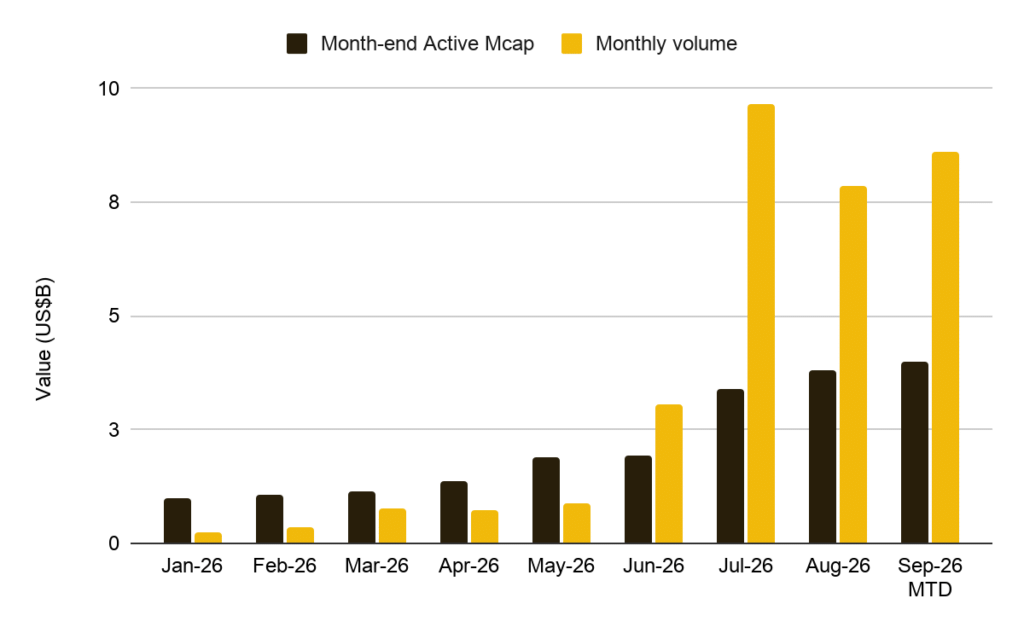
This data suggests that while the market is expanding rapidly, the primary demand currently originates from crypto-native investors, international markets, and on-chain applications, rather than traditional U.S. brokerage clients.
TD Cowen’s core inquiry isn’t whether “tokenization has a future,” but rather whether merely re-packaging an already highly accessible U.S. stock into a token offers a sufficiently compelling value proposition to become a “killer application.”
TD Cowen Identifies Stronger Demand for Perpetual Futures
In contrast, TD Cowen posits that crypto investors exhibit a significantly stronger demand for stock perpetual futures. Analyzing Binance data for Nvidia-related products, the firm found that 96% of the nominal trading volume originated from perpetual futures, with only 4% attributed to spot products.
Noch explicitly states that perpetual futures represent a more robust demand narrative at present. The core appeal of perpetual futures lies not just in moving stocks onto the blockchain, but in offering a unique combination of features: 24-hour trading, leverage, the ability to go long or short, and no expiration date. These functionalities are not fully available in the traditional U.S. spot equity market, thus providing clear product differentiation for traders accustomed to crypto derivatives.
TD Cowen anticipates that platforms will likely continue to expand stock perpetual futures offerings both domestically and internationally, driven by persistent retail investor demand for leveraged trading.
The True Competition: Solving Real Needs, Not Just On-Chain vs. Off-Chain
The SEC’s enablement of tokenized U.S. stocks does not signal an immediate migration of the multi-trillion dollar U.S. equity market onto the blockchain. The existing U.S. spot stock market boasts exceptional liquidity, zero-commission brokers, fractional share trading, and a highly mature clearing system. For the average investor, if the sole advantage of converting Apple or Nvidia shares into tokens is “24-hour trading,” its appeal might be less profound than some market participants imagine.
Perpetual futures, however, address a distinct set of investor needs: leverage, round-the-clock access, short-selling capabilities, and enhanced capital efficiency. This is why TD Cowen concludes that in the short term, the financial product most likely to capture activity from traditional markets may not be tokenized spot stocks, but rather stock perpetuals.
The SEC’s five-year exemption primarily resolves supply-side and regulatory hurdles, providing a legitimate avenue for platforms to offer tokenized U.S. equities. The more challenging question now falls to the market: Do investors genuinely need this innovation?
Considering Figure’s 99.9% of trades remaining in traditional stocks, juxtaposed with 96% of Nvidia-related crypto trades gravitating towards perpetual futures, TD Cowen’s current assessment is clear: while the institutional door for tokenized stocks has opened, genuine trading demand, at least in the short term, is more likely to flow towards perpetual futures.
Disclaimer: This article is intended solely for market information purposes. All content and views are provided for reference only and do not constitute investment advice. They do not necessarily reflect the views or positions of the author or the publisher. Investors should conduct their own due diligence and make independent investment decisions. The author and publisher will not be held responsible for any direct or indirect losses incurred by investors’ trading activities.