
Crypto Market Plunge vs. On-Chain Resilience: Stablecoins Drive a New Narrative
While the cryptocurrency market endured its most significant downturn since 2022, shedding trillions in value, a deeper dive into on-chain economic activity reveals a surprising resilience. Far from mirroring the market’s contraction, the underlying utility of crypto assets, particularly stablecoins, has continued to expand.
According to Chainalysis’ latest “2026 Crypto Geography Report,” the total cryptocurrency market capitalization plummeted by approximately 50% between July 2025 and the end of June 2026, equating to a staggering $2.1 trillion loss. Yet, the estimated global on-chain crypto economic activity saw only a marginal dip, decreasing from $9.5 trillion to $9.4 trillion – a mere 1.6% annual reduction. This stark contrast suggests a significant shift in the market’s dynamics.
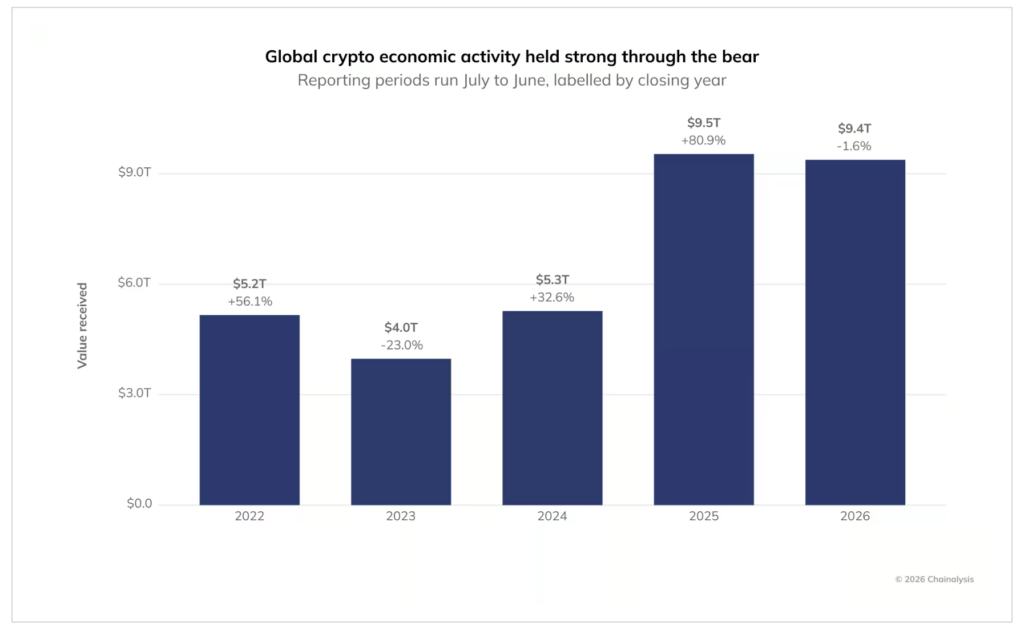
Speculative Trading Cools, P2P and Cross-Border Stablecoins Surge
A closer examination of market internals reveals a clear divergence. The value flowing into centralized exchanges, DeFi protocols, and other speculative crypto services decreased by 4.3%, from $9.3 trillion to $8.9 trillion. However, this contraction was powerfully offset by explosive growth in peer-to-peer (P2P) transfers between domestic individual wallets, which skyrocketed by an astounding 302.9%, from $56.8 billion to $228.7 billion.
Cross-border stablecoin transfers also demonstrated robust growth, climbing 77.5% year-on-year, from $124.2 billion to $220.3 billion. Recognizable monthly cross-border flows further illustrate this trend, rising from approximately $11 billion in January 2025 to $24 billion by June 2026. Chainalysis highlights that the average transaction size for these transfers is around $3,000. This figure points towards practical use cases such as payments by service providers, family remittances, and individuals moving savings out of volatile local currencies, rather than large-scale institutional trading.
Stablecoins have become the backbone of individual wallet transfers. During the reporting period, the value of stablecoins flowing into crypto services increased by 5.3%, and an impressive 96% of domestic P2P activity was facilitated by stablecoins. This explains how the actual transfer volume remained robust despite a noticeable cooling in speculative trading.
Market Cap Fluctuation vs. Stablecoin Expansion
As of the time of writing, CoinGecko data shows the global cryptocurrency total market capitalization at approximately $2.87 trillion, having seen a roughly 5.37% decline in the past 24 hours. Bitcoin is trading around $83,901, down 3.23%, and Ethereum at approximately $2,675, down 3.61%.
In stark contrast, the global stablecoin market capitalization stands at approximately $306.3 billion, demonstrating a consistent growth of 1.21% over the past 30 days. Monthly on-chain transfer volume for stablecoins is even more impressive, reaching about $7.13 trillion, an increase of 6.06%. USDT and USDC, the two leading stablecoins, command market caps of approximately $193.9 billion and $74.1 billion respectively, collectively accounting for about 87.5% of the total stablecoin market.
It’s important to note that the $7.13 trillion figure for stablecoin transfers encompasses all traceable on-chain activities, including exchange movements, DeFi protocols, and smart contract interactions. This broader scope means it cannot be directly compared to Chainalysis’ $220.3 billion cross-border data, which specifically tracks transfers where both the sending and receiving countries can be identified. The Chainalysis figure, therefore, represents a more conservative, lower-bound estimate of genuine cross-border utility.
Analysis: The Decoupling of Price and Payment Layers
The data strongly suggests that the cryptocurrency market is evolving into two distinct cyclical patterns. The market capitalization of Bitcoin, Ethereum, and altcoins remains highly susceptible to macroeconomic factors such as interest rates, leverage, and prevailing investor sentiment. Conversely, the demand for stablecoin payments, cross-border remittances, and their use as a digital USD savings vehicle is primarily driven by the fundamental need for fast, 24/7, and efficient cross-border movement of funds.
The report underscores that while speculative and trading activities have indeed contracted, the burgeoning adoption of USD stablecoins for payments, settlements, and as a hedge against currency volatility has largely cushioned the overall market decline. Furthermore, cross-border stablecoin flows exhibit high concentration, with the top quarter of payment corridors facilitating a remarkable 96.1% of the total cross-border stablecoin value. The exclusion of transfers where national origin or destination cannot be definitively identified implies that the reported figures might even underestimate the true scale and impact of this growing utility.
Disclaimer: This article is provided for market information purposes only. All content and views are for reference only and do not constitute investment advice, nor do they represent the views and positions of BlockTempo. Investors should make their own decisions and trades. The author and BlockTempo will not bear any responsibility for direct or indirect losses resulting from investor transactions.